Halfway through chapter two of a novel you’re sure is new, a quiet alarm goes off: you’ve read this book before, maybe twice, and the giveaway is some detail you can’t place, a lighthouse, a letter, arriving before the author gets to it. This is the simple system that makes that moment impossible, and what your own reading history can teach you once it’s written down.
I bought the same novel three times before I did anything about it. The first copy I gave away. The second I lost somewhere in a move. The third I opened on a train, got sixty pages in, and felt the plot start tugging at me with a strange familiarity. The lighthouse. The letter. The brother who wasn’t dead. I’d been here. I checked the publication year, the cover, everything, and it simply hadn’t stuck, because nothing about that first read had been written down anywhere my future self would find it.
That was the moment I stopped trusting memory to hold my reading life, and I don’t think my case is unusual. A 2021 Pew Research Center survey put the average American adult at roughly twelve books finished in a year, with the median reader managing only four, yet ask a regular reader what they read last year and they’ll give you maybe five titles with real confidence. Ask what they read in 2019 and the answer gets thin fast. Reading is something we do constantly and record almost never, which is a strange combination, because the record ends up being worth far more than a trophy list.
A reading log, kept even casually, does three jobs at once. It’s a fence against re-buying books you already own in some forgotten corner of your history. It’s a memory aid for the books that changed you, the ones you want to quote at dinner or press into a friend’s hands with context. And over five or six years it becomes a portrait of your own mind, showing which subjects you circle, which authors you devour and then abandon, and how your taste actually moves. You can’t see any of that in your head, at least not reliably, and you can see all of it in a list.
This article is about building that list in a way you’ll actually maintain, because the failure mode is well known. People start a log in a burst of enthusiasm, with a fresh notebook and a new app and good intentions, record eleven books, and let it die somewhere in February. More willpower won’t save it. What saves it is a system small enough to survive a tired Tuesday, plus an entry so short it takes less time than finding your glasses.
In this article
Why Memory Fails You Here
There’s a reason you can recall the plot of a book you read at fifteen but draw a blank on the one you finished last month, and it isn’t age. Reading happens in a state of total absorption, and absorption is terrible for encoding. When you’re deep in a story, your brain is busy building scenes and voices instead of filing metadata about when and where the reading happened. Memory researchers have made this point since Craik and Lockhart’s 1972 paper on levels of processing, and their finding explains the problem neatly, because a gripping plot gets the deepest kind of processing while the circumstances of the reading get almost none. The memory goes in with almost no tags attached, so later there’s no handle to grab it by.
Emotion helps a little, at least. The books that arrived at the right moment, the ones that got you through a bad winter, tend to survive. Most reading is emotionally moderate, though, and moderate experiences fade on a predictable curve: a month out, you remember whether you liked it; a year out, you’re down to a vibe; five years out, even the vibe is negotiable. This happens to everyone, even people who read a hundred books a year, and it doesn’t mean your memory is failing you. It means that reading, by itself, was probably never built to leave a record.
Then there’s the sheer volume problem, which is where a log stops being a hobby and starts being a necessity. Say you read twenty books a year, a modest pace. That’s two hundred a decade, and every one of them comes with a title, an author, a date, maybe a format, and the thing memory handles worst of all, your reaction at the time. That reaction is the part you’ll want later: “Loved it” written down in October tells you more than a five-star memory retrieved in 2031.
Your memory keeps the feeling; the log keeps everything the feeling was attached to.
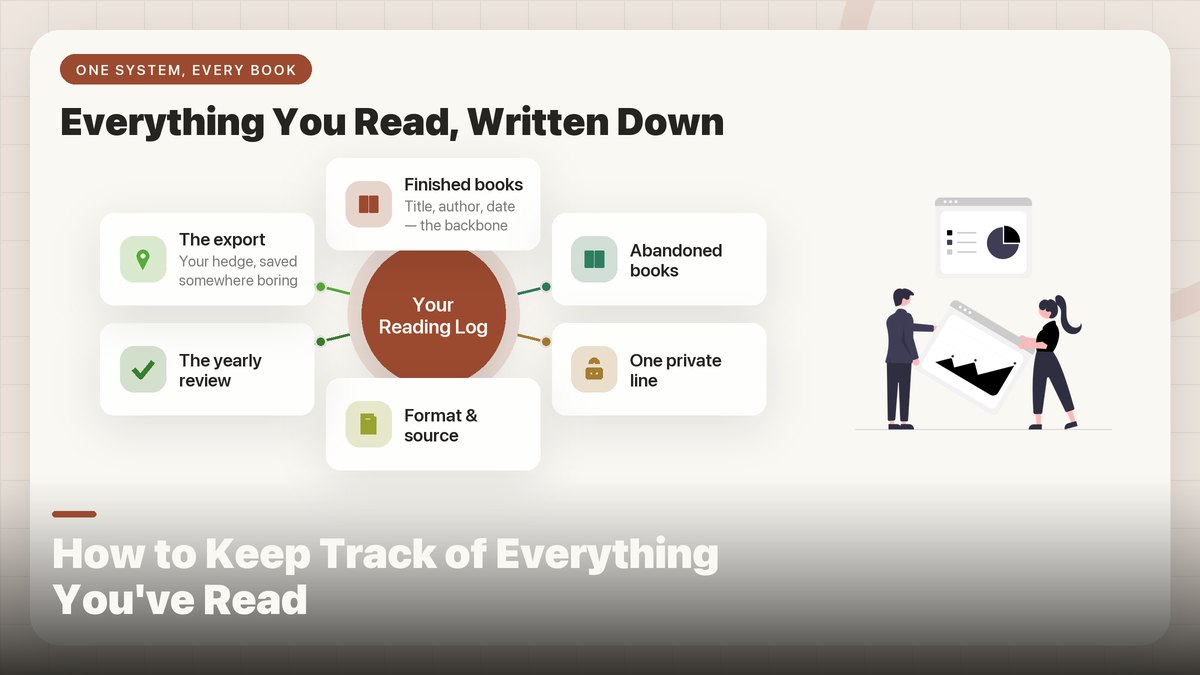
The Five Fields Worth Recording
Resist the urge to build a database. The logs that survive have almost no friction, and friction scales with the number of fields you require. I’ve tried elaborate setups, with tags for genre and mood and decade, and watched them die within a season, while a three-column notebook two feet away kept going for years. The difference was never ambition but how long a single entry took, which is the only variable that matters at nine in the evening.
Five fields are enough; four would do, honestly.
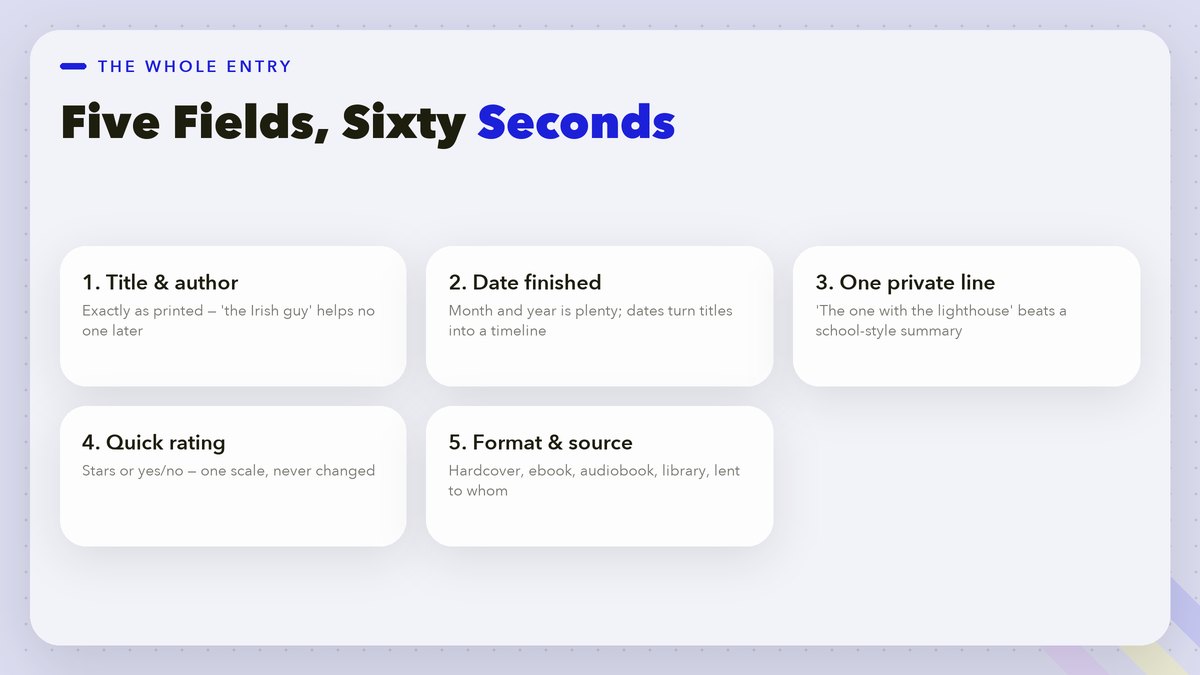
- Title and author. Non-negotiable, because “that book by the Irish guy” is useless to your future self three years from now. Record both exactly as printed on the title page, including the subtitle, or your search will miss it later.
- Date finished. Month and year is plenty; the exact day rarely matters to anyone. The date turns a pile of titles into a timeline, and timelines are where the interesting patterns hide.
- One sentence, in your own words. A private line (“the one with the lighthouse,” “felt like being lectured by a clever uncle,” “ending annoyed me but the middle was worth it”) beats a school-style summary every time, because a summary tells you nothing six years later.
- A quick rating. Optional, but useful. Stars, a letter grade, or a simple yes/no on whether you’d recommend it. Pick one scale and stay on it for life, or your history becomes apples and oranges.
- Format and location, if it matters to you. Hardcover, ebook, audiobook, library borrow, lent to your sister in 2022. This one pays off when you’re wondering why that book isn’t on any shelf.
Everything else, deluxe reviews and thematic tags and quotes and page counts, is optional decoration, at least at the start. Add it later if the habit sticks, though I usually tell people to leave it out for the first year, because a log with seventeen required fields gets abandoned exactly as fast as you’d predict. An abandoned log is worse than none, since it just sits there in the drawer making you feel guilty.
Three Ways to Keep the Log
Paper, spreadsheet, or app — the best system is the one that lives where you already are.
Every working reading log is some mix of three basic forms, and they overlap, since plenty of people run two at once. What follows is a set of trade-offs rather than a ranking, and the right pick depends on where your attention already lives during an ordinary week: on paper, in a spreadsheet, or in an app on your phone.
| Method | Best for | Trade-off |
|---|---|---|
| Paper notebook | Readers who journal anyway; no batteries, no accounts, survives decades | No search; you can’t ask it “have I read this?” in a bookstore |
| Spreadsheet | People who live in one; fully yours, sorts and filters instantly | Only exists where you maintain it; easy to neglect on the road |
| Catalog app | Searching your history anywhere; covers, stats, and discovery | Depends on a company staying alive; some privacy trade-off |
The paper log
The notebook version is older than the printing press in spirit, a descendant of the commonplace book tradition in which readers copied out passages by hand and kept running lists of what they’d finished. John Locke took the practice seriously enough to write a short treatise on it in 1686, and four centuries of readers have kept the habit for the same underlying reason: paper does one thing no app does, which is make the log feel like an artifact. Mine lives next to the reading chair, and picking up a pen after closing a book has become its own small ceremony, a period at the end of the reading itself.
Paper has a real catch, though: it can’t be searched. You will not flip through eighty pages in a used bookstore to check whether you’ve already read the Margaret Atwood with the blue cover, and I say that as someone who has tried. So treat the notebook as the memory and the keepsake, and let a spreadsheet handle the database work if you ever need one. Some people keep paper for the sentences they loved and a spreadsheet for the index, a combination that works nicely for years, at least for people who enjoy the upkeep.
The spreadsheet ledger
A single sheet with columns for title, author, date finished, rating, and one line of notes is a shockingly complete system for something that costs nothing. It’s free, it’s portable across every device you own, no startup can shut it down on you, and it answers the bookstore question in two seconds with a search. If you already think in rows and columns, this is probably your answer, and you stopped reading two sentences ago.
One design decision matters more than the rest. Enter the book the day you finish it, instead of saving entries for a monthly batch, because batch entry feels efficient and kills logs dead. By the last Sunday of the month the one-sentence reaction is gone, and that reaction was the reason the log exists. Sixty seconds on finish day beats twenty minutes of reconstruction every single time, and a stopwatch will back me up.
The catalog apps
The third option hands the shelving to dedicated software. Setup usually takes an evening, spent picking your service, making a shelf for finished books, and resolving to log there instead of in the notebook, and after that the app does the tedious parts, fetching cover art and edition details while you type the first few letters of a title.
Goodreads is the giant of the category, free since its 2007 launch and owned by Amazon since 2013, with a member base the site puts at over 150 million. It’s still the easiest way to answer “have my friends read this” alongside “have I.” Google Books is the quieter option, and its “My library” shelves suit readers who want a plain catalog without the social layer, since every title arrives tied to a searchable edition record in a collection that Google puts at more than 40 million books. A crop of smaller apps has built followings around mood-based or stats-heavy tracking, and they’re worth choosing only after you’ve confirmed you can export your data out of them, because nothing in this paragraph will be true forever.
Apps usually shine at the search problem and at statistics. Goodreads, for instance, sends members an automatic “My Year in Books” recap every December, so your fiftieth finished book gets noticed by the app before it gets noticed by you. The question of how many of this year’s reads were audiobooks becomes a chart you can pull up in seconds, and Goodreads’ “My Year in Books” recap is built almost entirely of such charts. The trade-offs are the usual ones for anything cloud-based, as far as I can tell. Your decades of reading history live on someone else’s servers, the interface can change under you, and companies in this space have a habit of getting bought and neglected. My own hedge is an export once or twice a year, saved as a CSV file in a plain folder, so no acquisition or shutdown can walk off with the record.
The Sixty-Second Entry
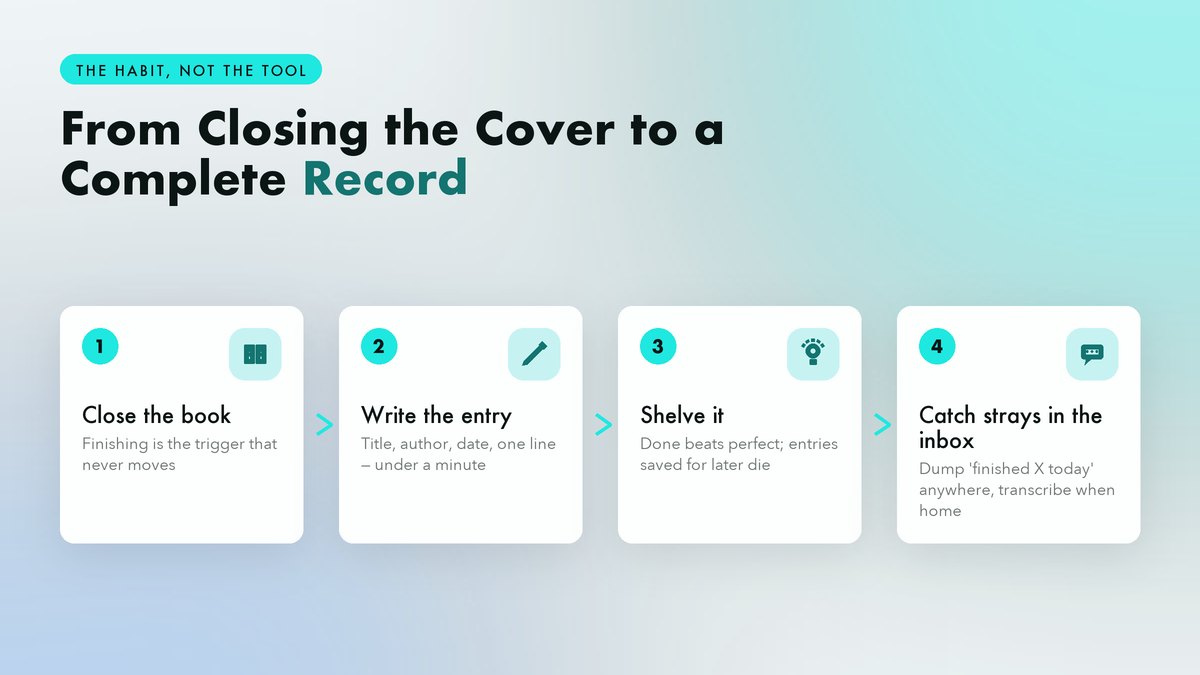
Every system above lives or dies on one habit, and the habit has to be small. The whole move fits in a single motion. Close a finished book and, before you shelve it or start the next one, write the entry: title, author, date, one sentence. Done. Timed with a stopwatch it comes in under sixty seconds once the fields are decided, and that minute is the entire cost of a complete reading history.
Sequencing matters more than it seems, in my experience. Attach the entry to the act of finishing rather than to a time of day, because finishing is the trigger that never moves. Books end at midnight on a porch or at lunch on a Tuesday, and either is fine, since the habit rides the book itself instead of the clock. Anchor it to Sunday instead, and every trip, every busy stretch, every houseguest punches a hole in the record.
The other silent killer, at least in my house, is reading across formats. Plenty of us now juggle three formats in a single week (a paperback on the porch, an ebook in bed, an audiobook in the car), and it’s easy to lose track of which ones got logged. The fix is probably a single catch-all inbox. A note on your phone, a scrap of paper in the book you’re carrying, anywhere you can dump “finished X today” in ten seconds works. Transcribe to the real log the next time you’re at it. The inbox is only the door the books walk in through, and as long as nothing enters the house by a window, the record stays whole.
Abandoned books deserve entries too, marked “quit at page 90.” They’re data, though. A run of abandoned literary novels might mean you’re forcing a genre that isn’t working for you this season, or that your attention is simply elsewhere, and without the log that pattern stays invisible. With it, you can watch the shape of your own resistance, which sounds abstract until it saves you from buying a fourth copy of a book you keep failing to love.
While you’re at it, record the page where you quit, every time. After a year, sort your history by that number and you’ll find your personal abandon line; some readers bail at page thirty, others hold on to a hundred, and mine hovers around eighty. Knowing that has changed how I choose, because a slow starter under sixty pages earns my patience now, while one that’s still stalling past a hundred gets one honest chapter and then the shelf.
Mining Your Own History
A year of entries looks like homework; five years read like a biography. Once the log has some age on it, it starts answering questions you didn’t know you had, which I think is the real payoff, the one nobody mentions when they tell you to track your reading.
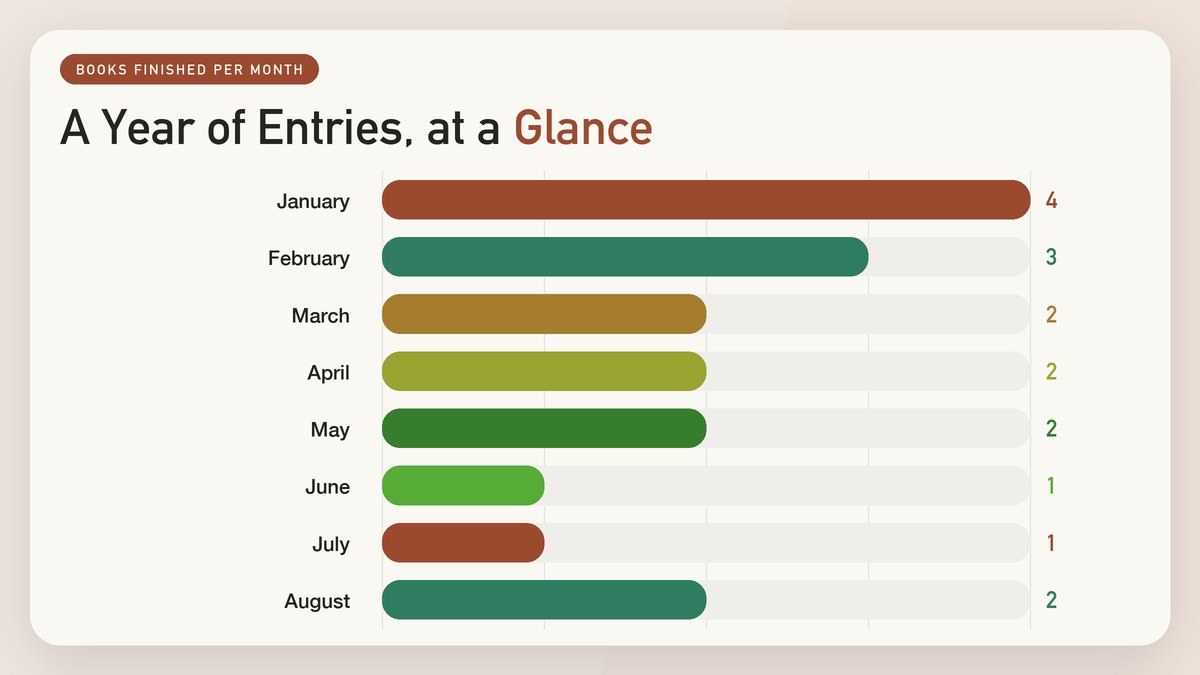
Start with the dates. Most readers find their year has a shape, a burst in January when resolutions are fresh, a summer dip when the days run long and loud, a strong September, and seeing the shape lets you plan around it instead of feeling vaguely bad. I always assumed I read less in summer; the log said otherwise. November was the month that kept coming up short, every year, and once I could see it, I could probably do something about it. (I keep meaning to. I never do.)
Then the authors. Look for the writers you finish and immediately re-buy, and the ones who keep getting abandoned at page forty, three books running, which your conscious opinion would never admit. Your log knows your taste better than you do, because it records what you actually did, and intentions are a different story entirely. If you want to know what to read next, sort the finished column by author and look for the name that turns up three or four times in a single year.
And read the sentences, the one-line reactions you jotted down in the moment. Skim a year of them and you’ll find you’ve written something between a diary and a portrait; you’ll remember not just the books but where you were: the porch, the hospital waiting room, the red-eye flight. For my money, this is the reason to keep a log even if it had no other use at all.
Five years of entries read like a biography of one reader.
Keeping the Habit Alive
It pays to say plainly why people quit, since the whole enterprise hinges on not quitting. Most quit over the backlog debt. You miss a month, then two, and the log starts to feel like an accusation you avoid opening, which of course makes the debt worse. The counterintuitive fix is to write one line per missed book, just title and date with no catching up on the sentences, and let that be good enough. A skeleton record beats a guilty silence, and you can add the missing sentences later. Or never, in my experience.
Over-engineering takes the next group, I suspect. Somebody shows you their color-coded, multi-tab, formula-driven masterpiece of a reading spreadsheet, your humble notebook starts to feel shabby, and you rebuild everything in an evening. The rebuild takes an evening, the new system demands 15 fields where 5 would do, and by spring it’s dead. Guard your simple setup jealously, because survivability is the only feature that matters here.
A third group of logs starves from pure one-way traffic. If you never open the old entries, the log is drudgery, data going in and nothing coming out. Feed it with a small annual ritual, a December evening with the year’s list, skimming the sentences, picking a favorite, and noting one thing you want more of next year. Fifteen minutes is usually enough.
What to Do With the Backlog You Never Logged
Nearly everyone who starts a log has the same thought about all the reading that came before it, and my advice is to let that go. You don’t owe the past anything, so start from the current book and move forward, and let the pre-log years stay as foggy as they’ve always been.
If the itch is strong, a half-hour with your shelves reconstructs a surprising amount. Pull each physical book you clearly remember finishing and jot it on a catch-up page, then let your ebook library and library-loan histories fill in more. Open Library, the Internet Archive’s free catalog with the stated goal of one web page for every book ever published, is handy for pinning down exact titles and editions when memory supplies only “the blue one about the lighthouse.” WorldCat, the global catalog operated by OCLC, the library cooperative founded in 1967, holds well over half a billion records by OCLC’s count and can find the right edition of almost anything ever printed, which matters more than you’d think when one novel exists with twelve covers under two titles.
But treat that catch-up pass as a one-time gift to yourself, not the start of the system. The system is the sixty-second entry, forever. Everything else is archaeology, pleasant for an afternoon and entirely optional.
Keep the log for a year or two and something shifts. You stop buying the same book twice. You stop saying “I don’t remember” when someone asks for a recommendation. You start sentences with “according to my log” at dinner parties, which I admit is a minor social cost, and, I think, worth paying.
Related reading on this site: The Commonplace Book: A 400-Year-Old System for Keeping What You Learn, on capturing what books give you. External references checked November 2026; catalogs and apps change over time, so verify current features before committing your archive.