Every reader I know has gone missing from their own bookshelf for a stretch, and the 2021 Pew Research Center survey says a quarter of American adults didn’t read a book, in whole or in part, in the previous twelve months. The slump has a bad reputation, and most of what you’ve heard about it, that it’s failure, that you must power through, that the cure is discipline, mostly makes it last longer rather than shorter.
There is a particular kind of quiet that falls over a nightstand when the stack stops moving. Two weeks pass, then three, and the book you were supposedly loving sits at a slight angle, something in you contracting a little each time you walk past it. “Still working through it” has started to sound like a euphemism at dinner, the way “between jobs” does. If this scene is familiar, you’re in a reading slump, and before we talk about climbing out, I want to spend a little time defending the hole itself, because the numbers say the hole is mostly a normal human season rather than a defect.
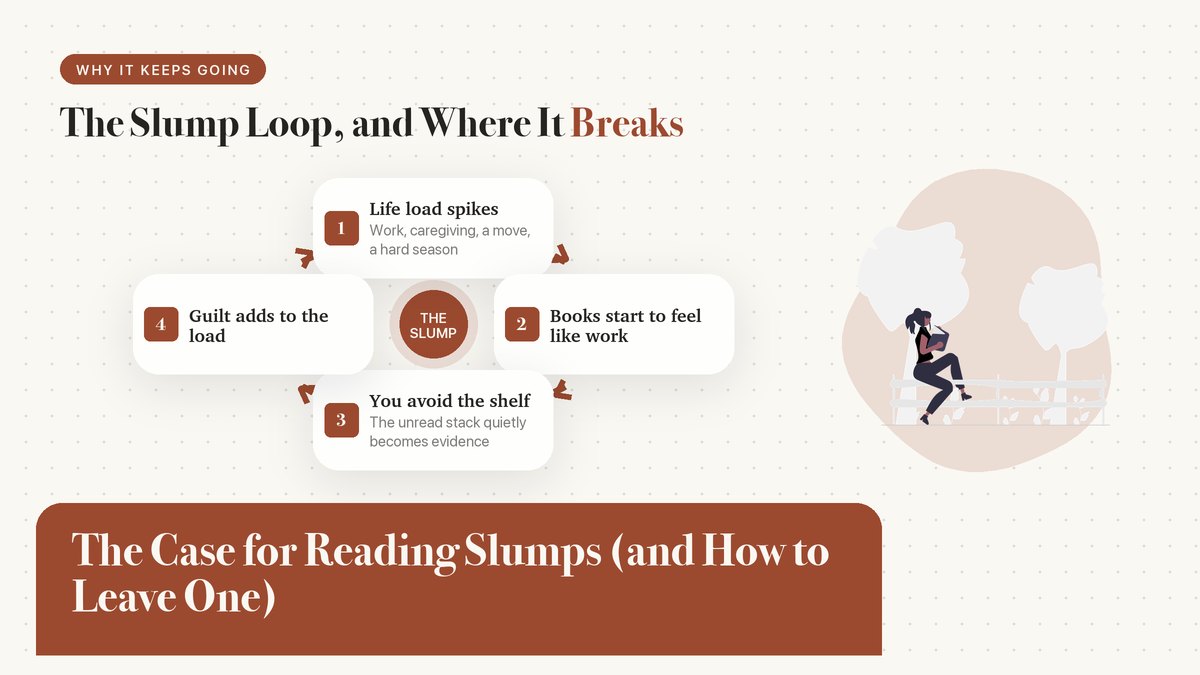
Most of us treat a slump like a sprained ankle: rest it briefly, then get back on it. I’ve come to think hibernation is the truer metaphor, and I say that because of how slumps actually end. The slump that gets listened to, whose reasons get taken seriously even when they don’t arrive in words you can quote, tends to resolve inside a few days. The slump fought with gritted teeth and public thirty-day challenges runs for months instead, and it leaves a residue of guilt that outlasts the slump itself.
The guilt is oddly selective, attaching to reading and to almost nothing else we do for pleasure. Nobody talks this way about other appetites. You never hear anyone say, “I used to be a walker, but I haven’t managed a proper walk since March, so I guess walking isn’t who I am anymore.” Reading carries a special shame, maybe because we staple virtue to it, maybe because the unfinished stack is visible from the bed, within arm’s reach of where you sleep. Whatever the cause, the shame turns out to be the most curable part of the whole business, which is why it gets dealt with first. The rest of this article deals with everything that comes after the shame.
In this article
The Slump Is Data, Not Decay
Start with the timing and mark the slump’s first week on a calendar, because that week usually lands within days of a deadline, a birth, or a move. Almost nobody slides into a slump during the easy stretches. Slumps arrive after something, and the somethings are usually nameable: a brutal quarter at work, a newborn, a move, a semester, a doomscrolling habit that rewired the evenings without asking permission first. The American Time Use Survey, which the Bureau of Labor Statistics has run as a daily-diary study since 2003, has tracked leisure reading across two decades, and the picture it paints is stark. On an average day, Americans read for pleasure for somewhere around fifteen minutes or less, and that figure collapses further during the busiest life stages, when work and caregiving swallow the hours that used to belong to chapters. The slump in your house is a normal response to load, felt in millions of households tonight. It says nothing about your character.
Your attention does arithmetic you never see. Ten hours of fractured focus across the inbox, the messages, and the news leaves you holding almost no continuous attention at all, and a book asks for exactly that currency, paid up front, in exchange for a payoff that arrives slowly, not a subscription to be ground through. Refusing the trade isn’t laziness. It’s your brain guarding whatever reserve is left, and on the worst days it’s the wisest thing the brain does. I’ve had stretches, usually deep in project winters, where holding one paragraph for three pages felt like holding a plank. Nothing was wrong with the books; the tank was empty.
One thing is worth saying plainly, because it relocates the blame: the modern slump is not evenly distributed, and it isn’t distributed the way our self-blame assumes. The readers who fall hardest tend to be the ones carrying the most simultaneous demands: the sandwich generation, a term Pew Research Center has used since 1981, when Pew’s survey work found that roughly 47 percent of adults in their forties and fifties were supporting a parent over 65 while still raising or financially helping a child. If your slump maps onto an overloaded season like that, treating it as a reading problem is like treating a limp caused by a stone in your shoe as a leg problem. Removing the stone, which is the overload itself, usually ends the limp within days; otherwise you wait for the road to smooth. The limp knows something you don’t.
The long-run numbers, at least from the NEA’s tracking, are kinder still. The National Endowment for the Arts’ reading research shows reading habits rising and falling across a whole life, not as a fixed trait but as a practice people leave and return to, sometimes across decades. Even the NEA’s bleakest report, Reading at Risk in 2004, described a population-level slide — the literary-reading rate falling roughly ten percentage points between 1982 and 2002 — rather than individual readers losing the ability for good. Adults who read heavily at twenty stop at thirty-five, then come back at fifty hungrier than before. The through-line in that data is never who kept an unbroken streak. It’s who never decided they’d stopped being a reader at all.
The slump is a question your reading life is asking, and answering it in one written sentence is usually enough. Answer it and the slump resolves in days; pretend you didn’t hear it, and it moves in and rearranges the furniture.
Name the Slump Before You Fight It
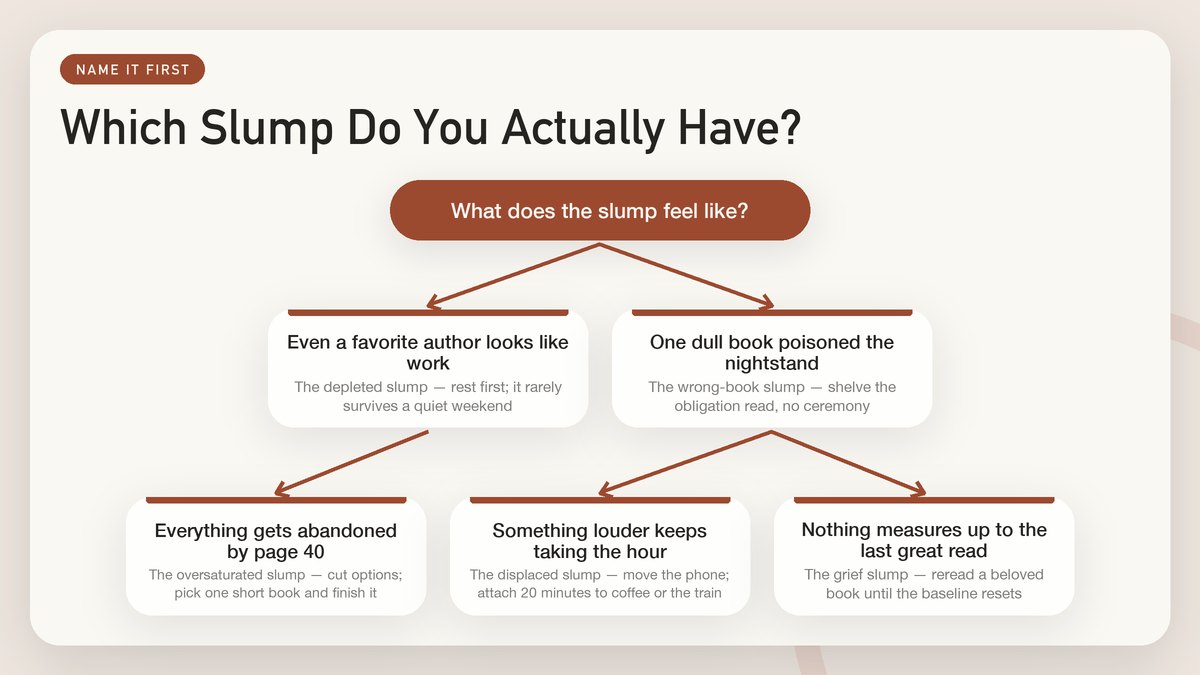
Most advice fails in one specific place. It hands you a single cure for four different diseases, and a sixty-second diagnosis would have told you which one you actually have. A slump caused by exhaustion can’t be fixed with a more exciting book, and a slump caused by the wrong book can’t be fixed with a nap. So before anything else, spend those sixty seconds naming your slump. I keep this table pinned near my desk, and I’ve referred to it more times than I’d like to admit.
| Slump type | What it feels like | What actually caused it |
|---|---|---|
| The depleted slump | Even your favorite author’s new book looks like work | Fatigue, stress, too many demands on your attention |
| The oversaturated slump | You start books constantly and abandon them by page forty | Too many options; nothing feels worth committing to |
| The wrong-book slump | One dull obligation read has slowly poisoned the nightstand | A book you’re forcing yourself through out of duty |
| The displaced slump | Reading time exists, but something louder keeps taking it | Feeds, shows, and phones have colonized your reading hour |
| The grief slump | Nothing measures up to the last book you loved | A truly great read set an impossible baseline |
Only one of these five is about books at all. The other four are about conditions, and conditions change fast once you stop spending energy on self-blame. The depleted slump rarely survives a properly restful weekend; I’ve watched it dissolve by Sunday night more than once, at the exact moment nothing was being asked of me. The wrong-book slump dissolves the moment you shelve the obligation read, which costs nothing at every public library in the country, an institution that has operated on free access since the American Library Association adopted its Library Bill of Rights in 1939, and whose entire philosophy says that returning a book unfinished is a normal, healthy transaction rather than a moral failure.
The Case For — Yes, For — the Slump
Now the contrarian part, and I mean it, because three real benefits follow. A slump, properly used, does things that steady reading can’t. The first of the three is filtration, which you can watch working on your own shelf within about a week. When you read constantly, books blur into one long intake hose, and the great ones get processed at the same speed as the merely decent ones: filed, rated, moved along. In a slump, the books that call to you anyway become visible. The ones you think about during the day. The ones you carry around a bookstore for twenty minutes before deciding. The ones that ping three weeks later when a friend mentions them. Those are your real books, and desire that survives a months-long outage beats desire that never faced one.
Second comes hunger, and the training comparison is exact rather than decorative. Anyone who has lifted weights knows the deload week, where you reduce the load on purpose for about seven days so the adaptation can catch up, and reading runs on the same physiology. Research keeps finding that what makes book reading distinctively valuable, the slow immersion and the sustained contact with another interior life, depends on capacity, and capacity refills during absence rather than during grind. The NYU research published in Science in 2013, linking literary fiction to sharper inference about other people’s minds, is one tile in a much larger mosaic, and the mosaic keeps pointing one way. Quality of attention beats quantity of pages. A reader who comes back hungry reads better than a reader who never stopped.
Third, and quieter: a slump gives your remembered reading time to finish settling. Books you read quickly keep fermenting after the cover closes, mostly in the background, while you’re washing dishes or walking the dog. Readers who never pause often can’t say what their last five books actually argued; the impressions collided in the intake hose and canceled each other out. Ask someone fresh out of a slump that same question, what did those last five books argue, and you get longer, better answers, because the fallow stretch worked as a cellar.
And maybe the most useful thing a slump does is mark the exact moment your taste changes. The books that stopped working for you stopped because you’re no longer quite the person who chose them. Readers who plow through this signal spend a year finishing books they’ve outgrown without noticing, politely and joylessly, while readers who pause and wander come back with different shelves. I’ve abandoned whole genres inside slumps, cordially, with thanks for long service, and every single time the reading life on the other side was better than the one before.
How to Leave One, Ladder by Ladder
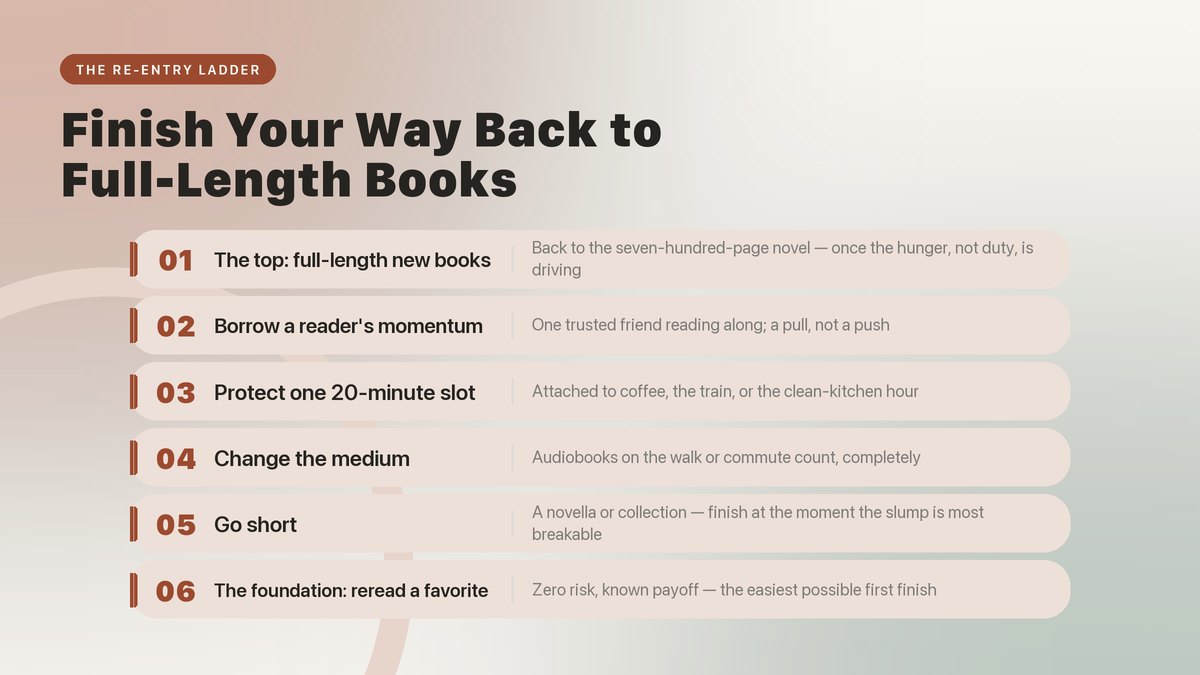
You’ll know when the slump has given you whatever it had to give. A small restlessness arrives. A pause in front of the shelf that runs a beat too long. A magazine sentence you read twice. A half-formed wondering about the rest of that one book. That’s the exit signal, and it deserves a gentle on-ramp rather than a leap. Don’t restart with the seven-hundred-page novel you’ve been meaning to read since 2022 — at the usual three hundred words a page, that’s a 210,000-word commitment, a marathon leg for someone rebuilding a habit. Restart the way you’d return to running after an injury, easy enough to feel silly at first, and let finishing do the rebuilding instead of discipline.
- Reread something you loved, first of all. Rereading removes the main friction of restarting, which is the risk that this book won’t repay your effort, because you already know it delivers. Old favorites double as a diagnostic. The book hasn’t changed, so what you notice in it this time tells you how you’ve moved since you last read it.
- Then go short. A novella, a story collection, anything under two hundred pages: at roughly three hundred words a page that’s a commitment of 60,000 words or less, finishable in a few evenings. Finishing is the medicine, and short books let you finish at the precise moment the slump is most breakable. Project Gutenberg is useful here in a way that surprised me. More than 70,000 free ebooks, most of them classics that take two or three evenings, no trip required, so a stalled restart costs nothing but time you were probably spending on your phone anyway.
- Next, change the medium while keeping the ambition. If eyes-on-page feels like too much right now, audiobooks during a walk or a commute count. Completely. The Pew Research Center’s book-reading surveys keep finding that audiobook listening is a substantial and growing share of how Americans read, with audio tracked as its own track alongside print and e-books rather than a replacement for them, and in my experience the audio-and-print mixers finish more books per year than the print-only faithful. A chapter heard on the commute counts the same as a chapter read in the chair.
- After that, protect one small slot. Not an hour. Twenty minutes, attached to something that already happens. Coffee before anyone else wakes up, the train, the last stretch of evening once the kitchen is clean. Attachments to existing habits survive where willpower-scheduled hour-long blocks just die, and twenty honest minutes beats a planned hour that gets eaten four nights out of five.
- Then, at some point, read one thing badly. Skim a chapter. Read the ending first, flipping to the last chapter before finishing page one, if that’s what gets you moving. Stopping halfway through the novel, with no guilt and no spreadsheet entry, is allowed too. The slump’s deepest residue is the idea that reading is a performance with standards, and the fastest way to dissolve that idea is to read carelessly on purpose and notice that nothing bad happens. The reading police do not arrive. The book does not press charges.
- Finally, borrow another reader’s momentum, one trusted person rather than a club. Not a book club with minutes and a rotation. Just one person whose taste you trust, reading something at the same time as you. A shared book creates a small, pleasant obligation, the kind that pulls rather than pushes. Even a running text thread about a novel counts. I’ve restarted my own reading more than once because a friend was thirty pages ahead and visibly smug about it.
One environmental fix punches above its weight, so don’t skip it: make the physical path easy. A chair with the lamp already on, a book left open and face-up on the pillow, the phone charging in another room after nine. Friction is the real governor of habits, far more than character ever is. Every extra step between you and the first page costs pages, and every step you remove gives some back. I once left a book on the kitchen table for a week as an experiment, and the experiment read itself within days.
Give the ladder two weeks, three at most, before judging it. Depleted slumps especially don’t break on command; they break on accumulated rest, and the first book back will probably feel merely okay, which is the slump loosening rather than the book failing. Most of the slumps I’ve watched up close, mine and friends’, cracked somewhere between the second short book and the third. That’s an estimate from the cheap seats, admittedly, but it’s a consistent one across maybe a dozen cases by now.
What Not to Do
Several habits reliably stretch a two-week slump into a six-month one. The first is replacement pressure, by which I mean signing up for public reading challenges while you’re down — the Goodreads Reading Challenge has run every year since 2011, and counters like it measure streaks. Streaks reward never stopping, which is exactly the thing you need permission to do right now. The second trap is the obligation stack. The dutiful, improving, important book stays on the nightstand as the official next read, and that book is a bouncer. While it guards the door, nothing fun gets in, and you won’t read the improving one either, because you never actually wanted to. Shelve it without ceremony. The nightstand should hold only books you actually want open.
A third trap looks like a cure, and it’s buying your way out. The slump bookstore haul, three promising new releases purchased with real optimism, feels like restarting, but it usually feeds the obligation stack instead of replacing it. Unread purchased books carry a faint invoice — a hardcover runs about $28 these days, and a nightstand full of invoices is where slumps renew their leases. While you’re down, borrow instead of buy, because libraries exist for precisely the experimental, low-commitment reading that slumps call for, and an abandoned library book stings far less than an abandoned twenty-eight-dollar hardcover.
The last trap is identity collapse, the quiet sentence “I guess I’m just not a reader anymore.” Push back on it, because the facts are against it. Reading is one of the most resilient habits humans carry; the NEA’s life-course data shows people restarting after gaps of a decade or more, which is why the bookish seventy-year-olds at your local library often read with the same greed as the bookish seventeen-year-olds. Whatever the gap feels like, you’re a reader inside it. Gaps close by their nature.
Nobody’s tombstone says “maintained an unbroken reading streak.” The books you come back for after a fallow stretch are usually the ones that stay with you longest.
So let the slump be what it is. A season, a signal, and if you’re lucky a sorting machine for what you actually love. Come back when the restlessness arrives rather than when the guilt flares, because those two feelings point in opposite directions, and only one of them knows where the exit is. If tonight you’re standing in front of a shelf that feels like a roomful of strangers, take the smallest, easiest, most familiar book on it. Read it badly if you like; nobody grades this, and the first page of the comeback rarely announces itself as one.
Sources and further reading: the Bureau of Labor Statistics American Time Use Survey, the NEA’s Reading at Risk research, the NYU study on literary fiction and theory of mind, and Pew Research Center’s book-reading survey. We update our articles periodically; reading-slump science, such as it is, moves slowly, but we re-check links on every pass.