You pick up a 32-page picture book, open it, and before the second page your brain
reaches for a comprehension question. There is a way to put the questions down and read aloud like
a person instead of a substitute teacher.
There’s a particular kind of dread that shows up around page three of a
bedtime book. You’ve done the voices, you’ve pointed at the pictures, and some old school instinct
rises up and whispers: ask them something — what is the dog doing, what sound does a cow
make, can you count the balloons. The kid is four, it’s seven forty on a school night, and the two
of you have landed in an assessment.
You’re in the majority if this sounds familiar. Most adults read to children the way their own
reading was checked, with questions at the end of every passage, because nobody ever showed them
another way to do it across twelve or more years of school. Another way does exist, and it starts
from what the activity already is: two people inside the same story at the same time, with nobody
grading anybody.
In this article
- Why Adults Keep Turning Pages Into Pop Quizzes
- What the Research Actually Supports
- Rule One: Read It Straight Through First
- Let the Kid Hold the Book
- How to Answer the Same Question Eleven Times
- Rule Two: Stop Before They’re Done
- Things to Say That Aren’t Questions
- When You Hate the Book They Love
- When You Skip a Night (or a Week)
- What You’re Actually Building
Why Adults Keep Turning Pages Into Pop Quizzes
Blame school, mostly. From roughly age six through eighteen, reading in an institutional setting
means reading that will be tested: you read the chapter, you answer the questions at the back, you
get the grade, and that loop is installed deeply enough that adults reproduce it automatically with
a three-year-old holding Sandra Boynton’s The Going to Bed Book. As far as their body
remembers, the quiz simply is what reading-with-someone feels like.
Anxiety does its share too. Parents have absorbed the message, from kindergarten readiness
pamphlets and from their own hovering, that every minute with a child should build a skill, and a
minute spent merely enjoying a book starts to look like a minute wasted. Even the American Academy
of Pediatrics, which told its member pediatricians in a 2014 policy statement to promote reading
aloud starting in infancy, frames the practice as bonding at least as much as literacy. Researchers
who study family literacy keep finding the same thing: parents pepper kids with questions because
questions look like teaching, and teaching looks like responsible parenting, until the book turns
into a prop in a performance of diligence.
Then you have the reading level printed on the back of so many books. You see “Ages 6–8” on a
paperback and start treating the evening like a placement exam, as though a publisher’s shelf label
were a proctor. Those ranges deserve some skepticism. They’re marketing shorthand, rounded up for
bookstore shelves, and they’re loose enough that a child who can decode a chapter book may still
want to be read to from a book of nearly no words at all. That wish is a preference, not a
regression, and it’s a reasonable one, because being read to and reading alone are different
activities that draw on different skills, and kids are right to want both.
What the Research Actually Supports
Literacy researchers have spent decades on this exact question, what happens between an
adult, a child, and a book, and their answers come out more relaxed than the quiz model suggests.
The strongest finding in the field is usually traced to Grover Whitehurst and his colleagues, whose
1988 paper in Developmental Psychology described a style they called dialogic
reading. The adult reads with the child instead of at them: following the child’s
attention, letting them name things, expanding whatever the child says by a word or two.
Whitehurst found that this back-and-forth around picture books produced vocabulary gains noticeably
larger than plain read-aloud did, and the effect held up across studies and over years of
follow-up.
Notice what dialogic reading is not: a quiz with a hidden right answer. In the fuller version,
sometimes called the PEER sequence, the adult prompts a remark about a picture, evaluates the
child’s response, expands it by a few words, and invites the child to repeat the expansion, and
none of those four steps involves catching anyone out. The adult follows the child’s finger, the
child names the elephant, the adult says “a big gray elephant, yes.” Nobody is checking
comprehension, because the conversation itself makes comprehension visible in real time, at the
child’s own pace. Scholastic’s long-running parent resource
pages on books and reading walk through dialogic reading and similar techniques with concrete
scripts, if you want to see the rhythm rather than read about it.
The American Library Association’s youth-services division, the Association for Library Service
to Children, has promoted a parallel message to parents for years through its Every Child Ready to
Read program, which it runs jointly with the Public Library Association, and the program is built
on the same insight: the talking that surrounds a book matters more than the formal questions
inside it. The program’s materials, and the association’s reading lists for every
age, are gathered on the ALSC’s pages and keep
returning to five practices: talking, singing, reading, writing, playing. Singing is on the list,
because rhythm and rhyme feed a young ear’s sense of how language sounds; quizzing never is,
because the surrounding talk was doing the work all along.
So the evidence points somewhere almost embarrassingly simple. Conversation beats examination,
and pleasure works as one of learning’s main delivery systems, which puts it squarely on the
team. A child who associates books with the warm, slightly silly half hour before sleep will read
more, later, than a child who associates them with being caught out not knowing something.
The question to ask yourself mid-page isn’t “what should they learn from
this?” It’s “are we both still having a good time?”
Rule One: Read It Straight Through First
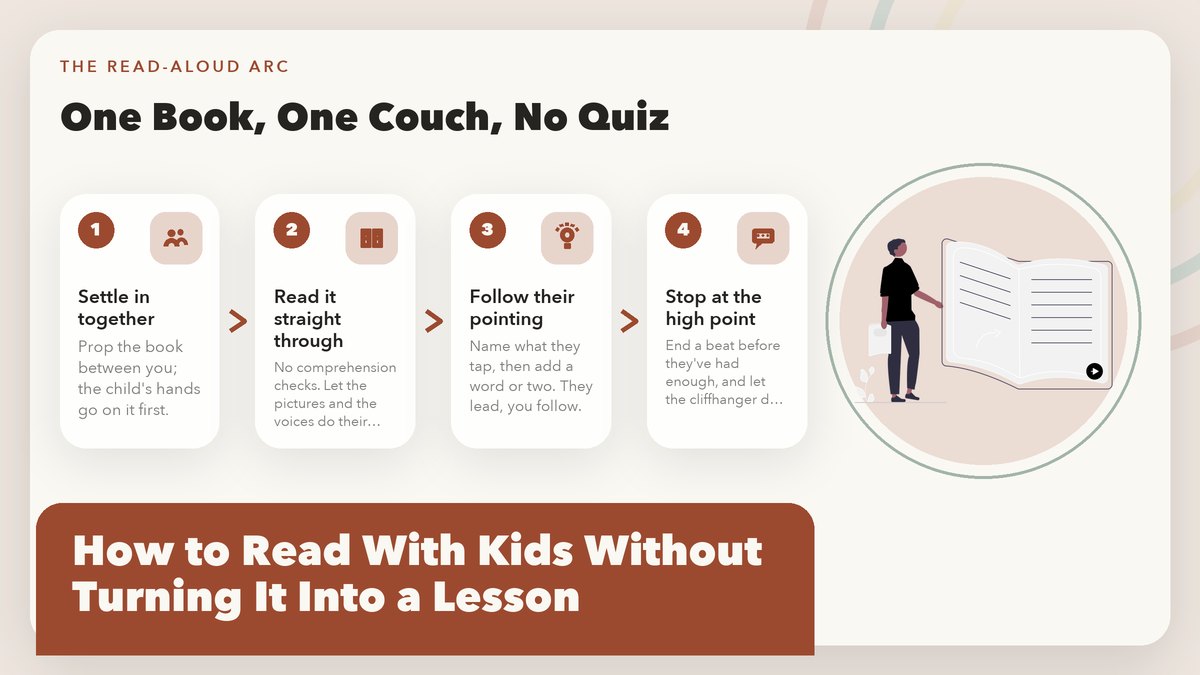
I’ll defend this one at any playground. The first time through any book, read it with zero
interruptions: no pauses for vocabulary, no “what do you think happens next,” no pointing out the
moral like you’re annotating a fable. Read it the way you’d read a novel yourself, straight
through, at a pace that lets the pictures work — which, for most picture books, means roughly five
to ten minutes end to end — with whatever voices the story seems to ask for.
Two things happen at once. The child gets the experience the author built, and picture books
are timed like jokes: Mo Willems’s Don’t Let the Pigeon Drive the Bus!, a 2003 book that
took a Caldecott Honor the next year, lives or dies on momentum, and you puncture it the moment you
stop to ask what color the pigeon is. Just as important, the pressure valve leaves the room. The
child learns, body-first, that story time is the one part of the day that goes unevaluated, and
they lean in harder when nothing is being asked of them, because kids can smell a trap.
There are books you’ll read thirty times in a month, of course, and on the fourteenth run
you’re allowed, invited even, to goof around. Voicing the pigeon as an indignant civil servant is
play, and play is on the approved list.
Let the Kid Hold the Book
Half the machinery of the quiz model is physical. The adult holds the book up at lecture
distance, aims it at the child, controls the pace, and the fix is to flip that arrangement rather
than the child’s attitude. Hand the book over, or prop it between you on the pillow, and let the
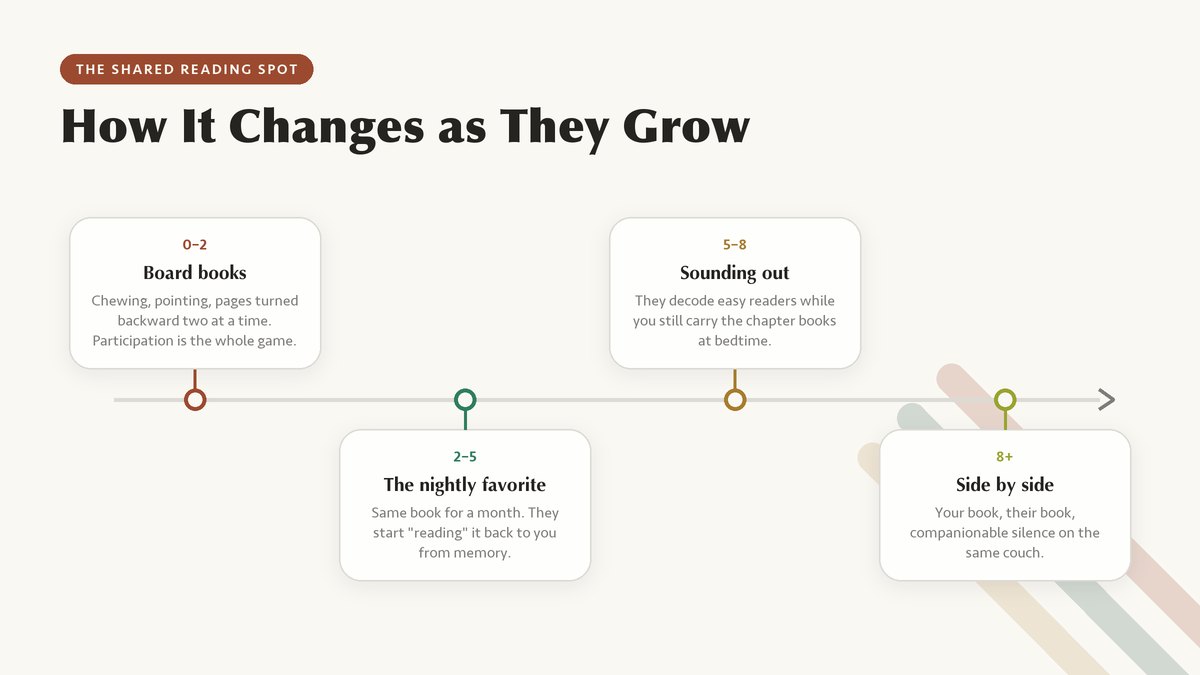
child turn the pages, however clumsily, backward sometimes, two at a time. Turning pages is one of
the ways small bodies participate in a story they can’t yet read, and the scrambling it forces on
you is a feature, since a page turned early is a chance to say “whoa, you beat me, what did you
see?”
Handing over the book also hands over the right to point. Kids point at pictures long
before they can ask questions, and pointing is the first draft of commentary. When a toddler jabs
a finger at the moon in Goodnight Moon — Margaret Wise Brown’s 1947 bedtime book, still
in print nearly eighty years on — and you say “moon, yes, the moon is watching the house,” you’ve
just done dialogic reading without a single worksheet. You followed their attention instead of
demanding theirs, and that inversion, child leads and adult follows, is the whole engine of reading
together.
How to Answer the Same Question Eleven Times
Every parent of a two-to-five-year-old knows the loop. “Why is the bear sad?” “Because he’s
lost.” Fifteen seconds pass, and then it comes again, and again. It is tempting to treat this as
malfunction; the question was answered, so the tape should stop playing, and yet the repetition is
the work. Young children re-ask because the question itself is pleasurable, the way a song’s
chorus is, and each pass is another lap around something they find interesting with you beside
them.
So answer it the eleventh time like the first. No sigh, no “I already told you.” Give the
answer fresh, maybe shorter, maybe with a small variation: “Still lost, but look, the rabbit’s
coming.” The variation keeps you sane; the freshness keeps the loop safe. What the child learns
from this exchange has little to do with the bear’s emotional state. They learn that questions are
welcome here, that asking repeatedly carries no penalty, that the adult’s attention doesn’t run
out, and that last lesson travels with them into school, where questions suddenly do carry
penalties and kids decide early whether asking is worth it.
When you genuinely don’t know the answer, and with picture books you often won’t, say so. “I
don’t know, that’s a weird sky” is a complete sentence and a better model than a bluff, since kids
can tell the difference by four.
Rule Two: Stop Before They’re Done
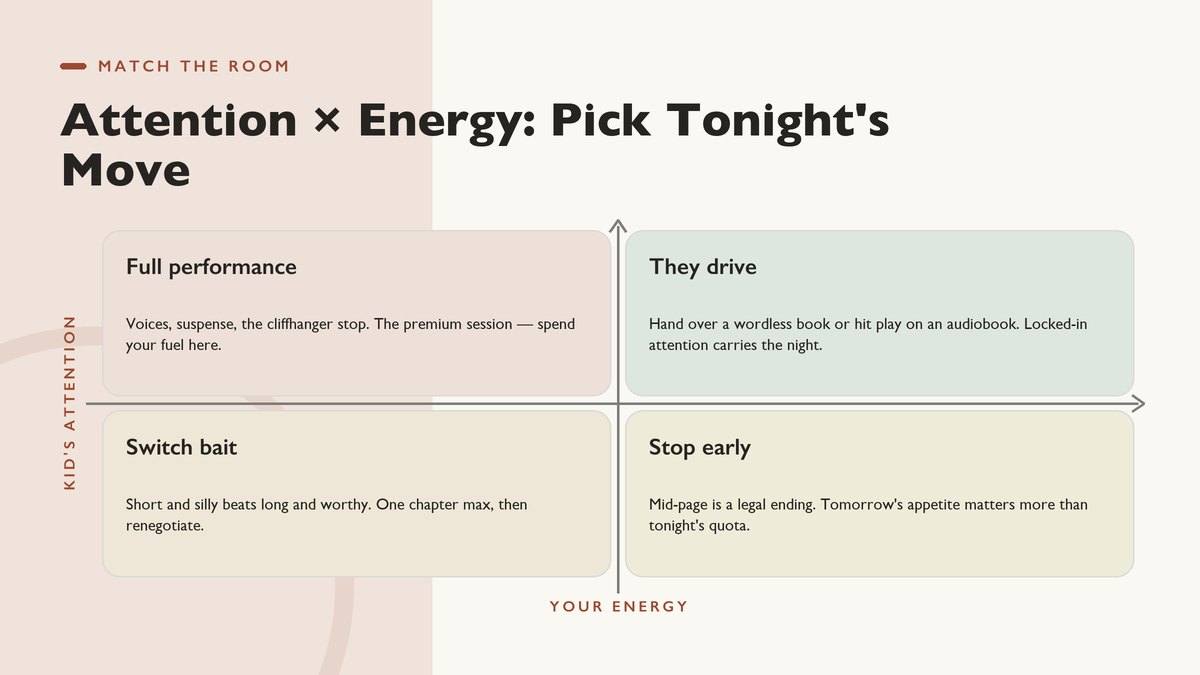
Read-aloud has one enormous advantage that nothing else in a child’s day offers: you control
the cliffhanger. A chapter can end with the door opening, the storm arriving, the note unsigned,
and then, maddeningly, it’s bedtime. Jim Trelease, whose Read-Aloud Handbook — first
published in 1982 and carried through seven editions — spent decades as the quiet bible of this
practice, built much of his advice on exactly this point. End sessions a beat before the child’s
appetite is satisfied, and the appetite grows. Stop at the natural high point, say “that’s where
tonight ends,” and absorb the protest as the compliment it is.
This cuts against every adult instinct, so it bears saying plainly: the goal of reading
together has nothing to do with finishing books. A chapter book that takes six weeks of evenings,
ten pages a night, does more for a child than a book plowed through in two sittings and shelved.
Dolly Parton’s Imagination Library understood this from the start; the program, launched in 1995
for the children of her home county in East Tennessee and now mailing books in five countries,
sends a free book monthly to enrolled children from birth to age five, and its site
is full of families whose whole ritual is one short book, slowly, every night, for years. That is
a program closing in on a quarter billion books mailed, all of it bet on pace rather than volume.
Stopping early also spares you the second-worst read-aloud failure, the child who conks out
mid-sentence while you’re hoarse on chapter nine. If they’re asleep, you’ve gone past the end of
their attention, and tomorrow’s session starts from tiredness rather than appetite. Shorter is
stronger, nearly always.
Things to Say That Aren’t Questions
Retire the quiz and you might wonder what to say. More than you’d think. Adults talk
constantly during good read-alouds; they just stop asking for answers, and the exchange continues
with different grammar. Instead of “what is the dog doing?” you narrate alongside the story: “The
dog looks worried.” Instead of “what sound does a cow make?” you answer it yourself, badly, on
purpose. Instead of “what do you think will happen?” you stake a claim: “I think the pigeon is
going to try it anyway.” Predictions issued as opinions invite disagreement, and that is the
entire trick. A child who corrects your prediction is doing comprehension work no question could
have extracted, and they’re doing it willingly.
Comparisons work the same way. “That castle looks like Grandma’s apartment building” opens a
conversation the child can walk into sideways, without being put on the spot. Personal bridges,
this reminds me of when you—, tell the child the story connects to their actual life,
which is about the deepest form of comprehension there is. None of these sentences ends with a
question mark, and none of them can be failed, which is exactly why they do the work a quiz only
pretends to do.
| Quiz reflex | Say instead | Why it works better |
|---|---|---|
| “What color is the balloon?” | “A red balloon, huge one, too.” | Kids absorb the vocabulary without performing it; comment instead of extracting. |
| “What do you think happens next?” | “I bet she hides in the wardrobe. I’d hide there.” | Your claim invites their disagreement, which is honest prediction rather than recitation. |
| “How many ducks are there? Count them.” | “That’s a lot of ducks. Where are they all going?” | Leaves the counting available without making it the toll for the next page. |
| “What was the bear’s problem?” | “Poor bear. He’s lost and it’s getting dark.” | Models summarizing as something people do for themselves, for no checker. |
When You Hate the Book They Love
You will, at some point, be held hostage by a book. The grating rhyme scheme, the
licensed-character tie-in with no actual story, the one where every page is a noisy button. Your
child will demand it nightly for a month, and some of those nights your soul will leave your body
around page two.
Grit your teeth and read it anyway, mostly. The attachment is the point, and the attachment
deserves honoring even when the title doesn’t. A child clinging to one specific story is doing
something developmentally ordinary, mastery and comfort, the joy of knowing what comes next in a
world where almost nothing is predictable to them. Read the dreadful book like it’s your favorite,
because to them it currently is, and kids can smell contempt through a picture book the way wine
tasters detect cork.
You’re allowed to manage your own suffering, though, as long as you manage it at the margins,
with substitution rather than prohibition. Keep the beloved book in rotation but position
alternatives next to it: “After the excavator book, this one has a pigeon.” Wordless picture books
are a gift here, since a child can “read” a nearly textless Caldecott winner like David Wiesner’s
Tuesday to you some nights, and flipping the roles gives a hoarse adult a real
break. Libraries help too; a weekly trip for fresh stock means most hostage situations expire on
their own when a shinier book appears. The Library of Congress’s Center for the Book,
which has run reading-promotion programs since 1977, keeps lists and resources aimed at exactly
this, building a home library habit without spending a fortune, and story hour at your local
branch is a legitimate way to outsource a night of voices.
If a book truly crosses a line for your family, a message you’re not okay with, that one you
can lose. Books disappear from shelves all the time in real homes. “Lost” works better than
“banned,” which mostly manufactures lawyers out of four-year-olds.
When You Skip a Night (or a Week)
Life will interfere. Work trips, flu, the week where bedtime collapses into a triage unit.
The habit literature tells you consistency is everything, and consistency does matter; kids settle
faster into rituals that actually happen. The part that gets left out: the ritual you’re
protecting is the pleasure. Missing five nights does no measurable damage to a child who trusts
the story will resume, while turning those five nights into a guilt-ridden makeup exam does
damage.
When you return, return warmly and skip the apology tour. “We’re reading again, where were
we?” gets you back into the book faster than a speech about how busy things have been, and it
teaches that reading is the household’s default state, the thing everyone returns to the way they
return to dinner.
If you’re away a lot, or reading aloud is simply hard for you, lean on substitutes without
shame. Maybe English isn’t your first language, maybe dyslexia makes the page a grind, maybe your
work schedule eats every evening. Audiobooks read by professionals count, full stop, and following
along with an audio chapter in the car counts. The PBS Kids
reading pages have free read-along video storybooks that keep the shared-attention piece while
someone else does the voices, and they exist precisely for households where the adult can’t be the
nightly narrator. The child still gets the story, the togetherness, and the idea that books belong
to them, and those three transfer. You get to stop performing a role that’s burning you out.
What You’re Actually Building
Strip every technique away and the core move is one small gesture: put the questions down.
Read straight through the first time. Let the small hands hold the book and turn the pages wrong.
Answer the eleventh “why” like the first, stop at the cliffhanger, issue your predictions as
opinions, and let the dreadful favorite stay in rotation until the attachment outgrows it. None of
this is the lazy version of anything. It’s the efficient version, shaped like the evidence rather
than shaped like school.
What a child gets from years of unquizzed story time goes past a head start on decoding. They
get a relationship with books that has never once been transactional, never a means to a grade,
never a performance for an adult’s approval, and that relationship is the one that survives. Kids
who were read to without being tested keep reading when the testing starts elsewhere, because
books live in a different compartment of their life, one that was always warm. You’re not skipping
the lesson. The lesson is the warmth.