A book usually ships with a name its author didn’t
pick. Here’s who actually decides, what the title is being tested for, and
why the subtitle ends up doing most of the selling.
Somewhere in a drawer of discarded drafts, F. Scott
Fitzgerald’s 1925 masterpiece is still called Trimalchio in West Egg,
named for a freedman who throws a lavish dinner party in Petronius’s
first-century Roman novel The Satyricon, and Steinbeck’s Of Mice
and Men (1937) nearly went out under the shrug of a name, Something
That Happened. If you’ve ever agonized over what to call your own book,
that history is worth sitting with: the greats didn’t land it on the first
try either. Naming a book looks like a small creative decision, the last
purely artistic one before commerce barges in, and it is neither small nor
purely artistic, because a title ends up as a piece of marketing, a piece of
metadata, a legal object, and a promise, all sharing one spine.
I’ve watched writers take the renaming personally, and I get it. You lived
with that working title for two years, through drafts and doubt, and then a
marketing meeting in a building you’ve never set foot in replaces it in a
single afternoon. The way I make peace with it: renaming isn’t an insult or
a whim, it’s a sequence of tests, and this article walks through them in
order, from the placeholder at the top of your draft file to the name on the
spine.
In this article
Most Working Titles Don’t Survive
Jane Austen called her manuscript First Impressions until 1813,
and her case is closer to the norm than the exception: a working title exists
so you have something to type at the top of the file, and for months it feels
permanent when it almost never is. She had drafted the book in the 1790s, and
a London publisher reportedly declined it by return of post before Thomas
Egerton took it on under the name we know. Fitzgerald had to be talked out of
his Latin by Max Perkins, his editor at Scribner’s, who understood that a
title most readers couldn’t pronounce, Trimalchio being a character out of
Petronius, would cost the book browsers before they ever opened it.
Look at what actually killed those two titles and the pattern is plain:
neither was bad writing, both were bad signage. That’s the bar a book title
gets judged by, because it’s measured against a stranger holding the book
for about eight seconds, not by how it flatters the author, and most lovingly
chosen working titles trip right over it. They were chosen by the one reader
who needed no introduction to the book.
There’s a flip side, though. Some working titles were right from day one,
and the naming meeting becomes a formality because nobody in the room can
improve on what the author typed in week one. When that happens everyone
exhales and moves to the subtitle, which is where the real fight usually
starts, so hold that thought.
Who Actually Gets to Decide
In a traditional deal, marketing and sales weigh in heavily, for the blunt
reason that they’re the ones who have to hand-sell the book to buyers at
chains like Barnes & Noble, and most first-time authors are surprised to
learn that the title decision usually sits with the publisher, the author’s
veto weaker than anyone wants to admit. The editor, your best advocate in
that room, still casts only one vote. Contracts differ, but final approval
over title, subtitle, and cover commonly sits with the house. I should
qualify that: some contracts do hand the author approval rights, which is
exactly why yours is worth reading before you sign it.
Self-publishing flips the arrangement Fitzgerald had at Scribner’s, which
is both the attraction and the trap. Every call is yours, including the bad
ones, and the bad ones don’t get intercepted by people who have watched a
thousand titles live and die; nobody talks an author out of a
Trimalchio the way Perkins talked Fitzgerald out of his. I’ve seen
self-published covers with lovely art sunk by a title nobody could say aloud
or remember an hour later, and nobody was rude enough to stop it. The
process stays the same; only the headcount in the meeting changes.
A title isn’t chosen so much as survived. Books go out
with the name that made it through the most tests, not the name anyone
loved most.
Hybrid and self-published authors can rebuild the committee’s function,
and I’d say they ought to. Round up four or five people who don’t know your
book, hand them the candidate titles with a one-line genre description, and
pay close attention to every hesitation and mispronunciation, because that’s
the whole meeting squeezed into one evening. It won’t catch everything a
sales force would, by definition, since four volunteers aren’t a national
team, but it catches the two failures that sink most independent titles: the
unsayable name and the unfindable one.
What a Title Has to Do
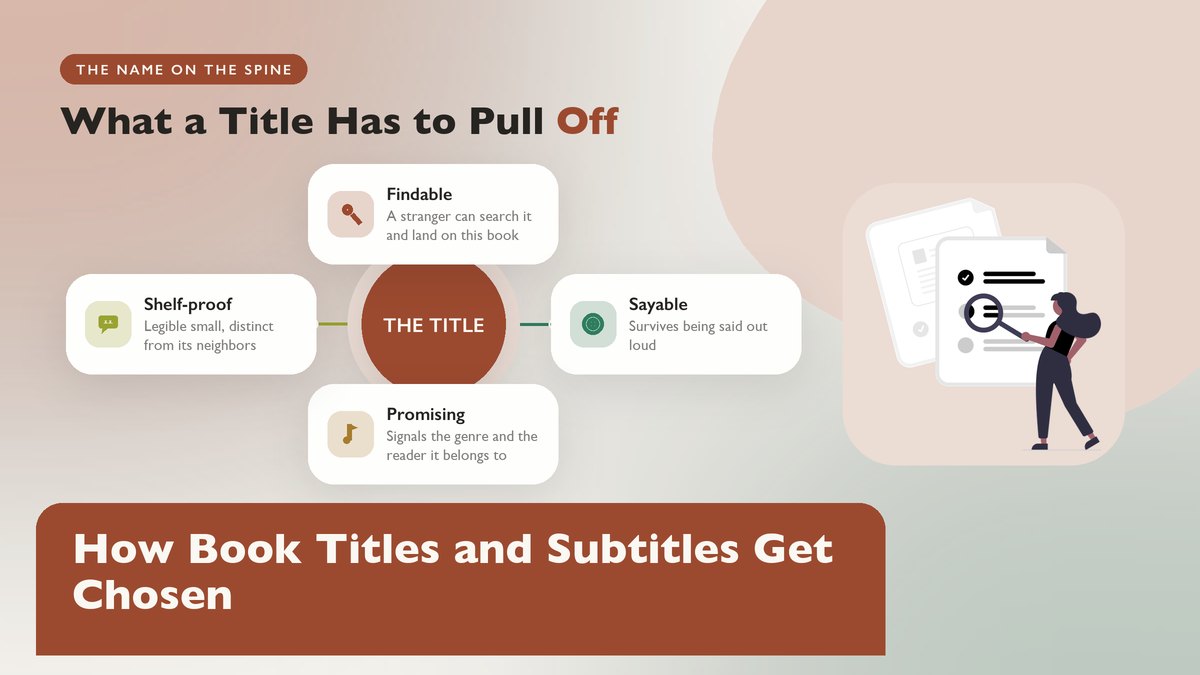
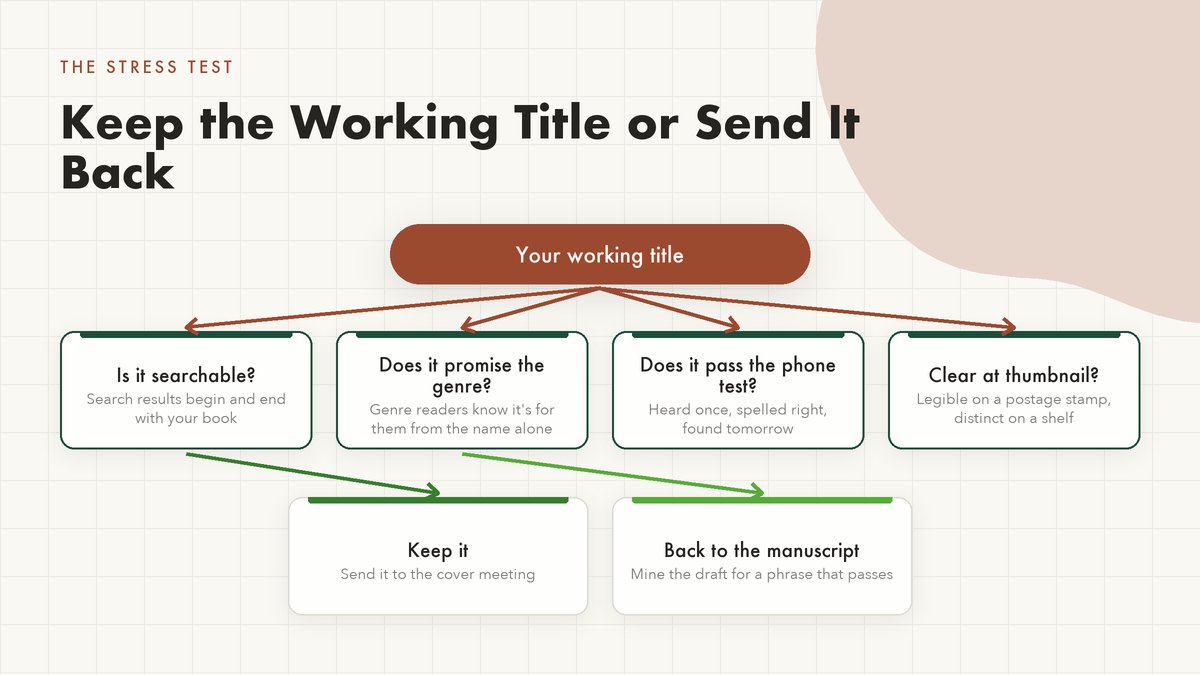
Strip the mystique away and a title has exactly four jobs, no more. A good
one handles all four without strain, and the trade runs this checklist
whether anyone writes it down or not.
| Job | What it means | How it’s tested |
|---|---|---|
| Stays findable. | A reader who heard it once can search it and land on your book, not a similarly named one | Type it into a search box and a catalog |
| Stays sayable. | It survives being spoken on a podcast or recommended across a dinner table | The phone test: say it, spell it, repeat it back tomorrow |
| Promises the book, telling the right reader “this is for you” and signaling the genre plainly | Match the promise to what the pages actually deliver | Show the title alone to genre readers and ask what they expect |
| Survives the shelf. | It’s legible at thumbnail size, distinct from its neighbors, and doesn’t embarrass anyone | The bookseller test: shrink it to a postage stamp and squint |
That fourth job, surviving the shelf, is where Fitzgerald’s literary
ambitions collided with commerce most often. A long, poetic, abstract title
can be a beautiful object and still fail the shelf test completely, since a
spine offers an inch of width and a browser offers about three seconds.
Fitzgerald’s Latin pointed at the book’s themes, lovely as an idea, and from
a bookseller’s side of the counter it was a doorstop of a title. It told a
browser nothing and promised less.
Two of the four jobs didn’t matter much a century ago and matter
enormously now. Findable and sayable are the newcomers, and a title that
collides with twenty other books online pays a tax on every single sale,
because the modern process starts with a search box long before it starts
with a poetry argument. The tests feel old-fashioned, in other words, but
the stakes aren’t.
The Subtitle Does the Heavy Lifting
If you’ve wondered why so many nonfiction covers read like a headline
followed by an explanation of the headline, it’s because the subtitle is
where the pitch lives, and James Clear’s Atomic Habits (Avery,
October 2018) is the cleanest recent example. The title earns the glance.
The subtitle closes the sale. Atomic Habits is a fine two-word
phrase, but Tiny Changes,
Remarkable Results is the part that tells a browser what they’re
buying. Strip the subtitle off most bestselling nonfiction and the title
alone would sell a fraction of the copies.
Fiction uses subtitles differently, and the difference teaches: Yann
Martel’s Life of Pi, the 2002 Booker Prize winner, carries the
modest “A Novel” as a genre signal, while a novel’s subtitle, when it
exists, usually adds mood or a wink rather than a pitch, and historical
fiction often spends its subtitle placing you in a century.
Reversing those roles is one of the most common amateur tells on a
self-published cover. Paragraph-length explanation stapled to a novel that
wanted mystery.
A subtitle is a sentence you may hear quoted back for thirty years, and
it travels as one unit. Retailers, catalogs, and
metadata feeds carry the full title-subtitle string, so the
pairing reads as a single sentence whether you planned it that way or not.
If yours reads like a sentence, it had better be a good one.
Sixty characters is roughly where e-commerce pages truncate long title
strings in search results, for the combined title and subtitle, as a general
rule. A subtitle that buries its hook after word twelve gets the hook cut
off at the exact moment a browser was deciding whether to click, so
front-load the promise and leave the elaboration to the flap copy, where
length costs nothing.
The Checks Before Anyone Commits
Three checks come before a candidate goes on a cover, and this is where
self-publishers skip steps a traditional house never would. First, the
collision search: type the candidate into book catalogs and see what else
already wears the name. Open Library,
run by the nonprofit Internet Archive and editable by anyone the way
Wikipedia is, is
the quickest free way to learn whether your perfect title belongs to
somebody else’s backlist. Sharing a name isn’t automatically fatal; generic
phrases get reused constantly. Colliding with a recent bestseller in your
own genre comes close, though, because the two books will stack on top of
each other in search results for years.
Second comes the trademark question, and the “For Dummies” series is the
textbook case: titles of single creative works generally can’t be
trademarked, the business counterpart to
the Copyright Office’s rule that names and titles aren’t protected, and the
protected asset in publishing is usually the series name. The series was
launched in 1991 with DOS For Dummies, and its publisher, John
Wiley & Sons, defends the mark so competitors can’t sell lookalike
knockoffs riding the
brand. The USPTO’s
trademark basics page lays out the single-work versus series
distinction, and if you’re building a series it’s worth reading before
cover one goes to print.
The 13-digit ISBN record is the third reality check: whatever you print
on the cover is what should sit in the record that retailers, libraries,
and wholesalers all draw from, and the 13-digit form became the worldwide
standard on January 1, 2007, replacing the old 10-digit one. The International ISBN Agency
maintains that standard, and the practical consequence is simple: title and
subtitle go into the record as separate fields, word for word,
capitalization and punctuation included. Get those details wrong and your
book will argue with its own listings across every store.
How the Shortlist Gets Tested
Once a house narrows to a handful of candidates, the testing starts, and
most of it is disarmingly low-tech. The phone test comes first: can someone
hear the title on a podcast, spell it, and find it tomorrow? Titles that
fail it bleed sales week after week, because word of mouth is the one
channel nobody can buy and it runs entirely on names people can repeat, so
a title that’s easy to say is hard to fake in that test.
Then the bookseller test, where a chain buyer’s verdict carries more
weight than authors expect; the verdicts are blunt. Sales reps carry
candidate titles and covers to the
people who stock the shelves, and those buyers say the quiet part out loud.
A buyer who tells a rep “I can’t shelve that spine next to its neighbors”
has killed more than one beloved title. You can argue with a focus group;
you can’t argue with the person deciding whether to order forty copies.
Big houses sometimes add formal research on top, testing titles against
sample readers or mining their own sales data for lookalikes. The details
vary house to house, and much of it is educated pattern-matching backed by
sales history rather than science. The direction is consistent everywhere,
though: the surviving title is the one strangers test well, and the author
makes a poor judge, being the single person alive for whom the book needs
no introduction.
Where Good Titles Actually Come From
Sit through enough naming meetings and a pattern shows up: the winning
title usually didn’t come from the meeting at all. It came from the
manuscript, pulled from the book’s own pages, the oldest trick going, and
it carries one built-in advantage, which is that title and text agree with
each other by construction.
The Sun Also Rises takes its name from the Ecclesiastes passage
quoted in the epigraph, “The sun also ariseth, and the sun goeth down,” so
it’s an epigraph before it’s a cover. Beloved is one word, the
single word carved on the tombstone at the center of Toni Morrison’s novel,
carrying everything the novel carries.
Both came from the text.
When a house is stuck, an editor will sometimes have someone reread the
manuscript with a highlighter, hunting the sentence that already contains
the title, on the theory that the best candidate is a line a reader would
have underlined anyway.
Next comes the pitch, usually buried in the author’s own paperwork.
Somewhere in the proposal or query letter, the author usually wrote one
clean line describing the book, and that line often holds
the title in embryo, waiting for someone in a meeting to say it out loud
and hear it click. Nonfiction does this on purpose, because the proposal’s
promise and the subtitle’s promise are typically the same sentence in
different clothes.
What doesn’t produce good titles is the cleverness session, the
whiteboard afternoon, the free-association hour. Puns die fast. Those
meetings generate them anyway, and puns are the fast food of titles,
amusing until Friday and fatal on a spine. (Every naming meeting has a
pun-defender; if you can’t spot them, it’s you.) The sessions do serve one
function, saying the bad ideas out loud so everyone can hear them die, and
afterward the group almost always goes back to the manuscript and the
highlighter.
Self-publishers can run the same play in miniature. Read your draft and
underline any line that could carry the book, gather a dozen or so
candidates, and test them the way a house like Scribner’s would, on
strangers rather than your writing group, who know too much about the book
to play the browser. Your group will pick the title that’s clever given
everything they know. The browser knows nothing. Design for the browser.
The committee, minus the salaries.
Type, Case, and the Cover
A chosen title still has to be typeset, and even small choices there
carry weight. English covers set titles in title case almost universally,
under the convention U.S. trade publishers call headline style. The rules
in chapter eight of the Chicago
Manual of Style say to capitalize the first and last words, the nouns
and verbs, and leave the short conjunctions and prepositions lowercase,
regardless of length. Readers can’t state
the rule, but they register a lowercase slip as a mistake, the same way
they feel bad kerning without knowing its name.
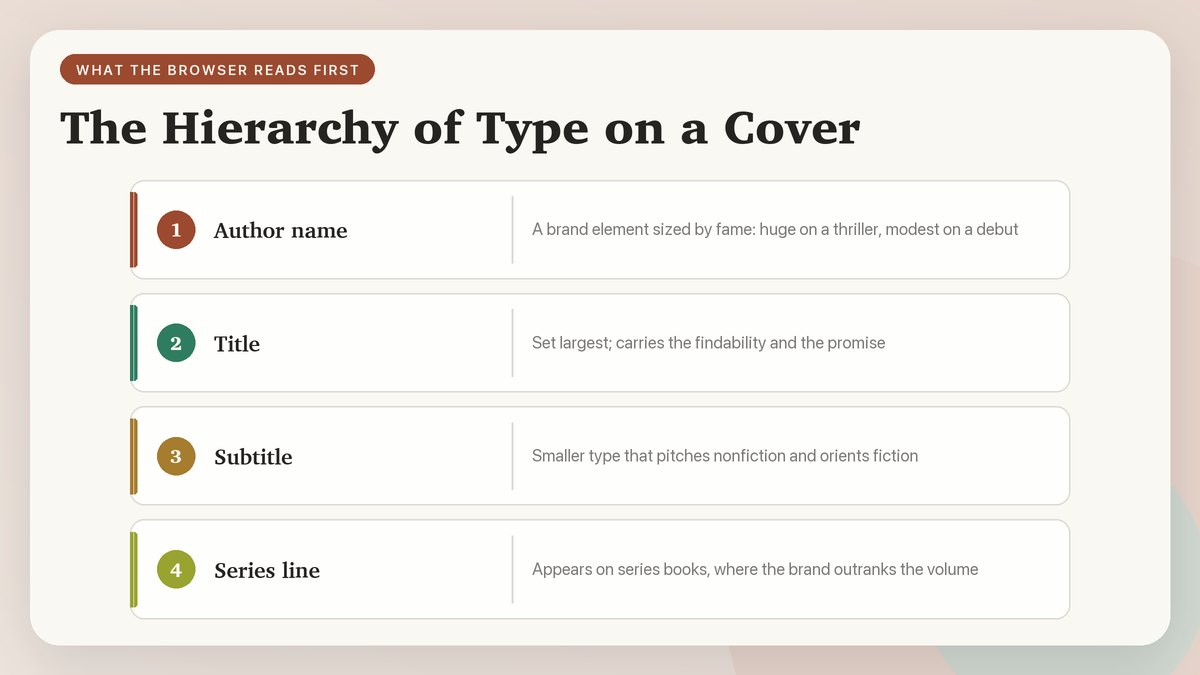
On the physical cover, the words arrive as a hierarchy: title biggest,
subtitle smaller, author name as a design element in its own right. Where
the author’s name sits relative to the title is itself a market signal. A
Lee Child thriller blows the surname up nearly to title size because
readers are buying the name, while a debut literary novel keeps it modest,
because nobody’s heard it yet. The title never appears alone. It appears as
part of a composition that’s arguing with the browser before a word of
prose gets read.
When the Title Changes Late
Sometimes a title clears every meeting and still dies at the wire. The
classic case is Joseph Heller’s Catch-22, published by Simon &
Schuster in 1961 after being written as
Catch-18 until Leon Uris’s World War II novel Mila 18,
also out in 1961,
reached shelves first and the publisher shifted the number to avoid the
collision. Orwell’s Nineteen Eighty-Four, published in June 1949,
passed through The
Last Man in Europe on its way to the name it kept. Late changes like
this are why advance reading copies sometimes carry a small mercy in the
front matter, a note warning reviewers that the title isn’t final.
Self-publishers get a less romantic version of the same story. The title
that seemed fine in draft collides with a bigger book, or simply fails to
convert in ads, and the author re-titles between printings. Unlike a
traditional house, you can do that over a weekend, re-upload the metadata,
and let the new name propagate through the retailers. Disorienting, but
survivable.
So if you’re naming a book right now, take the pressure off at the draft
stage. Call it Something That Happened if you must; Steinbeck did,
and the book turned out fine. Worry instead about the search box, the phone
test, and the spine. And leave the poetry for the cover deadline, because as
Fitzgerald learned in 1925, it will probably have to.
Naming conventions and standards referenced here
include the U.S. Copyright Office’s FAQ on title protection, the USPTO’s
trademark basics for series marks, the Chicago Manual of Style’s
headline-style rules, and the International ISBN Agency’s metadata
standard. Examples drawn from well-documented publishing history.