The Bureau of Labor Statistics files the job under
“editors,” puts the 2025 median wage at $77,920 a year, and describes the work as
planning, reviewing, and revising content for publication, which leaves out most of what
actually fills the day. Ask most people what a book editor does and they’ll picture someone
curling up with a manuscript and a red pen, fixing commas. The real job is stranger, more
businesslike, and to my mind a lot more interesting than that.
The federal job profile for editors lists a bachelor’s degree and
under five years of related experience as the entry requirements, which already tells you
the profession is trained on the job rather than credentialed in it; nowhere in the popular
imagination does that training happen in a leather chair, reading novels all day and weeping
at beautiful sentences. I’ve read enough editor memoirs and job postings to know the chair
is a myth. The actual work sits at an odd intersection of art appraisal, project management,
and internal politics, and most of it never involves a red pen at all. Maybe ten percent of
the job is the literary part people picture. The rest is a business job that happens to run
on books. If you’re a writer hoping to be edited one day, or a reader curious why one novel
felt tightly wound while another seemed to wander, it helps to know what the person behind
the job title is really doing with a manuscript during the year and a half or so it sits on
their desk.
“Editor” hides at least three distinct professions under one title. I plan to untangle
all of them here: what an in-house acquiring editor actually spends the week on, how a
manuscript moves through the four passes of editing, and what editors wish writers
understood about the relationship. The
U.S. Bureau of Labor
Statistics counted roughly 93,000 editors across all industries in its most recent
survey. The book-publishing subset of that number shares a job description that surprises
almost everyone who reads it for the first time. The surprise is how corporate that
description sounds, because nothing about the job posting prepares you for a career spent
negotiating calendars and making cases, and the BLS projects the field to shrink about one
percent between 2025 and 2035, with most of its roughly 7,900 annual openings coming from
people retiring out of the chair.
In this article
- Three Jobs Hiding Under One Title
- Acquisition: Reading for a Living, Then Defending What You Read
- The Four Passes Every Manuscript Goes Through
- A Week in the Life
- The Editor as Translator Inside the Building
- What Makes an Editor Say Yes
- What Editors Don’t Do
- How People Become Editors
- How to Work With an Editor Once You Have One
Three Jobs Hiding Under One Title
When a writer says “I need an editor,” they might mean three very different people, and
each gets paid by a different route. An acquiring editor at a publishing house draws a
salary, decides what gets bought, and then shepherds it through production. A freelance
developmental or line editor works directly with authors,
usually for a fee arranged through organizations like the Editorial
Freelancers Association, whose 2026 rate chart, built from a survey of more than 1,100
members fielded between November 2025 and January 2026, puts fiction developmental editing
at $52.50 to $70 an hour. A copy editor polishes prose at the sentence level, a craft
with its own professional body in the
Chartered Institute of Editing and Proofreading, which
began life as the Society for Editors and Proofreaders in 1988 and took its current name in
2020, and whose members sit qualifications and exams to prove they know an en dash from an
em dash.
The acquiring editor rarely touches a comma because there’s a profit-and-loss sheet to
defend; the copy editor has no say in whether chapter six exists at all, and at the EFA’s
fiction rate of $40 to $50 an hour, nobody is paying them to have one. These two roles
overlap less than you’d think, and the mix-ups cause real trouble. Writers query copy
editors for representation, which is a bit like asking a proofreader to sell your film
rights. Authors pay for a copyedit when the manuscript’s actual problem is structural and no
amount of comma correction will save it; the same rate chart prices a fiction developmental
edit higher precisely because diagnosing structure is harder work than polishing sentences.
I’ve watched that particular mistake cost people real money, and it always starts
with the same muddled job title.
| Role | Who pays them | What they actually decide |
|---|---|---|
| Acquiring editor | The publishing house | What the house buys; how the book is positioned; the shape of the edit |
| Freelance developmental/line editor | The author (or the house, as a contractor) | Big-picture structure, character arcs, chapter order, voice consistency |
| Copy editor / proofreader | The house or the author | Grammar, style-sheet consistency, factual flags, typographical errors |
| Managing / senior editor | The publishing house | Schedules, budgets, which projects move and which stall |
Managing editors own the fourth job in the building, and writers almost never hear about
it. Because the EFA chart assumes somewhere around five manuscript pages per working hour,
a 400-page novel eats weeks of one copyeditor’s calendar, which is why the production
calendar, the freelancer assignments, and the call about what happens when two books need
the same copyeditor in the same month all land on their desk. When an author asks why
everything is taking so long, the managing editor’s desk is usually where the real answer
lives. They are also, not incidentally, the people who keep a late jacket from colliding
with a printer’s schedule, which sounds trivial right up until it moves a publication date
by a whole season.
An acquiring editor’s real product is the argument that convinces a room
full of skeptical colleagues the book deserves to exist.
Acquisition: Reading for a Living, Then Defending What You Read
A few hundred agented submissions arrive in a year for an editor at a major house,
sometimes more in a hot category, and editors do read for a living. But the reading is
closer to panning for gold than to pleasure. Most submissions get a chapter. Maybe two. The tiny fraction that survive get read in full and discussed, then subjected to the part nobody
romanticizes: the profit-and-loss statement. Before an offer goes out, someone builds a
P&L estimating sales, royalty costs, printing, marketing spend. Editors describe
this as “falling in love with a manuscript and then having to prove the love in a
spreadsheet,” and they describe it that way because the spreadsheet wins arguments; a debut
novel with a hoped-for first printing of a few thousand copies doesn’t have much room to be
wrong about the numbers.
Acquisition is a group decision, which means an editor spends a startling amount of time
selling internally. Acquisition memos get written for people who will never open the book,
and they can run to several pages of comparative titles and sales math. Titles get pitched
at editorial meetings. Editors hunt for a colleague in another department willing to say
the right thing at the right moment when sales projections look thin. Trade coverage in
outlets like
Publishers Weekly, a trade paper that has
reported on the American book business since 1872, feeds that internal
momentum, which is why editors care so much about early buzz, rights announcements, and who
represents a project. None of this appears in any job posting I have come across, and all
of it decides which books reach the shelf.
The agent relationship runs on meals as much as on manuscripts. Most of what lands on an
editor’s desk arrives because an agent believed in it first. Editors take agents to lunch,
tell them what they’re hungering for next season, and signal well in advance which
submissions will get fast attention, sometimes by calling the agent before the manuscript
even lands.
Publishing runs on those conversations more than on anything in a catalog. A debut novel
that sells in a week usually sold because two people who trust each other got on the phone,
and the deal memo came later.
The Four Passes Every Manuscript Goes Through
Once a house buys a book, the manuscript begins a predictable procession through four
distinct passes. Each pass has its own goal, its own professional, its own going rate on
the EFA chart, and its own level of pain for the author. Skip one to save time or money
and the gap tends to show up in reviews later, sometimes by name.
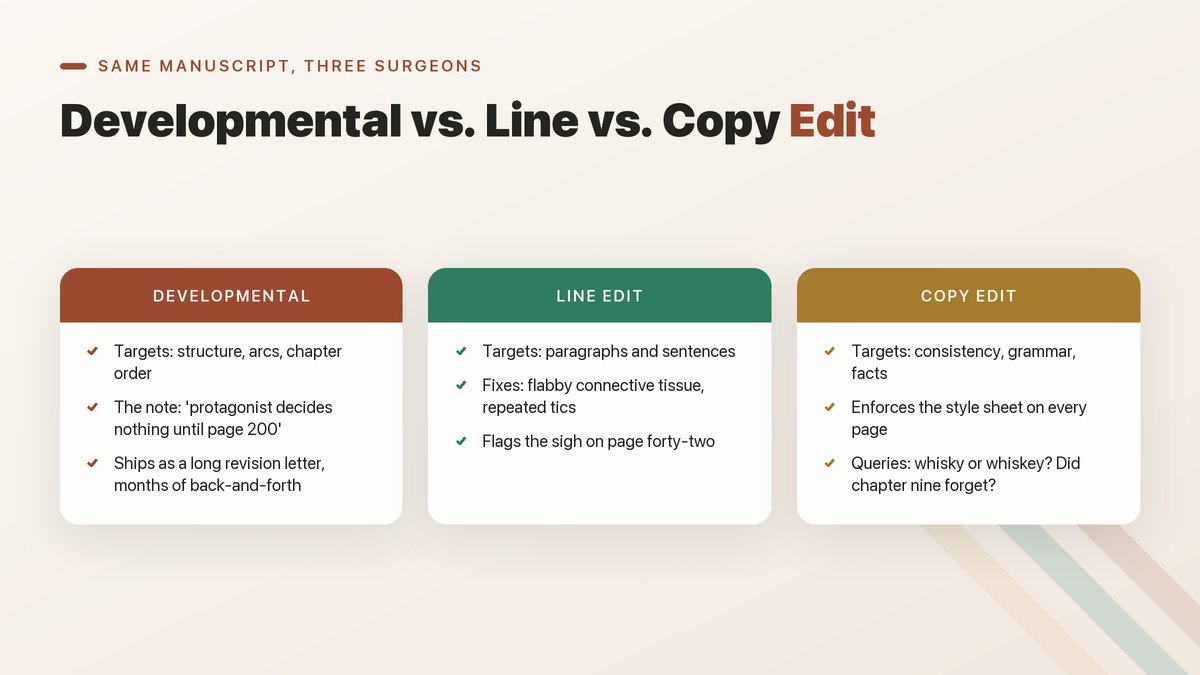
The developmental pass comes first and hurts the most. This is where the editor says
“your protagonist doesn’t decide anything until page 200,” or “the middle third repeats
the same argument three times.” Good developmental editors ask questions instead of issuing
orders, and the best ones send letters several pages long, five or ten or occasionally
more, rather than line-by-line corrections, because the problems at this stage live at the
level of structure rather than sentences. A great developmental letter reads like a very
smart reader confessing where they got bored, confused, or unconvinced. That’s gold, even
when it stings.
Line editing follows, and at the EFA’s fiction rate of $50 to $60 an hour it runs on a
different sensibility entirely. Now the editor works at paragraph and sentence level,
tightening flabby connective tissue and asking whether a character who sighed on page forty
needs to sigh again on page forty-two. Copy editing comes after, colder and more
mechanical: consistency against the style sheet, spelling, grammar, factual queries in the
margins. Is it “okay” or “OK” in this book? Does the detective drink whisky or whiskey, and
did chapter nine forget? Somebody decides all of that, and at this stage the author isn’t
the somebody. The proofreader goes last, checking typeset pages against corrected copy at a
pace the EFA chart puts around ten to fifteen pages an hour for fiction, catching what
everyone else has gone blind to after a dozen reads. Reedsy has
one of the clearest plain-English
breakdowns of these editing levels for authors hiring help on their own.
The style sheet is the small artifact here, and authors sometimes mistake it for
criticism. It’s a simple document, sometimes a single page, recording every arbitrary
decision made about a book: hyphenation, character name spellings, whether numbers get
spelled out. It exists so page three hundred agrees with page three, and it survives long
after the editor has moved on to the next title, because a copyeditor touching the book
years later will still check chapter names against that page.
When a copyeditor queries a choice on the manuscript, they’re usually checking it against
that sheet rather than a personal preference.
A Week in the Life
Meetings fill an acquiring editor’s calendar, if the job postings and interviews with
working editors are to be believed; the BLS profile gets this right in its flat way,
describing editors as people who “plan, review, and revise content,” which in practice
means the planning dominates. Editorial meetings, cover meetings,
marketing check-ins, production calls about a title running late, a call with an agent
about a submission that arrived that morning. The reading that made them want the job
happens in the margins, mostly at night or on weekends, and most editors would admit the
ratio tilts further toward admin every year. Somebody has to keep twenty books in various
stages of production moving, and that somebody is rarely a spreadsheet.
A concrete Tuesday makes this less abstract. The morning might hold a production
meeting about a novel whose cover keeps getting rejected by retailer buyers, then an hour
on a manuscript due at copyedit next month, where the editor rereads their own
developmental notes to check whether the author’s revision actually landed. Lunch is an
agent describing what two other houses just bought. The afternoon belongs to email: an
answer to an author’s anxious question about title changes, a memo begging for a second
season slot for a paperback that outperformed expectations, a polite decline to a
submission they admired and can’t place, one of several dozen such notes in a year.
Reading happens at nine that night, on the couch, with a pen. That hour is why they took
the job. The other nine are what keep it funded.
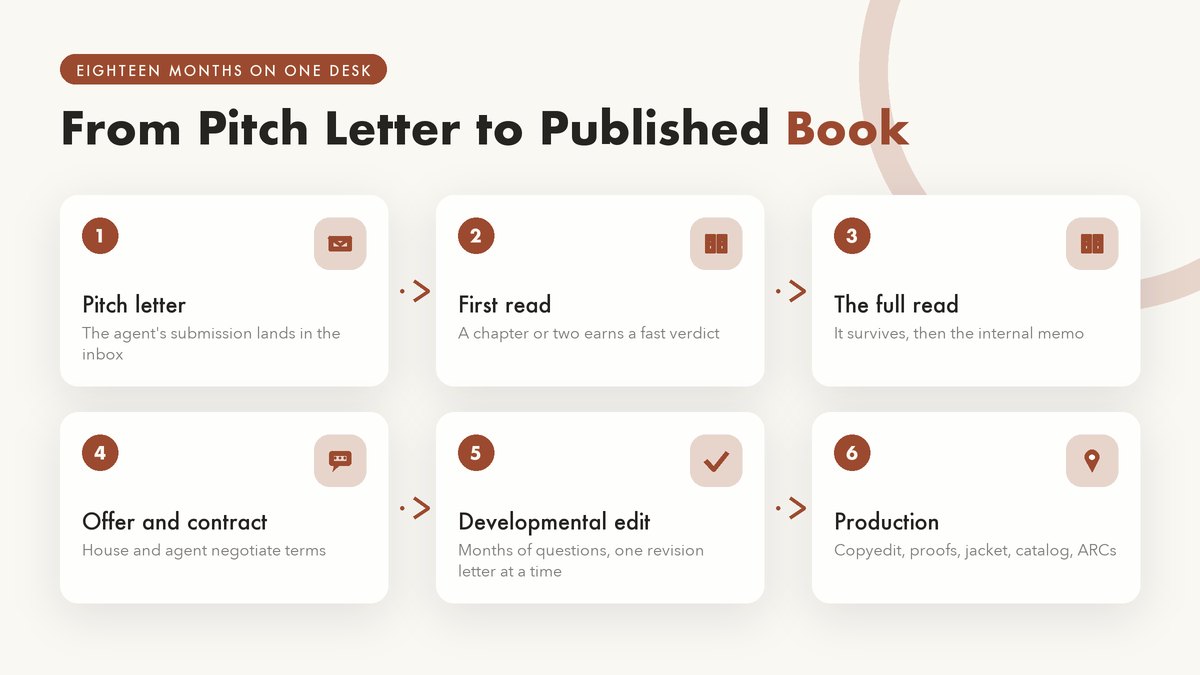
Here’s roughly how a single manuscript crosses that desk over a typical eighteen-month
arc, from first enthusiasm to finished book:
- Submission and first read. The agent’s pitch letter arrives; the editor
reads the sample in a sitting or two and requests the full manuscript, usually within a
week or two if the sample lands. - Full read, then the pitch. If the full survives, the editor champions it internally and writes the memo, several pages long, that frames the book’s case for the acquisition meeting.
- Offer and contract. Negotiation runs between the house and the agent, a stretch of weeks that belongs to others; the editor’s job is making the offer possible.
- Developmental edit. The deepest work of the relationship, often several
months and one or two big revision letters, each running several pages. - Line edit and copyedit. Shorter, sharper passes, deadlines measured in
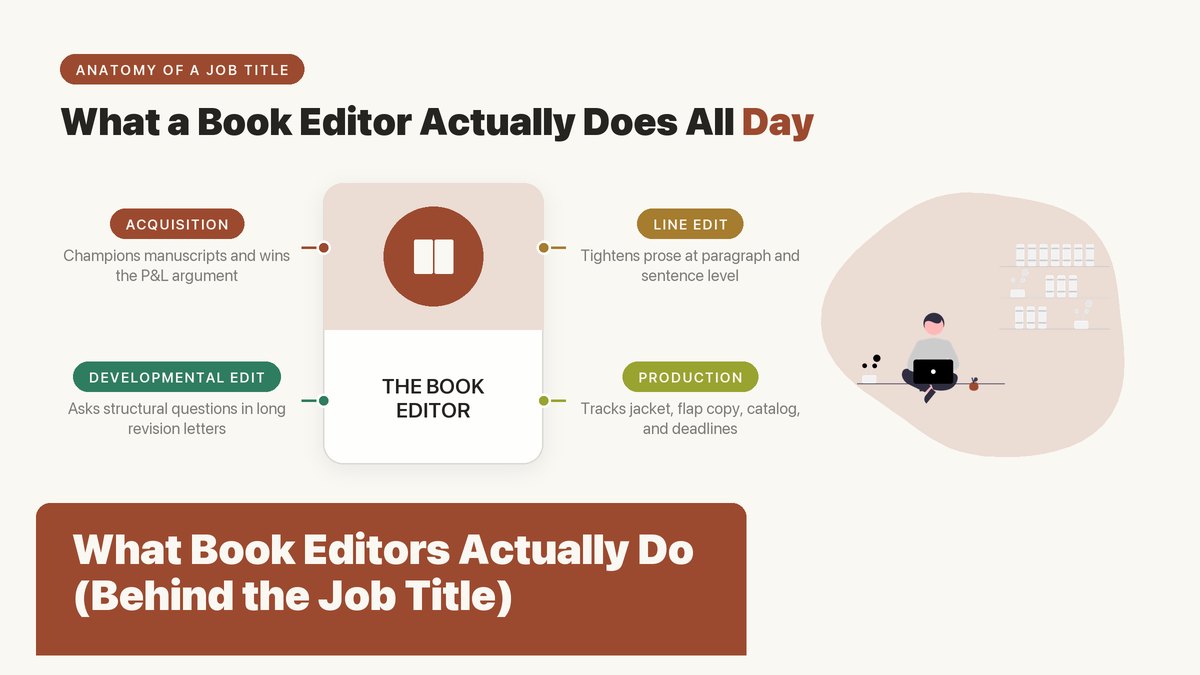
weeks, sometimes as few as four, rather than months. - Production and beyond. The editor tracks the jacket, the flap copy, the catalog listing, and the advance reading copies that go out to reviewers months before publication. Then the whole cycle starts again with the next submission.
Notice what’s missing from that list: long lunches about literature, silent reading by
a window. Both happen, but they’re not the job’s spine. The spine is advocacy, repeated
across dozens of small decisions the author never sees.
The editor is the only person whose job touches every stage, which is
why they’re often the author’s main line into the entire company.
The Editor as Translator Inside the Building
The translator metaphor survives a sales conference better than the boss metaphor, and
writers tend to picture the editor as their boss inside the publishing house. The editor
converts the author’s book into the language of the sales conference, then converts the
sales conference’s doubts back into notes the author can use. When marketing
says “we can’t position this,” the editor either turns that verdict into something
actionable or fights it with comparable titles and early reviewer quotes.
The stretches of silence that frustrate many first-time authors come straight from this
translating work. The silence usually isn’t neglect. The editor is moving the book through
rooms the author will never see, and nothing reportable exists until a cover draft lands or
a paperback date gets set. Annoying? Sure. And the alternative, an email every time
anything happens anywhere, would drown them both; an editor running twenty titles would be
writing two hundred update emails a week.
What Makes an Editor Say Yes
Voice, more than anything else, tips a maybe into a yes, since acquisition is so much of
the job. Editors describing their own decisions keep landing on the same few things. A
first page that sounds like a specific person, rather than a competent
imitation of whatever topped the bestseller list last year, will carry a manuscript past
readers who were looking for an excuse to stop. A completable pitch helps too. Fit matters
more than quality in the abstract, which sounds cynical until you remember that a house’s
sales team can only sell certain shelves, and a brilliant book nobody can position will
lose to a very good one they can.
Near-standard manuscripts round out the picture: somewhere around 80,000 words for most
adult fiction, formatted double-spaced in a readable 12-point font so an editor can still
think at page three hundred, they signal an author who will survive the production year
without drama. Editors talk to each other, and a difficult reputation travels faster than
a good one. None of this asks you to be fake. It asks you to be the kind of collaborator a
busy person can afford to bet a season on. Comps, as everyone calls the comparable-title
list, anchor every internal conversation about a book’s prospects. It’s exactly why
editors ask agents for them before the first meeting.
What Editors Don’t Do
An acquiring editor does not rewrite your book, and clearing up the myths matters
because wrong expectations sour real relationships. They suggest, they question, they
occasionally draw a line about something they can’t publish, but the drafting stays yours.
They also don’t personally market your book, however much social media asks them to;
publicity, sales, and marketing sit in separate departments with separate budgets and
their own logic. The cover isn’t fully theirs either. Editors advocate for jackets inside
cover meetings, but art departments decide, and their incentive, a cover that reads
clearly as a thumbnail on a retail page, doesn’t always match the author’s daydream.
Wild discovery is the myth hardest for writers to hear: editors don’t discover books in
the wild. Nearly everything they acquire arrives through agents they already trust. That
gatekeeping frustrates people on the outside, and I’d agree it isn’t a perfect system by
any measure. It persists because manuscript volume exceeds anyone’s capacity to read
fairly, and trusted agents compress that volume into a few hundred submissions a year per
editor instead of the tens of thousands that would arrive if every big house read
unagented fiction.
How People Become Editors
The assistant’s desk is where the usual path starts. Editorial assistants read the
slush overflow, write reader reports, answer author email, and absorb the house’s tastes by
osmosis, all at a wage far below the BLS median for editors as a whole. From there it’s
associate editor, then editor with a list of their own. Plenty
arrive by side doors, too. MFA programs, journalism, years of freelance copyediting at the
EFA’s per-hour rates all feed the profession, and each route leaves a different
fingerprint on how a person edits. Ask a working editor what the first two years looked
like and the answer is almost always the same: reader reports and mail and the slow
education of learning what a particular house will actually fight for.
The industry runs on that apprenticeship more than on any credential, which is why so many
editors can name the exact title of the first book they ever championed in a meeting.
How to Work With an Editor Once You Have One
When an editorial letter lands in your inbox, the instinct is to defend the manuscript
page by page. Sit with it for a week first. Editors describe the same pattern over and
over: authors who wait before responding end up agreeing with seventy, maybe eighty
percent of the letter once the sting fades. The letter looks like a list of criticisms.
It’s really a map of where a careful reader stumbled, and stumbling is information you
can’t get from anyone obligated to love you.
Four habits keep the working relationship smooth on both sides, and none of them cost
anything but a little patience in week one:
- Answer the letter itself. Number your responses to their
points so nothing gets lost across a long email chain, and give the editor something they
can route through production. - Push back where it matters, once. Editors expect negotiation on a
handful of points; what wears them down is re-litigating everything, and a second pass
over settled questions costs you the goodwill the first pushback earned. - Meet your copyedit deadlines. Production schedules run backwards from a
publication date, and a late author can cost a book its season. Retailers set orders
months ahead. - Spend your capital on the big stuff. Fight for structural issues that change the reading experience. Let single words go, because the word almost certainly wasn’t carrying the scene.
The reframe is the one thing worth taking from this piece. An editor is a critic who
got hired, sure, but that’s the smallest part of the job. They’re the person who bet on
your book in a room full of people who didn’t, then spent two years making the bet
survivable. That’s a stranger relationship than the movies suggest, and I’d say a better
one. Publishers like
Penguin Random House, itself the product
of the 2013 merger of Penguin, founded by Allen Lane in 1935, and Random House, founded by
Bennett Cerf and Donald Klopfer in 1927, post editorial job
descriptions on their careers pages that read more like project management than literary
criticism, which tells you where the industry’s center of gravity actually sits. The
romantic version of the job isn’t wrong, exactly. It’s about ten percent of the job, and
it happens after everyone else has gone home.
Sources and further reading: the
Bureau of Labor
Statistics’ editors’ outlook, the
Editorial Freelancers Association, the
Chartered Institute of Editing and Proofreading,
and Reedsy’s breakdown of the types of
editing. External links checked before publication.