Most queries die in under two minutes, and it has almost nothing to do with how good your book is. An agent with a full client list can open a hundred messages before lunch and sign two writers all year. This is how agents filter the pile, from the first skim of a query letter to the phone call that changes a manuscript’s life.
Every working literary agent I’ve met describes the same morning. Coffee, laptop, and a query inbox holding somewhere between forty and four hundred new messages, depending on how established the agency is. That flood arrives against a budget of maybe two or three new clients in a year, occasionally just one, while thousands of writers query the same agent over the same twelve months. Once you see how the filtering works, you stop polishing the parts of a submission nobody reads and start fixing the parts agents screen hardest.
In this article
- First, the Math Nobody Loves to Hear
- The First Screen: Your Query and Your First Pages
- What “I Know It When I See It” Actually Means
- The Business Filter
- How a Full Request Gets Read
- What an Agent Actually Does After Yes
- How Long It Takes, and What Silence Means
- The Red Flags That Quietly End a Maybe
- What You Can Actually Control
First, the Math Nobody Loves to Hear
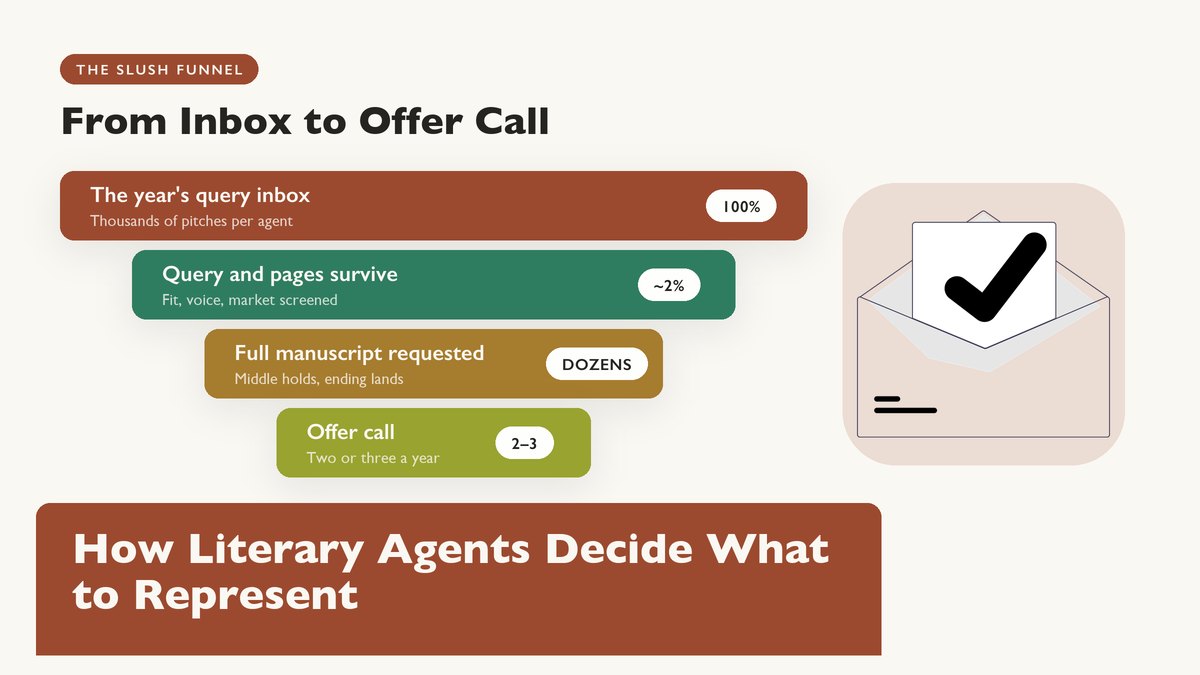
The rationing has arithmetic behind it. A novel takes six to ten hours to read properly, and an agent carrying thirty or forty existing clients can’t hand six of those hours to a stranger until something cheaper, the query, the first pages, has earned it. The process is a ladder of escalating commitments, where each rung costs the agent a little more time and the writer a little more hope.
| Stage | What the agent reads | What they’re judging | Typical survival rate |
|---|---|---|---|
| Query letter | Pitch, bio, a line about you | Is this a book at all? Is it for a market I sell to? | A few percent |
| Sample pages | First 5–50 pages | Voice on the page rather than in the pitch | Maybe one in twenty of the queries above |
| Full manuscript | The whole book | Whether the middle holds and the ending lands | A small fraction |
| The offer call | You, on the phone | Can I work with this person for years? | Two or three a year, per agent |
Those survival rates are rough, and individual agents vary plenty, but the shape holds nearly everywhere I’ve checked. Losing at the query stage isn’t a verdict on your prose. Most of the time it’s a verdict on fit and positioning, which is a different problem entirely, with different fixes, and you don’t revise a sentence to solve it.
Losing at the query stage and losing at the full stage call for opposite fixes, which is why the ladder matters more than any single rung. The first writer should reposition and re-query. The second has a structural problem somewhere around page one hundred and sixty.
A form rejection tells you almost nothing. An agent can’t, so they don’t try.
The First Screen: Your Query and Your First Pages
Most agents decide within a page, often within a paragraph, whether to keep going. Impatience has nothing to do with it; the signals they need simply arrive that early. A query of roughly 250 to 350 words that names a genre, a protagonist, a situation, and a cost reads like a professional submission. One that opens with a rhetorical question or a paragraph of weather reads like a draft, and an experienced agent pattern-matches the difference in seconds.
The letter, all 250 to 350 words of it, gets less scrutiny than writers fear and less credit than they hope. Its job is narrow: prove you know what kind of book you’ve written, and buy the pages a fair hearing. A beautiful pitch for a book the agent can’t sell lands in the same pile as a muddled one, which is why databases like QueryTracker, running since the late 2000s, organize agents by the genres they actually represent and how fast they respond. Spend your effort accordingly.
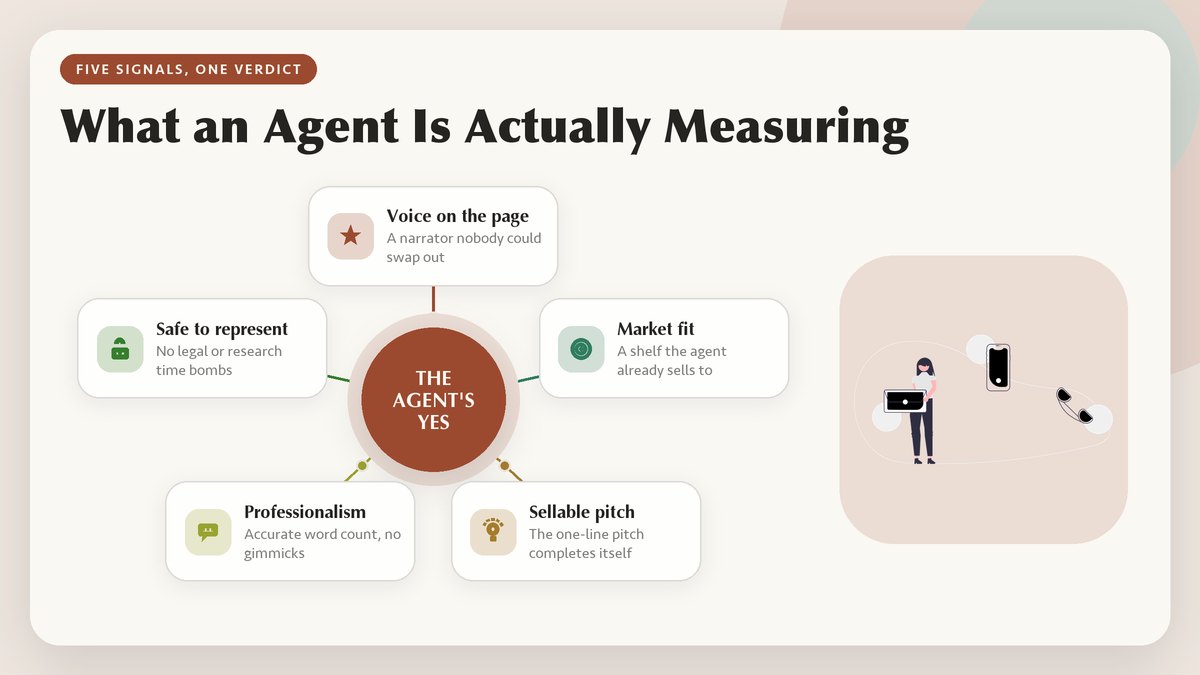
Then the pages, and this is where I’ve watched writers sabotage themselves most. Three months on the letter, then a first page of throat-clearing. Agents say they want voice, and they mean it, though the word gets used loosely. What voice means in a submission pile is a specific temperature, the sense that one particular person is telling this story and couldn’t be swapped for another narrator without the book going flat. Clean, grammatical, well-paced prose with nothing behind it loses to rougher prose with a pulse more often than workshops like to admit.
Two comparable titles, both from the last five years, pull real weight in the letter when they’re chosen well. They should be books that sold decently without being so enormous that the comparison reads as naive, and good comps tell the agent which shelf you’re aiming at while proving you actually read in your own category. Word count sneaks into the same scan. A debut fantasy pitched at 180,000 words announces that its author hasn’t studied the market for debut fantasy, where the practical ceiling sits somewhere around 100,000 to 120,000 words, depending on whose guidance you follow.
For fiction, a bio of two honest sentences with no credentials in it is enough. A credential is a bonus, a requirement it is not, and agents sign debut novelists with thin bios all the time. What the bio line screens out is fog and swagger, because “This is my first novel” reads as completely fine while “A guaranteed bestseller that will change fiction forever” ends the read on the spot.
Many agents don’t even finish the letter before jumping to the pages. They’ll read your opening paragraph and first scene before they ever reach your bio, which is why conference advice keeps collapsing into one instruction: let the book do the talking.
What “I Know It When I See It” Actually Means
Ask a room of agents what they want and you’ll hear some version of “something I can’t put down.” Push past the slogan and the famous phrase, borrowed from a 1964 Supreme Court opinion on obscenity, breaks into parts a writer can actually work on. Momentum, mostly. A protagonist who wants something specific enough to lose. And taste, the one nobody can lecture you into.
Momentum isn’t action, whatever the action-heavy advice online suggests. A quiet literary novel can hum if every scene changes what the reader understands to be at stake, and a thriller full of explosions can still stall if nothing matters more on page two hundred than it did on page ten. The question an agent asks without quite articulating it is whether each page makes the next one feel necessary. The protagonist part is simpler: vague longing reads as mush on the page, while wanting something you can name, and being in danger of losing it, is what gives scenes friction.
An agent’s client list is their professional identity worn in public, and taste, the unfair part of the equation, is also the most predictable because it leaves a written record. They’re asking whether your book belongs on the shelf they’ve already built, and an agent who reps atmospheric historical fiction is a poor target for a brisk commercial thriller, no matter how good the thriller is. Pull up any established agent’s entry in the Poets & Writers database and you’ll see the pattern written out in named clients, the same categories repeated for years. That’s the entire argument for researching agents before you query, and it’s why databases like QueryTracker exist, to match your book to people who’ve already shown they love its kind.
The Business Filter
Jane Friedman, whose newsletter The Bottom Line has tracked the publishing business since 2015 and whose book The Business of Being a Writer is a classroom text from the University of Chicago Press, has a thorough guide to how literary agents work, and the theme running through it is that an agent is a business partner first and a taste-maker second. This is the stage writers don’t like to think about, which is where a lot of full requests die without a rejection letter ever being sent. An agent isn’t judging your book as literature alone. They’re judging it as inventory they’ll personally have to sell to editors for the next year or two of their working life, and the operative word in the job description is sell.
Eighteen months is roughly how fast a hot category can cool, and agents feel the shift from the editor side long before writers do. That reframing explains rejections that otherwise make no sense. An agent who raves about your pages can still pass because their last three sales in your category bombed, or because the one publisher your book belongs with stopped acquiring it, or because their list already holds two clients writing nearly the same thing. None of that is visible from outside, and none of it is fixable by you. Agents run their lists like small portfolios, leaning toward whatever the market is buying and easing away from what it isn’t, and they follow deal reports in Publishers Weekly the way traders follow prices. The magazine has printed book-business news since 1872, and agents know what the last three comparable books in your category went for because reading it is part of the job.
A year of working life is the size of the bet every time an agent says yes, which is why they come off as middlemen with a mortgage rather than villains of the story. Understanding the bet they’re making tells you exactly which parts of your submission speak to it, and which parts are noise as far as they’re concerned.
A nonfiction proposal from someone with fifty thousand existing readers competes in a different weight class, and platform belongs to this filter even though fiction writers hate hearing about it. For nonfiction the author is the product, and the proposal is judged as much on the person as on the pages. Fiction is kinder, as any agent will tell you: there, platform is mostly bonus points, rarely a gate, though agents who handle publishing and screen rights together, like Jillian Davis, who built the book department at the Los Angeles agency Kaplan Stahler, increasingly weigh a manuscript’s adaptation potential alongside the prose.
Fifteen percent is where the money question starts: reputable agents earn a commission, that percentage being standard, on deals they make and nothing else. One rule covers both fiction and nonfiction. Money flows toward the author, full stop, a line that’s practically a motto among working writers for good reason. Anyone charging a reading fee, an editing fee, or a fee for a “submission package” is something else entirely, and Writer Beware, maintained by the Science Fiction and Fantasy Writers Association, an organization founded in 1965, keeps a long catalogue of these operations.
How a Full Request Gets Read
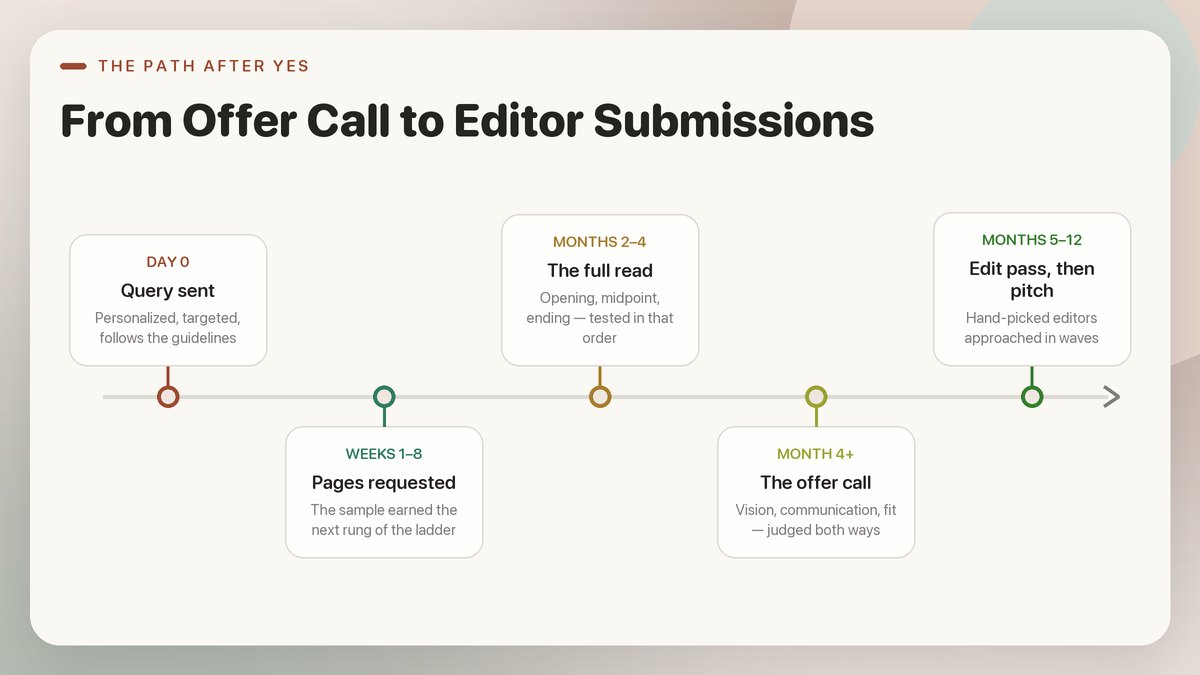
Suppose an agent who requested your sample pages back in week three emails to ask for the full manuscript. By that point you’ve beaten odds most writers never check, so let yourself take the win for an evening. What happens next surprises people, because the agent rarely reads a full the way readers read books. They read the opening chapters closely, then often skip ahead to test the middle, then go straight to the ending. If the spine of the book holds up under that rough handling, they circle back and read everything in order.
The middle is where most fulls die, usually somewhere after page one hundred. An agent who loved your first fifty pages jumps to the midpoint looking for evidence that the story is still developing, that the situation has grown teeth since page one. Sag in the middle isn’t a minor flaw under this reading. It registers as a broken promise, because the query letter made a claim about the entire book and the midpoint is the cheapest place to test it. The ending gets the same treatment, since an agent can’t pitch a book to an editor without describing how it ends, and an ending that fizzles poisons the pitch meeting before the meeting starts.
While they read, in the back of their mind they’re already drafting the pitch email they’d send an editor. If they can’t complete the sentence “this is a book about” by the midpoint, or if the honest completion of that sentence sounds like fifty other books on the market, that’s its own kind of death, quieter than a rejection letter because it never gets written down.
What an Agent Actually Does After Yes
Maybe a fifth of the job is gatekeeping, which is worth pausing on, because a lot of queriers picture the agent as a gatekeeper and little else. The rest, from the first editorial letter onward, starts after signing.
Nearly every agent does an editorial pass before submission, sometimes a deep one, two or three rounds of notes spread over a month or more. They know which editors flinch at which flaws, and they’d rather fix the flaw than watch it sink the pitch. Then comes the submission list: a dozen to two dozen editors picked by hand, sequenced in waves, each approached with a pitch letter your agent writes on your behalf. A real submission works as a set of individual arguments, each one angled at a specific imprint’s list, which is why agents keep up constant contact with editors between sales.
When several editors want the book at once, which happens most often with high-concept commercial fiction and breakout debuts, the sale changes shape. An auction runs over a fixed date with bids escalating; a pre-empt is one editor paying a premium to close the door early. Most books sell neither way. One editor makes a fair offer, and the agent’s job shifts to the contract, where the clauses that shape your career live. The option clause. The audio and translation splits. The reversion language that decides whether your book ever comes back to you. The fifteen percent buys you someone who has read a thousand of these contracts and knows which lines an editor can actually move.
Foreign rights, audio, film, serial excerpts at magazines, a second book on the strength of the first: the selling continues long after the deal. The career they’re building is the one you hired them for, and it extends well past the day your advance clears.
From the author’s side, none of it looks glamorous; it looks like waiting, and a month of silence between submission rounds is the ordinary case rather than a warning sign. The writers who get the most from their agents tend to treat the relationship as a working partnership rather than a verdict delivered by a judge.
How Long It Takes, and What Silence Means
Queries come back in anywhere from a week to never, and response time deserves its own section because it’s where writers lose their minds over nothing. Fulls take longer, often a few months, since the agent has to fit a stranger’s book around the paying work of existing clients, and a slow full is usually a full that keeps getting bumped by client manuscripts with delivery deadlines attached. Some agents post a no-response-means-no policy on their websites. Others answer everything eventually, and eventually can stretch past half a year, depending on the season and the client load.
One follow-up is the entire allowance: send it after the agent’s stated window has passed, or after roughly three months if they gave none. A polite nudge costs nothing, and weekly nudging costs a great deal. (I’ve heard of fulls sitting unread past two years; that’s the outlier, and it says more about the book than about the agent.)
Fifteen or twenty simultaneous queries is standard practice, not a scandal, and nobody respectable faults you for it. An exclusive is a courtesy you extend only when an agent asks for one, and if you grant it, set a time limit in your own head so a manuscript doesn’t sit parked for six months on a promise nobody wrote down.
The offer call is the one moment the balance of power flips. When an agent offers representation, it’s standard practice, expected even, to notify every agent currently reading your manuscript and give them a week or two to respond. This is the one point in the whole process where you hold the cards, and no agent will hold it against you. They’d do exactly the same.
The Red Flags That Quietly End a Maybe
A memoir whose author never checked whether the people in it might sue gets declined even when the pages sing, because agents are cautious people with reason to be. Their standing with editors is the whole business, and a manuscript that’s exciting but radioactive gets turned away anyway. The patterns repeat. A thriller resting on a research error anyone can verify in two minutes. A manuscript already circulating at publishers, which tells the agent either that another agent tried and failed with it, or that the author doesn’t know how the chain works.
Three hundred agents in one cc’d email is the classic self-inflicted wound, because behavior counts more than writers think. So does arguing with a rejection, and so does padding the bio with credits that evaporate under a ten-second search. Agents talk to each other constantly, at lunch, in private forums, and a name attached to a story travels fast. One polished, personalized query beats fifty bulk ones, every single time.
What You Can Actually Control
Strip the process down and the list is short. The match: sending your book to agents who demonstrably represent its kind, using resources like the Poets & Writers literary agents database alongside QueryTracker and the acknowledgments pages of published books, where authors thank their agents by name. The opening pages, which carry more weight than everything else in the envelope combined. And your own professionalism, meaning a clean query, an accurate word count, and no gimmicks.
- Match before polish. Thirty well-targeted queries will outperform three hundred random ones. Read an agent’s client list and recent deals before trusting their wishlist interview from 2019.
- Fix the first page last. Draft the whole book, then return to the opening with everything you now know. The first page is a promise the rest of the book has to keep, so write it once you know what the book actually delivers.
- Protect the middle. Before querying, run the skip test on your own manuscript. Read chapter one, then jump to the midpoint. In a twenty-chapter book that means chapter ten, read cold. If nothing has complicated, sharpened, or raised the stakes, that’s the revision to make first.
- Verify everyone. Check any agent you’re about to sign with against Writer Beware and their track record of actual sales, which QueryTracker and publishers’ deal announcements make easy to spot. Five minutes of checking has saved many writers from expensive mistakes.
Self-publishing is the door this article leaves out, and one qualification belongs here before you go. Agents are the front door of one publishing ecosystem, the traditional one, and plenty of excellent books now reach readers through other doors entirely, with their own economics and their own gatekeepers. An agent passing on your book is a decision about that book’s fit for that list at that moment. It isn’t a measurement of the book’s worth, and it says nothing about yours. The writers who get represented are rarely the most talented people in the pile. They’re the ones whose book found the right reader at the right moment, after enough well-chosen matches that the odds finally tipped.
Sources & further reading: Jane Friedman’s guide to literary agents, Writer Beware, QueryTracker, and the Poets & Writers literary agents database. Statistics in this article are industry-typical estimates, not guarantees for any individual submission.