Readers forgive a slow middle. They rarely forgive a borrowed ending, the twist that arrives from nowhere or the resolution so tidy it strangles the story, and Kahneman’s peak-end rule from the 1990s explains part of why: the exit gets weighted like the height. The goal is a last page that reads less like a surprise and more like a door finally opening.
Ask a room of readers what they remember about a book they loved, and most of them will start at the end: the murderer’s name spoken in the final chapter of a mystery, the last conversation between two people who’ve spent four hundred pages misunderstanding each other, some final image, a door closing or a train leaving or a hand going up in a classroom, that they’ve carried around for years without quite knowing why. Endings do a disproportionate share of the remembering for us, which is odd, because they’re usually the shortest part of the book. A competent middle with a great last twenty pages gets recommended more often than a brilliant middle that limps home. It doesn’t seem fair. It also happens to be true, and if you’ve ever pressed a book on a friend with the words “just wait for the ending,” you’ve already acted on this knowledge, probably without realizing it.
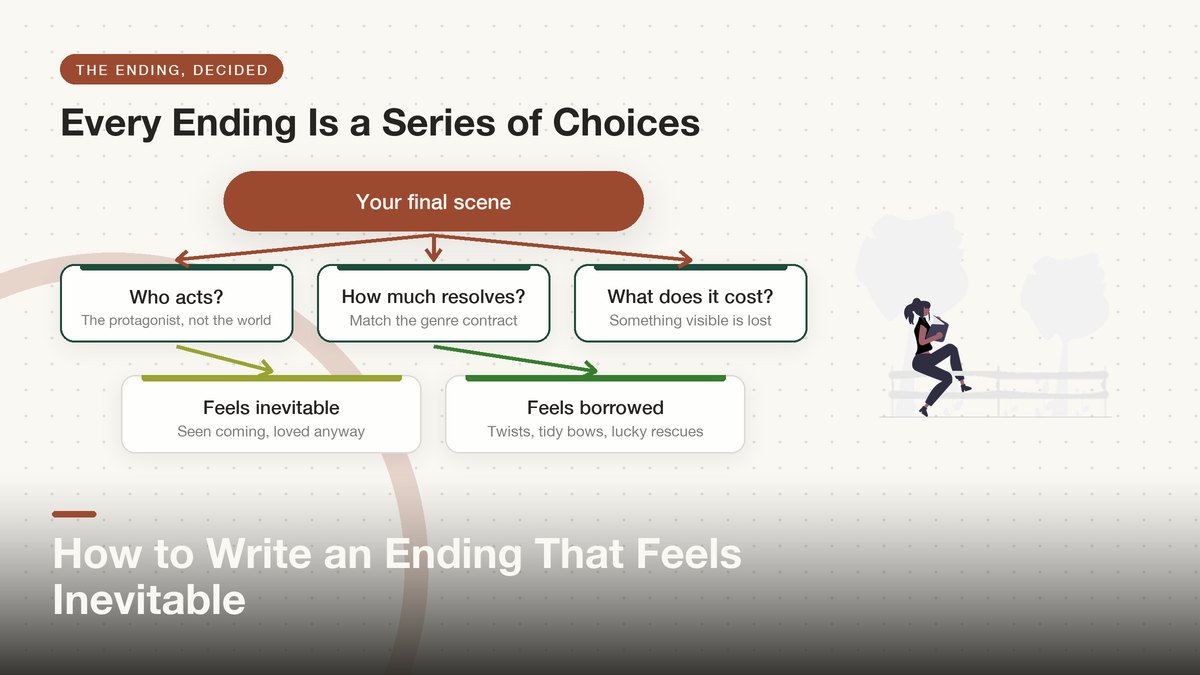
The trouble is that advice about endings tends to split into two camps, and both are useless. One camp says surprise them, which produces twists that arrive like weather, unconnected to anything the story bothered to plant. The other says resolve everything, which produces finales so thorough the book suffocates in its own ribbon. What actually works sits between those poles, and readers have had a name for it since Aristotle’s Poetics tied the quality of a plot to the necessity of its ending events. The good ending feels inevitable: given who these people are and what they’ve been through, of course it ended this way, and nothing else was possible. That’s a strange thing to say about fiction, a medium built on making anything possible, and it’s exactly why the job is hard.
In this article
Why the Ending Gets the Last Word
Psychologists have a name for the way we judge long experiences. It’s called the peak-end rule, first described by Daniel Kahneman and Barbara Fredrickson in the 1990s, and it says we remember an experience mostly by its most intense moment and by how it ended, rather than by any average of the whole. In the cold-water experiments Kahneman ran, people preferred a longer hand immersion that ended one degree warmer over a shorter, uniformly worse one, a result that makes no sense on any accounting of total pain. Readers work the same way. They don’t weigh your thirty chapters on a scale. They remember the height and the exit. The classical structure of plot, running from Aristotle’s Poetics — written around 335 BC, with its claim that plot is the soul of tragedy — forward, builds toward exactly this shape: a complication that rises, a climax that decides, a resolution that releases. The shape is old because the memory it serves is older than the naming of it.
None of this means the ending is just another scene, because it isn’t. It’s the part of the book that retroactively edits everything before it, so it can’t honestly be treated as the last thing you write, even though technically it is. A clever fourth act can make a sluggish second act look deliberate, layered, patient. One unearned twist does the opposite: readers start doubting scenes they previously loved, because the ending is where the story reveals what it was about all along. When the reveal doesn’t match the evidence, the evidence itself gets reread as filler.
A reader finishes your last page thirty seconds after finishing your book. It’s the one part of the entire experience they’ll be holding at that exact moment.
The Three Ways Endings Fail
Most disappointing endings fail in one of three recognizable ways, and it’s worth naming them, because each one needs a different fix. I’ve beta-read manuscripts, and abandoned published novels, that fell into every one of the three camps.
| Failure | What it looks like | The underlying problem |
|---|---|---|
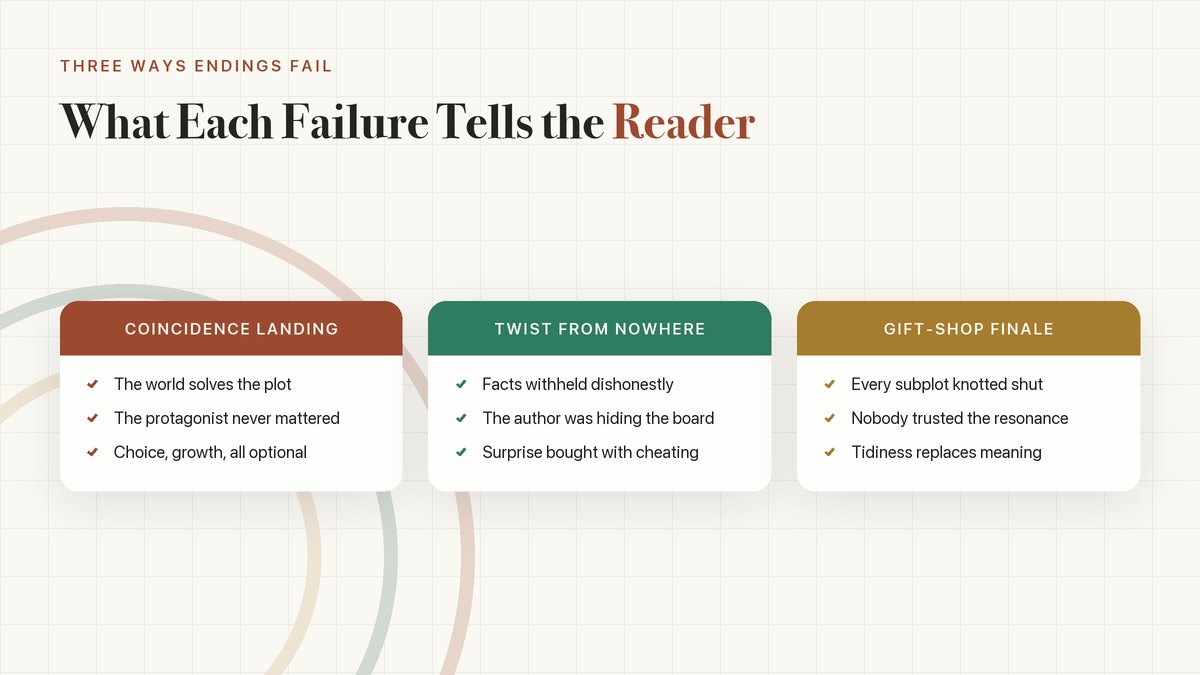
| Coincidence landing | A stranger’s letter, a lucky phone call, a villain who suddenly explains everything | The world solves the climax instead of the character, and nothing the protagonist did matters to the outcome. |
| Twist from nowhere | A secret twin, an unreliable narrator who hid the one fact that reframes everything | The author withheld information the viewpoint would honestly have had. Surprise bought with cheating. |
| Gift-shop finale | Every subplot knotted shut, every couple paired off, an epilogue covering the next forty years | Anxiety about loose ends, paid off as resolutions for threads the story never made the reader care about. |
Notice what’s missing from that list. “The ending was sad” isn’t on it, and neither is “the ending was open.” Sad endings and open endings fail all the time, but they fail for the reasons above and never because of their temperature. A bleak ending that grows out of the character’s own choices can be the most satisfying thing in the book, as the last chapter of A Tale of Two Cities (1859) has been demonstrating to readers ever since. A happy ending that arrives by parachute is the one readers throw at the wall.
The Promise Ledger
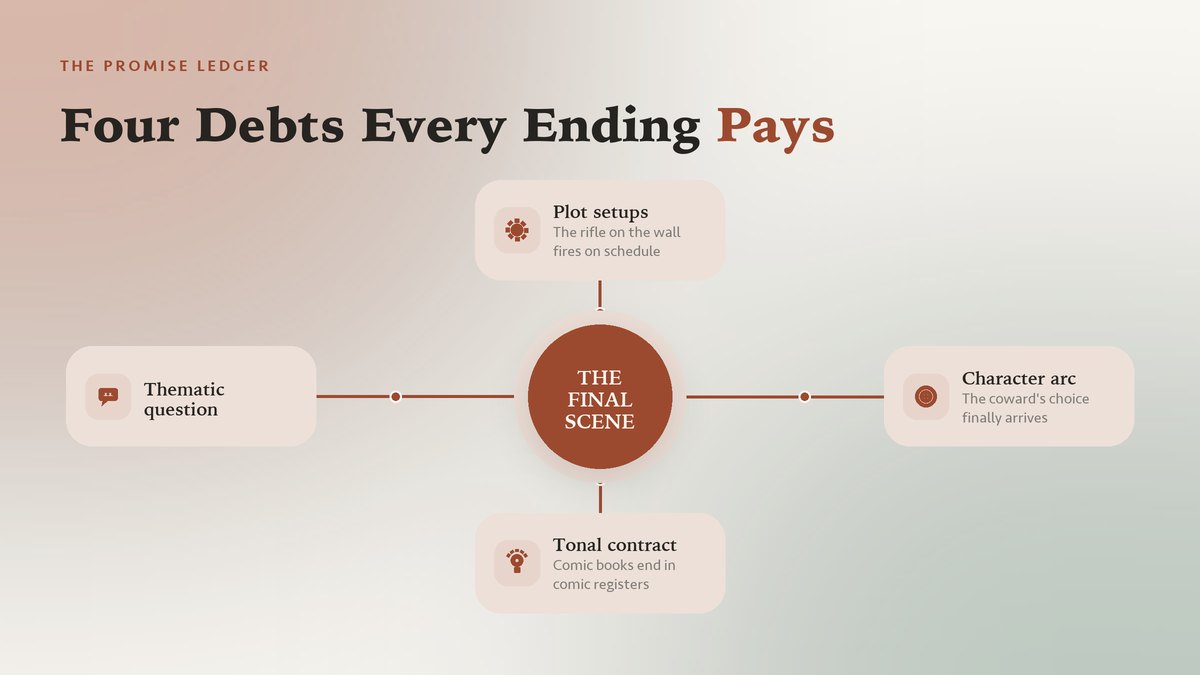
A practical way to think about everything an ending owes is as a stack of promises. A story promises things, some loudly and some in passing, and the ending pays them. The promise made in chapter two is a debt sitting on the ledger. Anton Chekhov’s famous advice to a young playwright — in an 1889 letter he asked why a rifle hung on the wall in act one was never fired, and in a follow-up to a fellow writer he suggested taking the hammer off the rifle when the shot isn’t needed — is the best-known version of the principle, and “Chekhov’s gun” has become shorthand for the whole idea, even though Chekhov himself phrased it slightly differently in different letters. The point was never that everything must explode; in one letter Chekhov suggested removing the rifle’s hammer when no shot was needed, because nothing on the page is free. Spend a paragraph on the locked attic and the attic is on the ledger, and the reader, who did not skim that paragraph no matter what you assumed, will arrive at the final page holding a copy of the ledger.
The ledger has more columns than plot mechanics, though, and this is where endings fail in ways the writer didn’t see coming. A story also promises a who: the arc, not the puzzle, is what readers carry out of a book like Anna Karenina. The coward who flinched in chapter one has raised a question about what he’ll do when it counts. It promises a how, too. A book that has been warm and comic has trained its reader to expect a resolution in that register, and a swerve into gothic tragedy will feel like a broken agreement even if every plot point clicks. And it promises a what it all meant, because a novel about forgiveness ends wrong if it ends in revenge, no matter how logical the revenge is to the machinery of the plot. Dickens wrote two endings for Great Expectations in 1861 and, at Bulwer-Lytton’s urging, swapped the bleak original for a softer meeting between Pip and Estella, because the promise of that book was never romance but Pip’s decency. The letter in which Chekhov recorded his advice to a young playwright frames it the same way: every element on stage exists to serve the whole rather than decorate it.
Make the Climax Grow Out of the Character
The single most reliable fix for a weak ending is moving the solution from the world into the protagonist. Ask what this particular person, with the exact flaws and partial growth they’ve accumulated, uniquely does in the final crisis. If any competent person off the street would do the same thing, the ending isn’t theirs yet, and that’s the test I’d apply before touching a word of the last chapter. Inevitable endings are character-shaped rather than plot-shaped, in Chekhov’s sense that every element serves the person at the center of the stage. The cowboy who talked his whole life walks into the gunfight talking. The planner with the color-coded notebooks, one notebook per subplot in the version I’d write, finally improvises, disastrously or gloriously, because the plan was the thing she had to lose. Your ending should be the fullest expression of who this person has become, which is why you can only write it once you know who that is.
This is also where “predictable” gets separated from “inevitable,” because the two are nothing alike, whatever anxious drafts suggest. A predictable ending can be predicted by anyone. The couple gets together, the detective names the murderer, the farm is saved: Agatha Christie built a fifty-five-year career, from The Mysterious Affair at Styles (1920) to Curtain (1975), on endings her readers could predict in kind but never in detail. An inevitable ending can be predicted only by someone who has understood the book, who these people are and what the story keeps asking of them. Readers rarely resent an ending they saw coming when it arrives wearing the story’s own logic. They resent the one that shows up wearing the author’s panic.
One more thing about the climax itself. It should cost something visible. Not necessarily a death, since cost can be a friendship, a version of the future, a self-image the character has been hiding behind for years; Steinbeck’s Of Mice and Men (1937) charges George the first two at once. But if the final crisis resolves without taking anything from anyone, the reader’s sense of stakes evaporates at the precise moment you need it most. The denouement, the old theatrical name for a story’s untying — Gustave Freytag drew the word into his five-part diagram of dramatic structure in 1863 — is held to the same standard in every craft reference on it. A good one does more than stop. It returns to the stakes raised at the start and answers them with what the middle earned.
The Resolution Dial: How Much to Answer
After the climax you still control one dial, and that dial is how completely to resolve. There’s no correct setting, but there is a correct match between your setting and your book. A tightly plotted mystery has promised airtight closure, so it had better deliver the solution, the motive, and the means, the three boxes Conan Doyle’s Holmes stories tick off in their final chapters every time. A literary novel about an inarticulate family may promise almost nothing except one last honest moment, and stapling closure onto it would break its own spell. The mismatch, rather than the setting, is what readers feel as a flaw.
| Setting | Best suited to | What you still owe |
|---|---|---|
| Closed | Mysteries, heists, romances, quest plots, anything built on a question with an answer | The answer, delivered on the page, plus a short beat showing what it changed |
| Bittersweet | Coming-of-age stories, family sagas, war narratives | The main question answered; one cost acknowledged rather than repaired |
| Open | Literary fiction, character studies, stories about ongoing lives rather than closed cases | A final image or action that carries the theme; ambiguity with a pulse, never a shrug |
The open ending deserves one warning, because it’s the most abused setting on the dial. “Open” does not mean “unwritten.” An open ending still lands on a final, concrete moment, a gesture, a sentence, a choice made or pointedly skipped, and that moment has to carry the book’s question inside it. Chekhov’s “The Bet” ends exactly this way: the lawyer walks out of his self-imposed confinement a few hours before the fifteen years are up, leaving a note that renounces the two million rubles he stayed silent to win. When readers complain about an open ending, what they’re usually complaining about is an empty one, where the story simply stopped and mistook interruption for art. If you want to watch masters calibrate this dial on short masterpieces you can read in a single evening, Project Gutenberg, with its tens of thousands of free public-domain ebooks, has the endings of Chekhov’s and Maupassant’s stories free and legal to study side by side. Read the last two pages of four or five of them in a row and the pattern of deliberate final images becomes impossible to unsee.
The Epilogue Question
If your ending works, someone will suggest an epilogue. Maybe you, maybe an early reader. Resist the reflex. An epilogue is a second ending stapled after the first, and it almost always moves in the wrong emotional direction, because endings release tension while epilogues re-inflate it with summary. When J.K. Rowling appended the “Nineteen Years Later” section to Harry Potter and the Deathly Hallows, jumping to the grown characters at King’s Cross platform watching their own children board the Hogwarts train, she gave readers the coda many of them had asked for since the series’ 2007 finale — and undid, for some of them, the exact ambiguity the final scene had earned. “Three years later, she opened the bookshop after all” can do the same to your last page. An epilogue steps outside the story’s timeframe to report on it, and reported events feel flatter than witnessed ones.
That said, epilogues have legitimate uses. A story spanning decades may need a coda to give the reader one last foothold in time. A tragedy may earn a brief widening of the lens, the way Shakespeare’s survivors get the stage to themselves at the end of the bloodbath. The test I’d apply, at least for my own drafts, is simple. Does the epilogue contain a scene, meaning a specific moment with somebody doing something, or does it contain a report? Scenes can justify themselves. Reports almost never do, and if the material is genuinely that good, it probably belonged in the final chapter proper.
My rough rule, and I hold it loosely: write the ending you want the reader to carry out the door, then stop, the way Hemingway’s The Sun Also Rises (1926) stops on “Isn’t it pretty to think so?” after two hundred pages of war, bulls and a friendship already broken. If you catch yourself adding an epilogue to patch a dissatisfaction with the ending, the dissatisfaction is the thing to fix.
The Last Page Is a Different Instrument
Whatever the dial setting, the final page does a job no other page does. It converts the whole book into something the reader now carries. Two craft moves matter more than everything else on it, and the first is the final image; ask ten writers to name a famous closing image and at least one of them will recite Gatsby’s green light. Endings that linger tend to end on something seen, heard, or held, an object or a gesture or a weather report, rather than on an explanation. Explanations close. Images resonate. This is why so many memorable novels end on a small physical action; it gives the reader’s imagination something to keep doing after the text stops. The boats beating on against the current, borne back ceaselessly into the past, that close F. Scott Fitzgerald’s 1925 The Great Gatsby are probably the most quoted final image in American fiction. Poets & Writers, which has published craft interviews with working novelists since 1987, keeps returning to the same instruction, phrased a hundred different ways across those decades. Stop explaining and let the last thing be a thing.
The second move is the last line itself. Read yours aloud, against the quiet of an actual room, then set it next to the first line of the book. There’s no requirement that they rhyme or mirror each other; the device is so well known by now that it can smell premeditated. But they should plainly belong to the same book, with the same cadence, the same level of honesty, the same distance between narrator and reader. An ending line that suddenly switches registers (“And so, dear reader…”) spends trust you’ve been saving all book.
Reverse-Outline Your Ending
When an ending isn’t working, I don’t rewrite it forward. I outline it backward. Take your final five or ten pages and build a skeleton of them, one line per beat: what happens, what information lands, what changes. Then, for each beat, walk the whole manuscript asking where the reader was actually prepared for it. Not where the information exists somewhere in the text, but where the reader received it, in a scene, attached to an emotion. A fact buried in a paragraph of description is technically on the page and functionally invisible, which is the same as not being there at all. A writing-center overview like Carnegie Mellon’s student writing resources is a useful reference for this kind of beat-mapping, especially if you come from essay writing and feel more at home with scaffolding than with novel-shaped intuition.
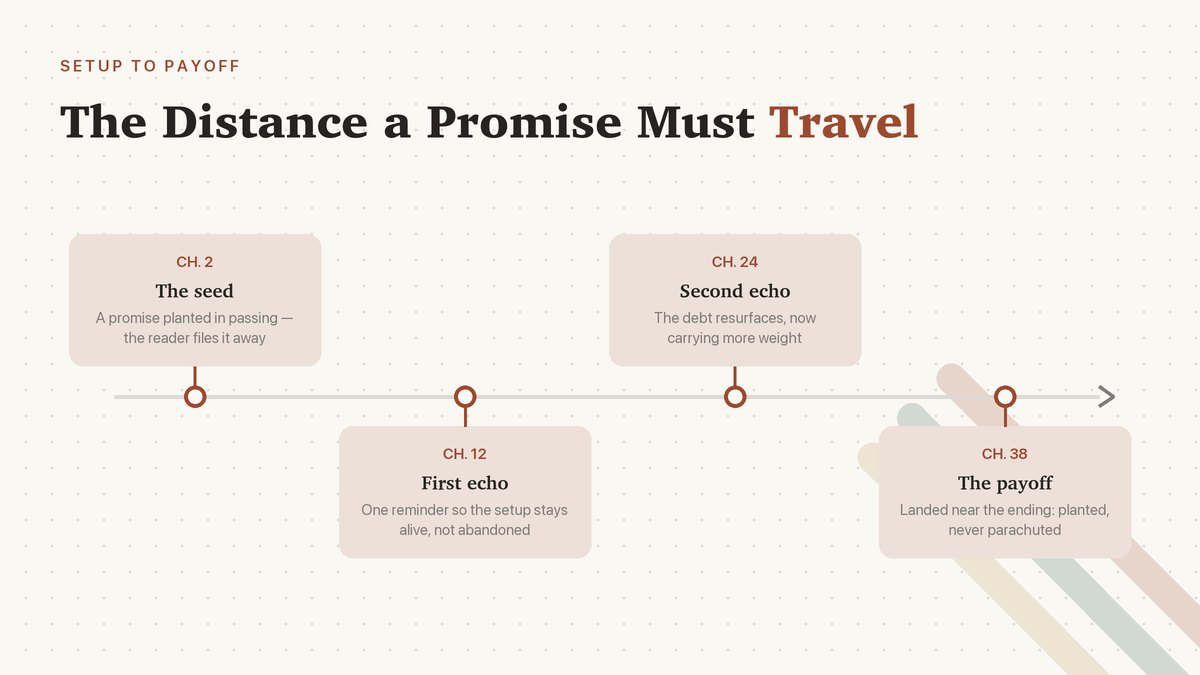
Compress the ending down to its bones and the whole arc finally becomes visible, because setup and payoff are really a distance problem. A reveal seeded fifty pages before the ending feels planted. The same reveal seeded five pages earlier feels rigged. Flip it around and a setup from chapter one that pays off in chapter thirty can feel abandoned for twenty-nine chapters straight unless it echoes a couple of times along the way. You don’t need a spreadsheet for any of this, or any special software either. A margin and a pencil will do.
What to Ask Your Test Readers
Beta readers will happily tell you whether they “liked” the ending, and that information is nearly worthless, because a liked ending and a working ending are different things. Ask questions that force evidence instead, starting with the four below. Verdicts can wait.
- “Where did you think the story was going at the halfway point?” If everyone guessed the actual ending by chapter ten, your setup is doing too much. If nobody came close, check whether you planted anything at all.
- “Did anything in the last chapter feel like it came from outside the book?” This is the coincidence-landing detector. Readers know exactly which moments felt imported, and they’ll point at them if you don’t make them justify the whole ending.
- “What do you think happens to these people in the week after the book ends?” An ending that works makes readers involuntarily extend the story. If they can’t imagine a single day past your last page, the characters stopped being alive at some point. Find where.
- “Which of the early setups did you expect to matter more?” Whatever they name is a ledger entry you either forgot to pay or forgot to cut.
One honest caution from experience: readers are excellent at reporting symptoms and terrible at prescribing cures. When a test reader tells you the ending “felt rushed,” they are almost always right about the feeling and almost always wrong about the cause. In my experience it’s rarely the pace of the final chapter; more often it’s a payoff that arrived without its echo, two hundred pages earlier. Treat every reader note as a location to investigate rather than a surgery to perform.
None of this makes endings easy. They’re the one part of the book where every promise you’ve made, on every level from plot to tone, comes due at once, and the bill always arrives before you’re ready. But the standard is simpler than the craft: one ending, this story’s ending, every promise accounted for. Write the only ending this particular story could have had, pay what you promised, and get off the stage while the image is still glowing. If a reader closes the book and immediately wants to argue that the ending was obvious from page one, take the compliment. Obvious at the end, invisible on the way in. The books that manage it don’t feel constructed when you reread them; they feel like they were always going to happen, which is the most carefully constructed feeling in all of fiction. Nobody hands it to you. You earn it one kept promise at a time, all the way down the ledger.
Sources and further reading: Chekhov’s letters collected on Wikiquote, the denouement reference linked above, Project Gutenberg’s public-domain story collections, and Carnegie Mellon’s student writing resources, all of them cited in the text. Internal reading on this site: our guide to fixing a saggy middle, and our piece on outlining a novel without killing the surprise.