Poetry is the only art form people apologize for not understanding. Nobody feels guilty for failing to get a song on the first listen, yet a dense poem can make a grown adult confess that they were never good at this. This guide dismantles that shame and replaces it with a working method.
My own breaking point came with a supposedly accessible poem in a magazine, twenty lines, every word familiar, the whole of it opaque. I read it four times and understood less on each pass, which felt like proof of a personal defect. The defect was in the method, not in me, because I had been trained to read poetry the way you read a legal form: extract the information, check the box, get on with your day, and a poem answers that treatment with twenty lines of nothing.
That method fails almost every time, and the reason is structural rather than mystical. A contract hides information and rewards extraction; a poem stages an experience, and experiences don’t compress into bullet points without losing the part you came for. Prose walks you down a corridor toward a conclusion. A poem sets you down in weather.
Poems have machinery you can learn to watch, and what follows is the sequence I’d hand anyone who flinches at the genre, in roughly the order your senses wake up. The equipment list is short: about twenty quiet minutes and permission to stay confused in the productive way, not a literature degree and not a dictionary the size of a brick.
In this article
Start With Your Ear, Not Your Dictionary
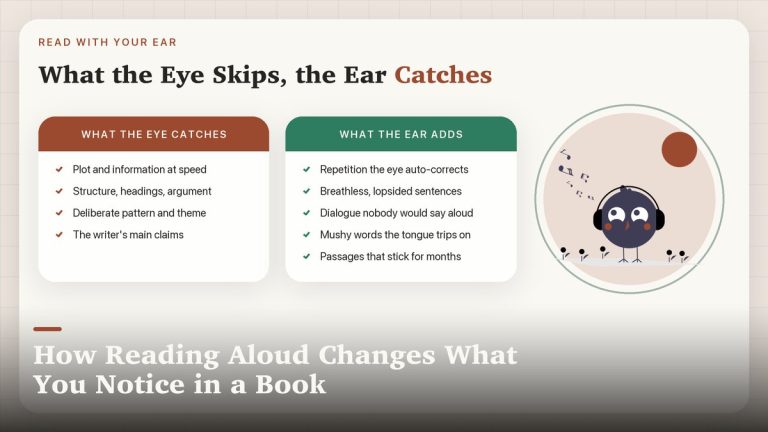
The fastest way to make a poem legible is to stop looking at it. Sound carries an enormous share of what a poem is doing (rhythm, emphasis, hesitation, the drop of voice at the end of a line), and your eye, trained on years of prose, bulldozes through all of that hunting for the sentence’s end so it can extract the meaning. Reading out loud forces the pace down to speech speed, somewhere around 150 words a minute for most readers, which is slow enough for the poem’s actual contours to become audible.
The Poetry Archive, a free online library launched in 2005 by the British poet laureate Andrew Motion, holds hundreds of recordings of poets reading their own work, and hearing Seamus Heaney, who won the Nobel Prize in 1995, or Gwendolyn Brooks, the first Black writer to win a Pulitzer, deliver their own lines re-tunes your ear within minutes. The Poetry Out Loud program, a recitation contest the National Endowment for the Arts has run with the Poetry Foundation since 2005, has involved well over four million students across the country, and its site keeps recordings plus performance guides built for exactly this kind of listening. Start with one recording there, the Heaney and Brooks readings being the obvious first stops, before you wrestle a poem on the page, because the page version is a score, and scores make more sense once you’ve heard the music played.
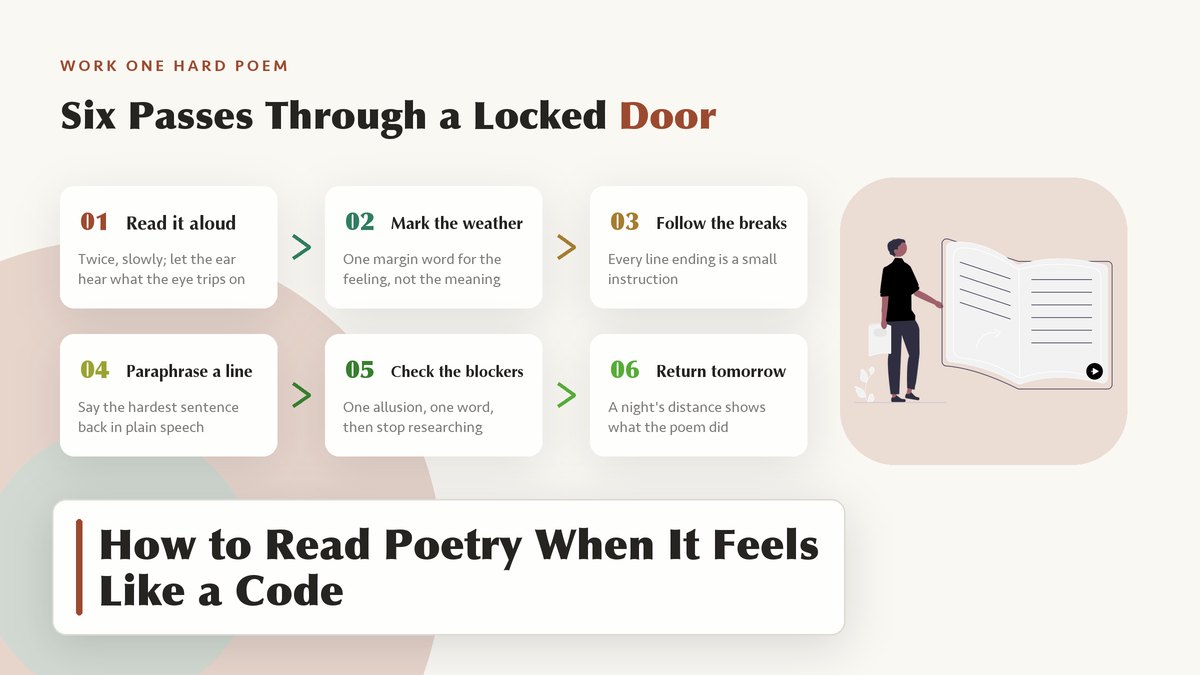
Then say the poem aloud twice, at conversational pace; the eight-line Dickinson further down takes under thirty seconds per pass. The first time, read for sound only and don’t stop to figure anything out. The second time, mark where your voice wants to slow, where it drops, where a line physically refuses to end; those hesitations are the poem’s punctuation working at a level prose never touches, and noticing them costs nothing but patience.
A poem on the page is sheet music; read it only with your eyes and you’re studying the score without hearing the piece.
The Line Break Is the Instruction
The mechanical heart of the whole business is the line break. Prose wraps at the margin and nobody cares, but a poem’s lines end where they end on purpose, which makes the break the most information-dense mark on the page. When a sentence spills past the end of a line and finishes on the next one (the pros call it enjambment, and the Academy’s own guide to reading a poem is the friendliest place to meet the terms), the break itself is doing something: it suspends the thought at a chosen point, or pivots it, and sometimes it sets up an expectation the next line flatly refuses.
A paraphrase test works on almost any stubborn poem, and the mechanism behind it is simple. Take one line, any line, and say it back in plain speech, the way you’d explain it to a smart friend on a bus; the break tells you where the poet wants your attention to stall even when the sentence would rather keep moving. If you can paraphrase even a third of the lines this way, the poem’s argument usually starts assembling itself, because you’ve stopped treating each sentence as a riddle and started treating it as a person making a point with strange emphasis.
For a toy version, take the flat sentence “I went to the store for milk and came home with a dog,” which is a logistics update and reads exactly like one. Now break it: “I went to the store / for milk and came home / with a dog.” Each line stops on something small, the eye drops to the next line hunting for the rest, and the dog arrives with far more commotion than the plain words justify. Nothing in the sentence changed; only the stall points did, and a reader’s attention pools in those stalls. Poets place them with more care than they spend on almost any other decision in the poem, so treat every break as deliberate until the text proves otherwise.
Poets.org, the site of the Academy of American Poets, keeps a big glossary of poetic terms for the moments when you really need a definition, and it doubles as a map of what there is to notice. One warning, from experience: look up a term the first time it matters to a poem sitting in front of you, not before. Reading about the villanelle in the abstract (nineteen lines, five tercets and a closing quatrain, two end-words repeating on a fixed schedule) is like reading about swimming on dry land. The knowledge does nothing until the water is at your chest. (The word enjambment comes from a French verb meaning to stride over, by the way, which is exactly what the sentence does to the line.)
Three Passes, Three Different Jobs
One pass through a poem is almost never enough, and ten identical passes aren’t any better. What works is giving each reading a different assignment, which is the most practical change I’ve made to my own reading and the one people resist most, since it feels wasteful to read the same page three times. It isn’t wasteful: each pass is cheaper than the last, and the third takes about ninety seconds.
- First pass, the weather report. Read it aloud at conversational pace, the Dickinson stanza above in under thirty seconds, with no notes and no analysis, and at the end write one word in the margin about how the poem left you feeling, maybe dread, maybe ease, maybe static you can’t source. That word does real work later; it becomes your anchor for everything after.
- Second, the machinery. Read slowly and watch the parts move: count where the lines break, note which images repeat or mutate, and mark where the poem turns, since most good ones pivot somewhere past the middle, the way an essay does.
- Third, the argument. Read it once more and say back, in a single plain sentence of ten words or fewer per stanza, what the poem is doing (accusing, remembering, bargaining, refusing to mourn) rather than what it means.
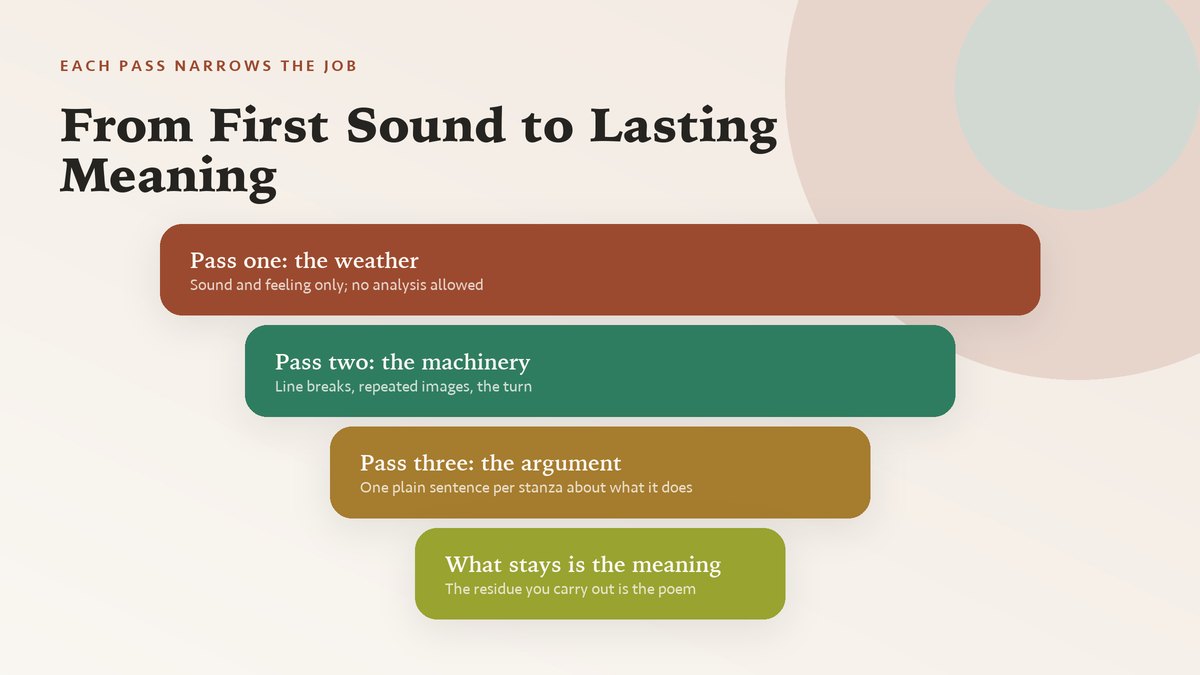
Each pass relaxes a different anxiety, which is why the method beats “read until you get it.” Pass one grants you the right to not understand yet, pass two hands you observable facts so the confusion stops being formless, and by pass three most of the fog has burned off on its own. The order surprises people, though it shouldn’t, since you can’t watch the machinery of a poem you haven’t first let yourself hear.
Try It: One Poem, Three Passes
The method only proves itself on a real poem, so here it is end to end, on one short enough to quote whole. Emily Dickinson’s “I’m Nobody! Who are you?” runs eight lines in two stanzas, was published in 1891 four years after her death, sits firmly in the public domain, and behaves politely under all three passes, which is partly why anthologies lean on it so hard. The first stanza:
“I’m nobody! Who are you?
Are you nobody, too?
Then there’s a pair of us — don’t tell!
They’d banish us, you know.”
Pass one: read it aloud and do nothing else. The voice that comes out is conspiratorial, half a giggle, and the exclamation points are doing most of that work before you understand a thing. Write one margin word (mine was “giggling”) and notice how much it tells you about the poem’s register before you’ve grasped a single line of its argument.
For the second pass, watch the machinery move. The break after “Who are you?” hangs a real question in the air for a full line, and the next line answers it, which is enjambment working as suspense instead of decoration. Dickinson capitalizes Nobody and Somebody the way you’d capitalize two countries, and that one typographical habit turns a common noun into a place you can live or get exiled from, while the dashes stall the voice at chosen spots, same job as always. Then stanza two pivots hard, from finding a friend to mocking the alternative, and it pivots just past the middle, right where the three-pass model predicts a turn.
Pass three, one plain sentence per stanza. Stanza one: the speaker finds another outsider and swears them to secrecy like two kids under a blanket. Stanza two: she mocks the public self-promoter, the one telling his name “the livelong day / to an admiring bog,” because a bog can’t admire anything back, it can only absorb. Two sentences, maybe forty words of your own, and the poem’s position is now something you could argue with, agree with, or quote at a dinner party. Total elapsed time runs about twenty minutes, plus whatever a detour into Dickinson’s dashes costs you, and the distance traveled is from “fine, a poem about nobody” to an actual claim about privacy and self-advertising.
Meaning Is What’s Left When You Stop Digging
Somewhere in school, most of us absorbed the idea that a poem is a vault with one correct combination, and that smart people spin the dial until it clicks. Critics have been arguing about what poems mean for as long as poems have existed. The Poetry Society, founded in London in 1909 and still publishing its journal The Poetry Review, remains busy with the reading, publishing, and arguing (see poetrysociety.org), and more than a century of unresolved argument is a strong hint that the arguing is the point of the form rather than a failure of it.
A more useful model treats meaning as residue. It doesn’t sit inside the text waiting to be extracted; it forms between the text and you, after contact. Two honest readers can leave the same sonnet with overlapping but different readings, and neither is wrong the way a wrong arithmetic answer is wrong. When a poem won’t solve, the productive question shifts from what does it mean to what did it do to me, and where in the language did that happen.
| Prose habit | Why it backfires on a poem | Do this instead |
|---|---|---|
| Hunting for the thesis sentence | Poems rarely state; they enact. The stating is often the least important line | Ask what the poem is doing, not what it claims |
| Underlining “important” lines | Every line carries weight. Pull four out and the rest looks like filler | Track patterns: what repeats, what turns, what breaks |
| Reaching for the dictionary immediately | Context usually glosses the word, and the pause kills the sound you were building | Circle it, read on, look it up after pass one |
| Quitting when confused | Confusion is often the intended register. Grief and mystery feel identical at first | Stay for one more pass before you shelve it |
The table doesn’t promise confusion is fun, because it often isn’t. Sometimes a poem is beyond where you are right now, and no method fixes that today. The payoff is that quitting stops feeling like failure once you can tell “this is doing something I can’t name yet” apart from “this poem and I are done with each other.”
Six Shapes You’ll Meet Before the Year Is Out
A lot of the “code” feeling is really a shapes problem. Novels come in one shape, and poems come in dozens, each carrying different expectations. Learn to recognize six of them at a glance (the sonnet with its fourteen lines, the seventeen-syllable haiku, the villanelle among them) and whole categories of confusion stop forming, because the form starts doing part of the reading for you.
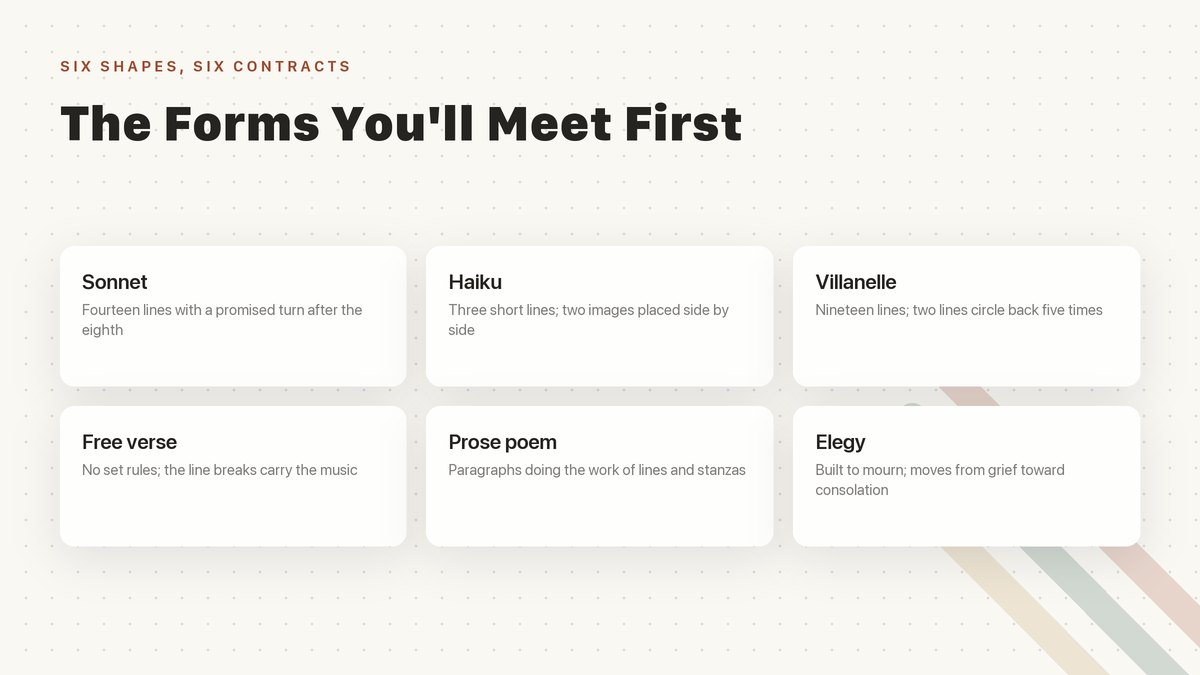
You don’t need to memorize meter or count stresses. Scansion, the business of marking stressed and unstressed syllables, is a real skill, and it’s optional for pleasure reading, though it turns fun once it clicks. Start with the shapes in the grid, since they cover most of what you’ll meet in magazines, anthologies, and poem-a-day emails. The Academy’s Poem-a-Day has dropped one poem into subscribers’ inboxes each morning since 2006 with a short note from a poet, which is the lowest-pressure way I know to build shape recognition: delete the ones that don’t land, live with the ones that do.
Keep a Doorstop Poet for a Season
Stop sampling poets one poem at a time; the fix is one poet with fifty or more poems in print (Whitman, Dickinson, Brooks, Hafez in translation, whoever tugs first) and a season spent living inside that book. That’s my favorite piece of advice on this whole page, and almost nobody follows it, because sampling is what curious readers do.
The reason it works is mechanical: one poet’s obsessions repeat, their images rhyme with each other across books, and somewhere around poem thirty you feel a poem of theirs turning before it does, which is a fluency no sampler develops. Project Gutenberg has free digital editions of nearly every poet old enough to be public domain, including Walt Whitman’s complete work, so the experiment costs an evening of browsing. Dickinson’s dashes and capitalization read strange for about two weeks, so give them time. Then one day they don’t, and that flip is when you realize the fluency was always available.
Hear some bad poems on purpose, too, because nothing trains your ear faster than a line falling flat in real time. Every collected edition has them; even the greats wrote filler, and the weak poems are a free training ground the sampler never uses. Sit with one weak poem from that collected edition and ask where it loses you (usually it’s a vague image or a borrowed emotion that never got specific), and the answer teaches more than the masterpieces do, because a flaw is easier to name than a virtue, and naming things is how the ear learns.
When the Poem Still Won’t Open
Some poems resist every pass, and the sensible move is a checklist of last resorts rather than a fourth identical reading. Read it once more aloud at half your normal speed, a pace that makes a twenty-line poem take about a minute, which sounds pointless and works more often than it has any right to. Check whether the title is doing hidden labor, since poets sometimes hide the answer in plain sight at the top. If one specific image blocks you (a myth, a borrowed line, a historical moment), look up only that one thing and then stop, because researching a poem to death is its own failure mode, and I’ve watched myself turn ten minutes of reading into ninety minutes of Wikipedia.
Stopping is the discipline, and it took me years to learn it. Say a poem keeps pointing at one figure you half-remember from school, a Celtic hero, a Roman goddess, whatever it is. Read the two paragraphs on Wikipedia that matter about that figure and close the tab before the related articles open their mouths. I used to research poems the way some people alphabetize spice racks, thoroughly and to no end, and one lookup followed by a return to the page is the rule.
And give yourself permission to shelve the thing. A poem that won’t open today may click in five years, once some life has happened to you that the poem was apparently waiting for; I say that as someone who used to treat shelving as surrender. On a genuinely cold poem, give it the two minutes the third pass takes, or walk away. Some poems stay shut for years, and that’s a delay rather than a verdict on you.
Further reading and sources. The Poetry Archive for recordings, the Academy’s own how-to-read guide and its glossary for terms, and the Poetry Society for a century of the argument itself. Related reads on this site: why rereading changes what a text gives you, how to annotate without ruining the page, and taking notes on fiction without killing the story. External links were checked at publication; if one has moved, the resource is usually searchable by name.