There’s a particular kind of regret that shows up about three chapters after you decided to underline “just the good parts.” The pen never stays still, the page fills up, and somewhere in all that ink the story has slipped out the back door. This is a method for keeping what fiction teaches you while still letting it do the one thing it’s built to do.
I used to take notes on novels the way I took notes in college, and I took notes in college badly. Highlighter in hand, I’d mark whatever seemed important, and by page eighty the book looked like a traffic accident while I’d long since stopped caring who did it. The notes were copious; the reading was dead.
Fiction fights back against that kind of attention, and it usually wins. A novel is not a textbook wearing a costume. Textbooks are built to be reduced, and the reduction loses almost nothing; a novel stripped the same way comes out as a joke. Middlemarch reduces to “a young woman marries the wrong scholar,” which is technically accurate and contains every reason not to open the book in the first place.
So the job changes. Notes on fiction aren’t a compressed copy of the text. They’re a record of your collision with it. The whole system I use now runs on one rule of thumb, earned by ruining good books with good intentions: the note should never take longer to write than the moment took to read. Pause five minutes to capture a two-second shiver and you’ve stopped reading, you’re transcribing.
Your urge to mark the page isn’t some study habit leaking into pleasure, either. Readers have scribbled in novels for centuries, and the evidence sits all over the historical record. The Library of Congress holds countless volumes dense with other people’s marginalia, and Book Traces at the University of Virginia has built an entire research program out of ordinary readers’ penciled reactions in old library copies. One of the oldest reading habits there is, and you’ve probably felt guilty about it.
In this article
Why note fiction at all
Fair challenge. Plenty of fine readers never write a word in a novel and remember plenty, and I don’t note every book either. The case for doing it rests on one uncomfortable fact about memory: we’re excellent at remembering that we loved a book and nearly useless at remembering why. Ask me about a novel I read four years ago and I’ll give you the weather of it, the mood, maybe one scene, but the sentences that rearranged me at the time are gone, and most of what the book had to teach went with them.
Because fiction does teach, just from an angle rather than head-on. It shows you what a completed arc feels like, what an honest sentence sounds like, how a writer smuggles exposition past your guard. That’s the material worth keeping, and perversely it’s the material that evaporates first. Plot you can always look up. Craft moves you can’t, since they’re buried in the texture of one particular page.
There’s a second payoff, quieter than the first. Writing one sentence about why a passage worked forces you to name the trick, and naming it is most of the way to stealing it. This is how writers read, which is why so many working novelists annotate as they go, and you don’t need a manuscript of your own to borrow the habit. A pencil is a lot cheaper than an MFA.
One honest caveat before the method. None of this works if you do it on every page. Notes on fiction are seasoning, not the meal, and everything below is built around restraint.
Pick a tier before you start
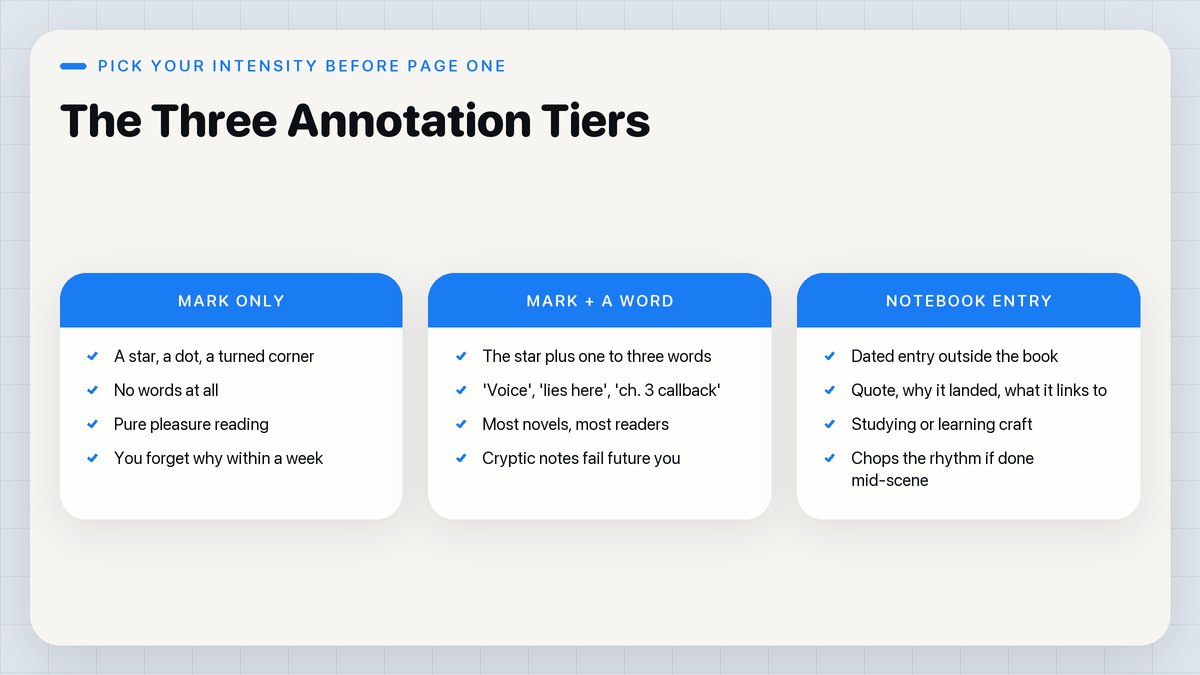
The biggest failure mode in annotation is tier drift. You begin with modest intentions, a small mark here and there, and by the second act you’re writing paragraph-long responses in the margin as if the book had accused you of something. Pick your intensity before page one, and know what each level costs and buys.
| Tier | What you actually write | Best for | The risk |
|---|---|---|---|
| Mark only | A star, a dot, a turned corner. No words. | Pure pleasure reading. | You forget why within a week. |
| Mark + a word | The star plus one to three words: “voice,” “lies here,” “ch. 3 callback.” | Most novels, most readers. My default. | The word has to make sense later; cryptic fails future you. |
| Notebook entry | A dated entry outside the book: quote, why it landed. | Books you’re studying or learning craft from. | Chops the rhythm mid-scene. |
That table flattens things on purpose, because in practice I drift between the middle and bottom tiers inside a single book, and you will too. What matters is where the default sits. When in doubt, mark it and move on. You can always go back, and a reread with a pencil happens to be one of the great cheap pleasures in reading.
A note on fiction is a bookmark for a feeling, not a summary of a page.
A margin code you can write with one hand
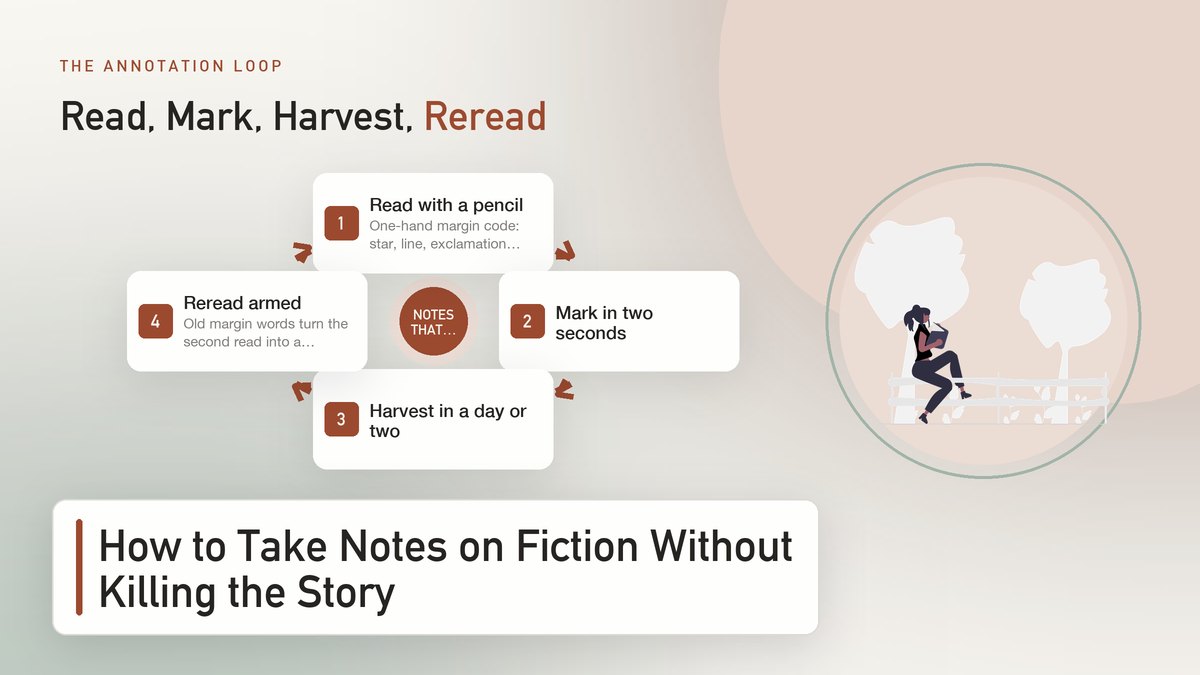
Take this part if you take nothing else. Build a tiny set of margin symbols and use them the same way, book after book. Mine has four, which is roughly two more than I need. A star means a sentence I wish I’d written. A vertical line marks a passage doing structural work. An exclamation point means real surprise, and it stays meaningful precisely because it’s rare, while a question mark flags something that rang false. Any of them can be drawn without looking away from the line I’m on.
The one-hand requirement matters more than the symbols do. Anything that pulls your eyes off the text for more than a second is an exit ramp, and story is a fragile vehicle that won’t wait while you fiddle. This is why I’d steer you away from sticky tabs for fiction in particular. Tabs are superb for research reading, but fishing one out of the back cover, peeling it, pressing it down straight is a five-second production, and five seconds sounds trivial until you count how many “important” moments a good novel runs per chapter. Forty interruptions a chapter breaks the reading in half. Two or three don’t.
Do write in pencil, though. Ink is a commitment and pencil is a conversation; I’ve softened on passages I once slashed through and been glad the evidence erased. And since I used to treat paperbacks like public documents, let me say this plainly: it’s fine to write in your own books. The never-mar-a-page instinct is mostly resale value plus some inherited reverence, and readers have marked their books for as long as books have existed. The Folger Shakespeare Library’s reading guides make the point gently that interacting with the text, even physically, is part of how Shakespeare has always been read, in classrooms and theaters alike.
A confession about vocabulary, while I’m at it. For years my margins said “important!”, which is the least useful note a person can leave, since present-me has no idea what past-me meant by it. Important how? Pretty sentence, or the butler just lied? Three words of margin is a tight budget, and specific always beats general on that budget. I also went through a phase of underlining in pen because pencil felt less serious; the ink bled through onto the facing page of a secondhand paperback, and I can still see the ghost of it. Buy the pencil.
When to stop and when to keep reading
Timing is the hardest skill in all of this, and no system can fully automate it for you. Mid-chapter, mid-scene, sometimes mid-sentence, the book reaches out and grabs you. A line lands. A character does the unforgivable thing. You know the feeling. Stop every time and you’ll read forty pages a day while it feels like a job; never stop and you’ll finish every book inside a pleasant fog with nothing to show for it.
My working rule, refined across maybe a hundred annotated novels, is to sort each interruption on the spot, and the sort is into hot and cold. A hot reaction lives in the chest and tends to be about character: the betrayal, the mercy, the reveal. A cold reaction is technical, almost intellectual, and tends to be about craft. The narrator slid closer or further away. The chapter broke exactly where a lesser writer would have pushed on. Cold reactions keep. They’re the ones that evaporate fastest, the ones you can’t rebuild from memory, the entire reason you’re noting anything in the first place. Hot reactions can almost always wait, because the feeling stays findable until the end of the chapter. If it doesn’t, it wasn’t that hot.
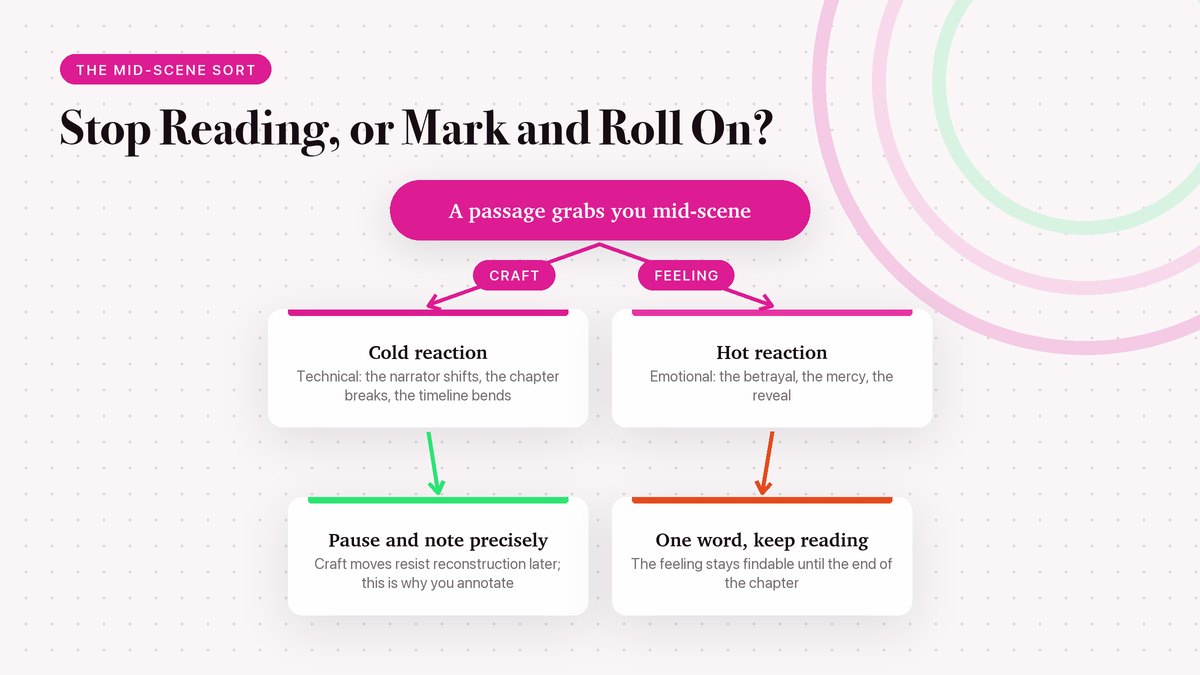
None of this gets executed perfectly. On a good reading night I follow my own flowchart maybe seventy percent of the time, and the rest of the time I either over-note a gorgeous chapter or let some technical gem slide past unmarked. Both are recoverable. The flowchart’s real job is to hold the default at “keep reading,” since the default, not the exception, is what actually runs your evening.
What a good fiction note actually contains
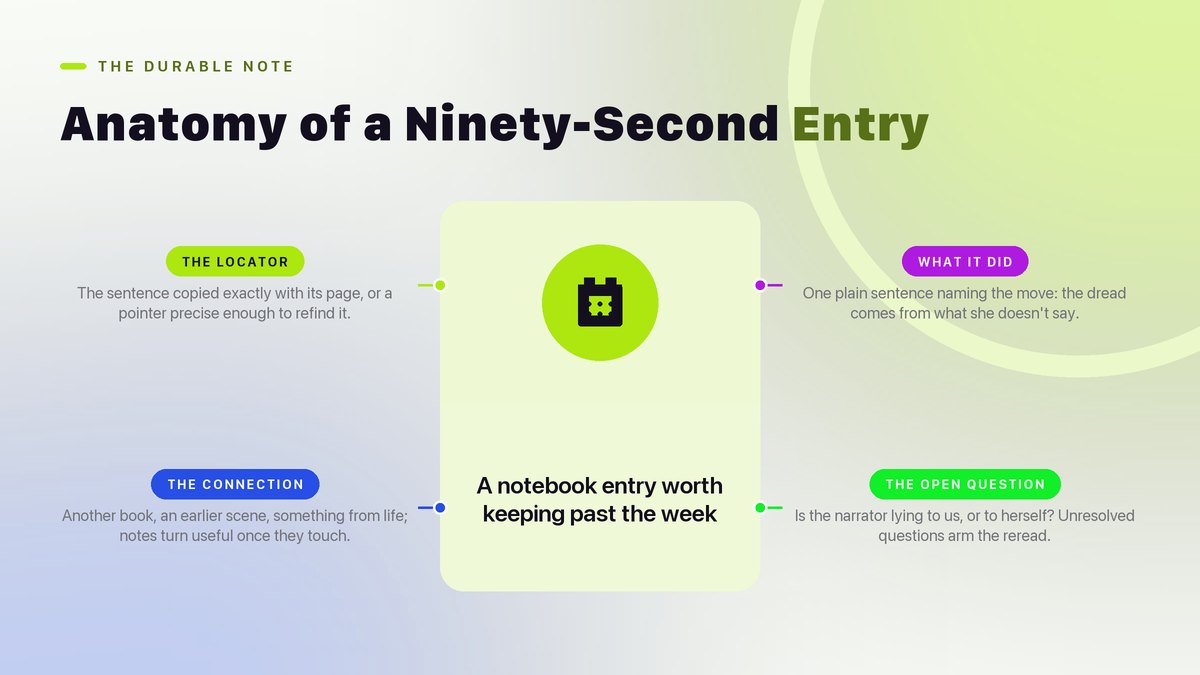
When you do sit down to the fuller, notebook-style entry, four small parts do all the work. This is the anatomy I’ve fallen back on through detective novels, doorstop literary fiction, and one ill-advised week of annotated space opera:
- The locator. Copy the sentence exactly with its page number, or write a pointer precise enough to refind it (“p. 142, the laundromat scene”). Vague pointers like “somewhere in chapter 6” burn you later.
- What it did. One plain sentence. “The dread comes from what she doesn’t say.” You’re naming the move, which is the whole point.
- The connection. Another book, an earlier scene in this one, something from life. Fiction notes turn useful the moment they start touching each other.
- Leave it open. A question, even a small one: “Is the narrator lying here, or lying to herself?” A reread armed with your old questions becomes a different book.
That’s the whole entry, about ninety seconds start to finish. Ten minutes means you’re drafting a book review, a fine activity on its own terms, just a different one. My early notebook is full of miniature essays where one sentence would have done, so I know the failure from the inside.
Notice what’s absent from that anatomy. No star rating, no verdict, no would-recommend, because fiction notes are for you and you already know whether the book landed. What you won’t remember in March is the machinery underneath the landing.
The ten-minute harvest, within a day or two
Almost nobody does this next step, and it’s what separates a note-taking system from a graveyard of margin marks. Within a day or two of finishing, sit down with the book for ten minutes and flip through every mark you made. Most of them, and I mean most, will look inert now. The star that felt urgent on page 90 earns a shrug on revisit. Cross those out without mercy; their work is done, and their work was keeping you alert while you read.
The survivors, perhaps a fifth of them on a good book, get promoted. If you keep a commonplace book, they move in now, and if the tradition is new to you we’ve written about the commonplace book system separately. Digital notes work the same way, and the medium is beside the point. What matters is speed more than elegance, and that’s because the half-life of “why did I star this?” is brutally short. Two or three days, for me. Wait a week and your margin marks might as well belong to a stranger.
I resisted the harvest for years on the grounds that it was homework stapled to a pleasure. Then I tried it once and found the ten minutes fun in a closing-the-loop way. You take one more lap around a book you just loved, and you come out the other side with eight or ten entries that still mean something instead of a hundred cryptic stars. I’ll take that trade every time.
The second read is where notes pay rent
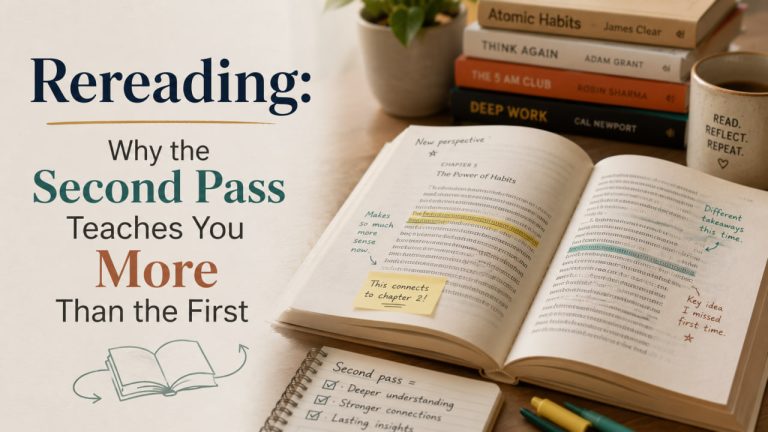
Everything so far assumes a single pass, which is most reading. The method earns its rent most visibly on a reread, though, and the interesting discovery was what your notes do to the second reading itself. Reread cold and you mostly re-enjoy the book, with maybe a flicker of dread at the foreshadowing you now see. Reread carrying your own margin code and notebook entries, and you’re in conversation with your past self. Where you wrote “voice,” you now hear the specific filter on the narration. Where you wrote “lies here,” you catch the lie mid-sentence instead of pages later.
If you’ve never done it, pick a beloved paperback and reread it once with your own notes in hand. It’s the closest thing reading has to a cheat code, and it costs nothing but a second trip through a book you already like. The Folger Shakespeare Library treats repeated, annotated encounters with the same text as the ordinary way to read a great writer rather than the obsessive one, and that squares with my experience exactly.
For pure beach reads you’ll never reopen, honestly, don’t bother with any of this, and I’ll say that as the person selling the method. Tier one, a few stars, one quick harvest. Save the full apparatus for the books that ask something of you.
If you read on a screen
Kindles and reading apps make marking effortless, which is exactly the problem. Highlighting on a touchscreen carries so little friction that you can rack up three hundred highlights in a long novel without once deciding anything was worth keeping. Nobody chose. Digital reading deletes the cost of a note, and the cost turns out to have been doing the quality control. So on a screen, reimpose the tax. One highlight per chapter, two if the book is truly extraordinary, and let the constraint force the choice a paper margin used to force for free.
The harvest translates, at least. E-readers export your highlights as a file, which means you can dump the whole pile into your notes app after the last page and purge it the same way you’d flip the margins. From three hundred raw highlights, keep the eight that still mean something two days on, and write your four-part entry for those. If you want a free pile of classics to practice the whole system on, Project Gutenberg has tens of thousands of public-domain novels whose copyrights expired generations back, so you may quote them in a notebook as freely as you like.
One caution applies everywhere and bites hardest on screens, where copying costs nothing. Keep quoted passages short, fair use notwithstanding. The U.S. Copyright Office publishes plain-language guidance on fair use, and a private notebook sits comfortably inside normal practice. But a note serves you best when it forces the choice of one sentence anyway, since pasting in a whole paragraph is usually a dodge from the harder work of writing the single sentence about why it mattered. And if part of your reason for annotating is to write better yourself, the UNC Writing Center’s advice on using quotations applies more than you’d expect. Quote because you have something to say about the line.
None of this should turn your reading into paperwork, and the test I run on any note habit is simple. Does the book still find me at 11:40 p.m., one chapter past my intentions? If yes, the system works. When the notes start eating the reading, the notes are what’s wrong, and the repair is always the same: less. Fewer marks, fewer words, lower tier. The story outranks the notebook, every single time. That, if anything in this article deserves ink, is the sentence to underline.
Related reads on this site: The Commonplace Book: A 400-Year-Old System for Keeping What You Learn · Rereading · How to Annotate a Book Without Feeling Like You’re Ruining It. External sources checked November 2026: Library of Congress, Book Traces (University of Virginia), Folger Shakespeare Library, Project Gutenberg, U.S. Copyright Office, UNC Writing Center.