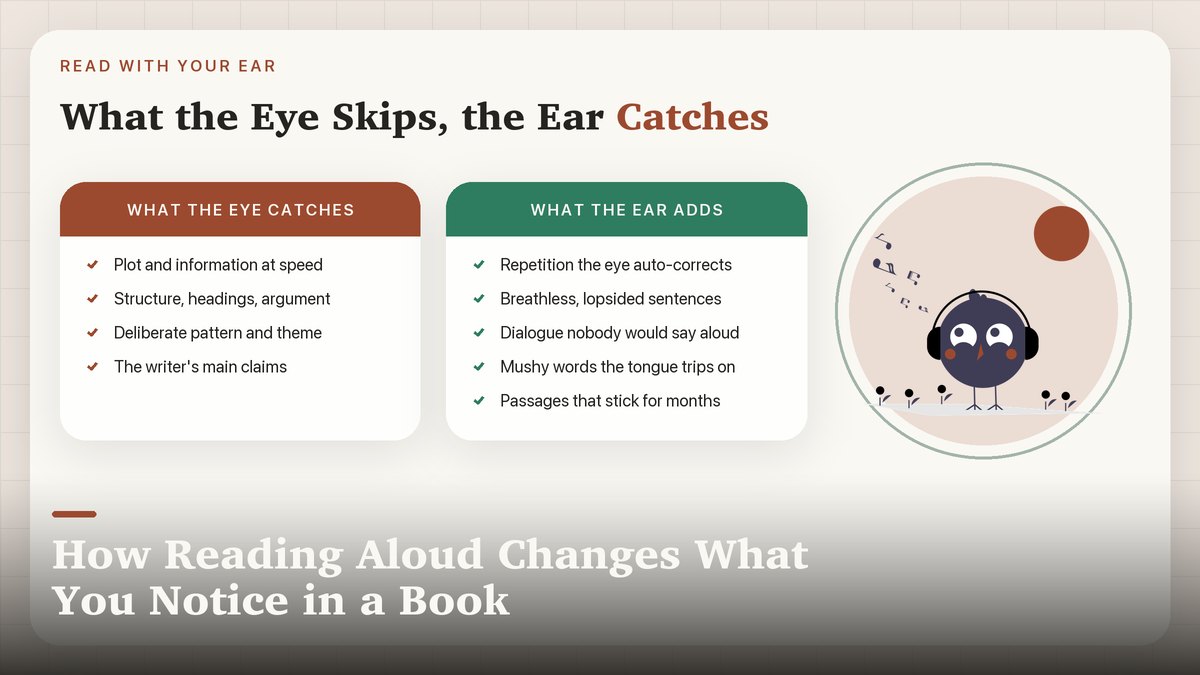
Silent reading runs somewhere around 250 to 300 words a minute, and that speed is exactly what costs you. At that pace the eye skims, auto-corrects, and fills gaps, while the ear has no such tricks available to it. Speaking a page out loud drags your attention down to speech speed, roughly 130 to 150 words a minute, and what it surfaces are the things the eye trained itself to skip years ago.
Most of us haven’t read a book aloud since someone last read to us, and for a lot of adults that was childhood, decades ago. Reading became something the eyes do, privately, at speed, and the voice atrophied the way any unused instrument does. I’d like to make a case for a small, slightly awkward habit: keep a pencil near the reading chair, and every so often, speak a page — about three hundred words, a single printed page — in a normal voice, the way you’d read a recipe to someone across the kitchen.
The gap between those two speeds is where everything interesting hides. The average adult reads silently at somewhere around 250 to 300 words a minute but speaks at maybe 130 to 150, and speaking slows you down whether you want it to or not. You stop scanning and start hearing, and the ear starts catching a whole class of things the eye learned to ignore years ago, back when reading was a chore to finish rather than an experience to have.
None of this needs a good voice, or privacy, or any equipment beyond the book itself. A closed door and ten honest minutes are enough. What follows is what actually changes when a page has to pass through your mouth, and how to build the habit without it turning into one more chore you abandon by February.
In this article
- What the Ear Catches That the Eye Skips
- The Oldest Memory Trick There Is
- How to Read a Page Aloud, Alone
- Your Own Drafts Deserve the Same Treatment
- Learn From People Who Already Read Well
- What About Just Listening to Audiobooks?
- The Cases Where Reading Aloud Won’t Help Much
- One Step Further: Reading to Someone
What the Ear Catches That the Eye Skips
Four things, roughly in the order you’ll notice them
Three “suddenly”s in two pages is what repetition sounds like, and the ear is ruthless about it. Writers repeat words on purpose; a deliberate echo can tie a chapter together the way a refrain ties a song. They also repeat words by accident, the same adjective leaning on every noun, and your eye reads right past this while the ear flags it almost immediately, because saying a word for the third time feels strange in a way that seeing it doesn’t. Your eye probably skimmed over a doubled word in something you read last week. Your tongue would not have let it through.
Second, rhythm — the poets even have a technical word for the grammar of it, lineation, the interplay of breath, grammar, and where the line breaks. Every sentence has a shape in the mouth, a pattern of stresses and pauses, and some sentences are shaped badly enough that the breath runs out before the grammar does. A clause that looked fine on the page will leave you gasping halfway through, or force a stop in the wrong place, which is why writers have sworn by reading aloud for centuries. Dickens built a whole second career out of performing his own prose to packed halls; his 1867–68 reading tour of America sold out theaters from Boston to New York. If a sentence can’t be said in one comfortable breath, the sentence has the problem, not you.
Typos, homophone slips, a character’s name that changes spelling by chapter nine — the tongue catches what the eye forgives. Silent reading auto-corrects all three, because the eye reads for intent and the mouth has no such shortcut. Say “the utilization of” out loud and feel what happens, or try a sentence so hedged and passive that you’ve forgotten the subject by the time the verb finally arrives. Speaking forces every word to earn its slot in real time, and the weak ones announce themselves with a stumble you can’t un-hear.
Fourth, and maybe most useful for fiction, dialogue stops being text and becomes speech. Read a conversation silently and it can seem fine, even witty; say it, and you can hear within two exchanges whether anyone would actually talk this way. Do the characters interrupt each other, or does each one wait politely for a turn that real people rarely wait for? Do the voices differ from each other, or are they generally one person in different fonts? Your ear knows the answers before your brain has finished forming the question.
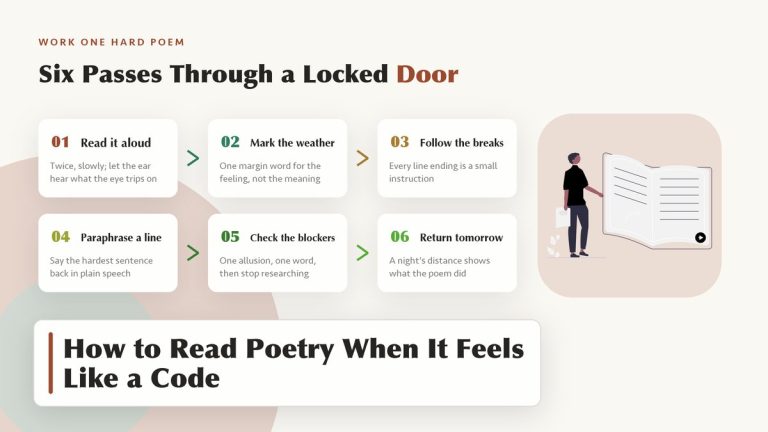
“Read it more than once” is the instruction the Academy of American Poets gives for any poem, and that is why the spoken pass sits at the center of how poetry gets taught. Their essay on how to read a poem treats reading it aloud as a basic step rather than an advanced one: listen for rhymes and clusters of similar sounds, because sound is where a poem’s meaning is partly built, line by line, and none of that is audible at eye speed. The ear gets a vote.
Silent reading tells you what the page says. Reading aloud tells you how the page works.
The first time you do this with a book you love, it stings a little. You’ll find a paragraph you underlined years ago that now sounds overwrought, or hit a sentence you once found gorgeous and hear that it doesn’t actually parse once the breath has to organize it. That sting is the point of the exercise, because the book hasn’t changed; your access to it has.
The Oldest Memory Trick There Is
Memory researchers call the second payoff the production effect, a name attached to work by the psychologist Colin MacLeod and his colleagues at the University of Waterloo around 2010: saying words out loud helps them stick, often noticeably, compared with reading the same words silently. The usual explanation is that speaking adds a second encoding, the motor memory of forming the sounds, on top of the visual one, so the brain files the word in more than one place and loses it from neither.
Homer, the Norse sagas, entire law codes — oral cultures held enormous bodies of story in memory for centuries before anyone thought to write them down, and you’ve felt the same mechanism your whole life. Phone numbers you say back to the clerk outlast the ones you only nod at, and the recipe step you read aloud is the one you don’t have to check twice. The Harvard scholar Milman Parry confirmed the mechanism in the 1930s, recording illiterate bards in Yugoslavia who recited epics thousands of lines long from memory and repeated the same formulas the next day; his student Albert Lord carried the work into the 1960 book The Singer of Tales. The mouth files its own copy of everything the eye alone lets go.
Twenty seconds, once, at normal volume, is the practical version for a reader. When a passage matters to you, a paragraph you want to keep or an argument you’ll want to reconstruct later, underlining alone is the weaker move, because the highlight fades within weeks while the spoken version sticks for months. Say it too. The words lodge more firmly than a highlight ever manages, and passages I’ve read aloud I can usually still paraphrase months later, sometimes with the rhythm still attached, even though I underline constantly and retain a fraction of that.
How to Read a Page Aloud, Alone
A ten-minute protocol that won’t eat your evening
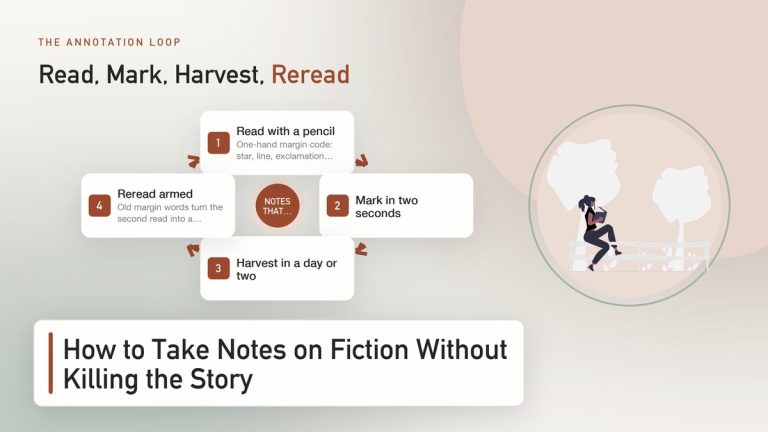
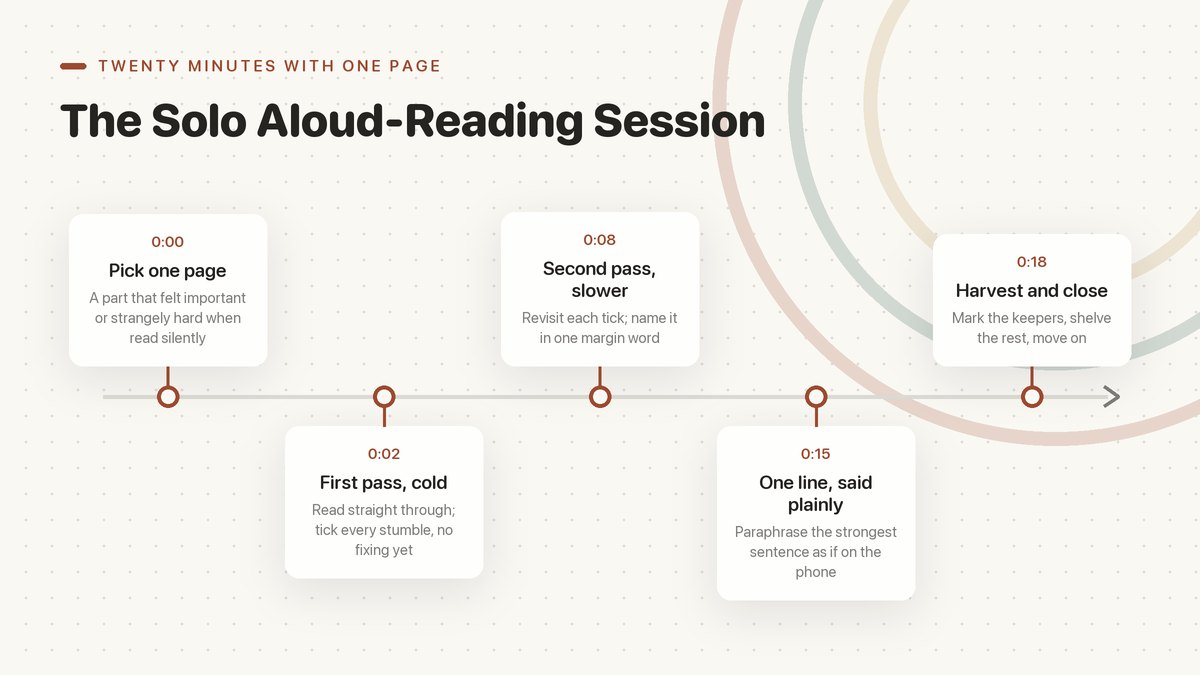
One page, roughly three hundred words, is the assignment; a whole chapter is too much. Ideally pick a page that felt important or strangely hard on the silent read, because a page chosen for being difficult gives the ear real work to do while a random page mostly confirms what the eye already told you. Keep a pencil in hand before you start; the three to six ticks per page need marking as they happen.
First pass, cold. Read the page out loud without stopping, the way you’d read to a patient listener, and don’t fix anything yet — just notice where your attention snags: the stumble, the breath that ran out early, the word that sat wrong in your mouth. Put a small tick in the margin at each snag, and expect three to six per page. I’d trust every one of them, in my experience, over any received rule about what good prose is supposed to sound like.
Second pass, slower. Go back to the first tick and work through the list in order, reading each flagged sentence once more and asking the ear what, specifically, caused the trip. Was it repetition, like the third “suddenly” in two pages? A breathless clause? A word used slightly wrong? Sometimes the sentence is fine and you were distracted, in which case cross the tick out, though most ticks, in my experience, pay out. Above each surviving one, write one or two words naming what you heard, the same way a copy editor marks a manuscript, small and quick and legible only to you. “Echo.” “Breath.” “Clunk.” “Voice?” You’re drawing a small map of how this writer’s prose behaves under pressure.
One line, said plainly. Pick the sentence that hit hardest and say it again, then say what it means in your own plain words, as if explaining it in thirty seconds on the phone to a friend who hasn’t read the book. Writers compress meaning into surprising shapes, and the shapes can dazzle while the meaning slides past. The paraphrase, spoken out loud in your own words, checks whether anything was behind the dazzle. Usually there is, and occasionally there’s nothing there at all, which is also worth knowing.
That’s the whole practice: one page, two passes, one paraphrase, ten minutes, maybe twelve. For source material that costs nothing and belongs to everyone, Project Gutenberg lists just under 80,000 free ebooks as of this writing, public-domain novels from an era when prose was genuinely written to be heard, digitized and proofread by volunteers since 1971.
A Shorthand for the Marks
“Echo,” “breath,” “clunk,” “voice?” — four or five margin words, used the same way across every book, is all the vocabulary the ticks need. Mine run “echo” for repetition, “breath” for rhythm trouble, “clunk” for a sentence that fights the mouth, “voice?” for dialogue that sounds off, and “keep” for a passage worth saying again later; steal the idea, pick your own words, and write them on the inside cover so a six-month gap between readings doesn’t strand you.
Five seconds is the budget for each margin note, and shorthand exists to protect it. One word beats a paragraph of margin notes, and a one-word note takes under five seconds to write in the moment, while the snag is still audible in memory. Elaborate annotation systems fail for the same reason elaborate diets fail: the overhead eats the habit.
| What the page holds | The silent read | The aloud read |
|---|---|---|
| Repetition of words and sounds | Invisible; the eye auto-corrects | Flagged by the third echo |
| Breath and rhythm problems | Unreadable on the page | You run out of air, on schedule |
| Clunky, mushy constructions | Often pass unnoticed | Underlined by your own tongue |
| Dialogue authenticity | Easy to fake in print | Obvious within two exchanges |
| Memory of key passages | Fades within weeks | Sticks for months |
Pages per hour is the wrong meter for this practice. A silent hour covers maybe forty pages; the protocol covers one, and the slowdown feels like failure only if you keep the old score. You’re trading coverage for depth on the pages that deserve it, and most pages don’t, which is exactly why the protocol says one page instead of the forty a silent hour would cover.
Your Own Drafts Deserve the Same Treatment
Fifteen drafts in, your silent reading can no longer see the prose; it keeps seeing what you meant instead of what’s there. Ask a novelist about revision — most will mention reading the manuscript aloud at some stage, many at several, often as the last pass before sending it out — because the ear catches the exact flaws an eye trained on the same fifteen drafts cannot. The mouth has no such loyalty. Samuel Johnson’s advice to a young poet was to strike out every passage the poet thought particularly fine, and reading aloud does a quieter version of that striking for you.
The sentence, the scene, and the opening are the three scales where it works. At the sentence level, the trip test exposes dead clauses and borrowed phrasing. At the scene level, reading dialogue aloud shows you when two characters talk past each other in a way that reads as conflict but sounds like an interview. And at the opening, maybe three hundred words where a stranger decides whether to keep going, reading aloud is brutal and useful. If the first page makes you impatient when spoken, it was making readers impatient silently; they were just too polite to say so.
There’s a fix embedded in the habit, and it tends to show up after two or three months. Reading your own prose aloud teaches your hand to write speakable sentences in the first place, the same way reading good dialogue improves your dialogue ear, and after a while you’ll catch the mushy construction at the keyboard, before it ever reaches the page. Catch it early. In my view that’s the real payoff, because the reading stops being revision and starts being prevention.
Your eye forgives your own sentences because it knows what you meant. Your ear only knows what you said.
Learn From People Who Already Read Well
Twenty years of volunteer readers built the best free ear training there is. LibriVox turned twenty in 2025 and hosts more than 21,000 completed recordings of public-domain books, all read by volunteers, and the quality varies, which is instructive on its own. Listen to two readers take the same chapter of Dickens and you’ll hear within minutes how much a reader’s choices shape a text: where they pause, what they emphasize, which character gets a voice. Dickens himself toured Britain and America giving paid readings of his own work to packed halls, so the material was practically engineered for this.
For something closer to performance, Poetry Out Loud, the recitation contest run by the National Endowment for the Arts with state arts agencies since 2005, publishes recordings of students and finalists performing classic poems from its free online anthology. The program has reached more than 4.6 million students and 89,000 teachers across 22,000 schools since it began, and its 2026 national champion, an eleventh grader from Carmel, Indiana, took home a $20,000 grand prize for reciting other people’s words out loud. Watch a few recitations and notice how much interpretation lives in delivery alone. A sonnet can sound like a shrug or a confession depending on breath and pace, and both are defensible readings of the same fourteen lines.
And for the deep archive, the Folger Shakespeare Library, the world’s largest Shakespeare collection, publishes the plays free to read online alongside recordings of actors performing them, material written to be spoken and still spoken nightly somewhere on earth four centuries after the First Folio of 1623. Hearing a trained actor land a line you stumbled over in your own head teaches you fast how much delivery carries, and how much the words alone were never supposed to carry by themselves.
Treat it like the ear training it is. Musicians call learning a solo note for note off a record transcribing, and they do it for phrasing; readers can do the same for nothing, with a free website in place of the record collection and the headphones you already own.
What About Just Listening to Audiobooks?
A fair question, since an audiobook puts a professional voice between you and the page at roughly the pace of ordinary speech, somewhere around 150 words a minute. They’re wonderful, but they sit closer to silent reading than to reading aloud, and the difference matters. When you listen, you’re receiving sound; when you speak, you’re producing it, and the production effect research suggests it’s your own mouth, your own breath, your own effort that makes the memory stick. Passivity is what makes audiobooks great, and it’s also what they can’t give you.
A middle ground exists, and comedy gains the most from it. Follow the text while you listen, eyes on the page, and you get two channels for the price of one: the professional’s phrasing as a model plus your own eye for the actual words. A good narrator will show you pauses your silent reading never suspected were there, because comedy lives on timing. Wilde, Wodehouse, anything where the joke lives in the pause, audio is the better format for those, and I say that as someone devoted to paper.
Just don’t let audiobooks gradually replace the speaking habit. Listening trains your taste; speaking trains your attention. The first shows you what good sounds like, and the second shows you what this page, the one in front of you right now, is actually doing.
The Cases Where Reading Aloud Won’t Help Much
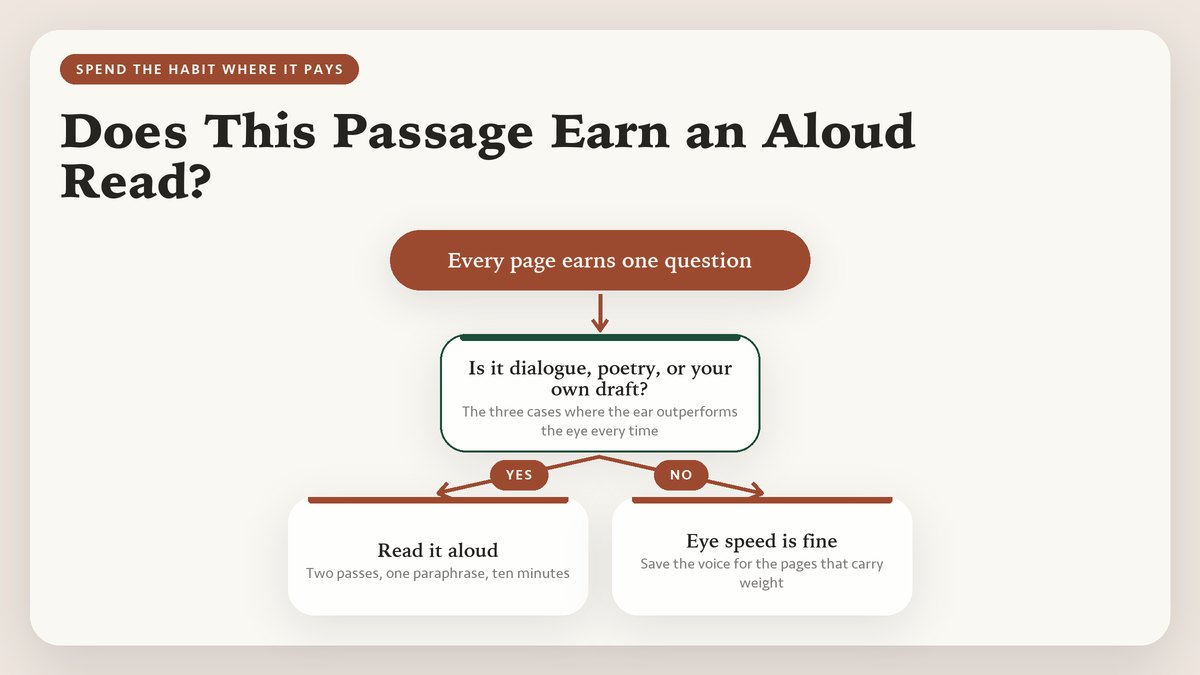
Dense reference material — a programming manual, a field guide, a book you’re mining for facts — is the big exception. Its value lives in structure and lookup rather than sound, and reading it aloud is drudgery with no payoff at the end. Poetry is the opposite case and repays a spoken pass almost every time, even the poems that look forbidding on the page, and the “read it more than once” advice from the poetry teachers applies double there.
Very plain prose, the kind of clean journalistic nonfiction written to be read over the air, is a grayer area. Read a page of it aloud and the ear confirms rather than discovers. Confirmation has value too; it just costs the same ten minutes as a discovery does.
And then there’s momentum. If you’re forty pages from the end of a thriller at midnight, for heaven’s sake keep going. The habit earns its keep on the ten percent of pages that carry the weight: the opening, the turn, the paragraph you’ll want to keep. Everything else can be read at eye speed, the way you always have. The goal was never to perform the whole book. It was to stop letting the fast, forgiving eye be the only reader you’ve got.
One Step Further: Reading to Someone
The oldest variation is also the best one: read to an actual person. A chapter to a partner who likes being read to, a poem to a friend, a passage to your book club before the discussion starts. A listener changes the practice again. You start modulating, holding back a little at the good part, and you discover that some passages you admired privately flatline in front of an audience while others you nearly skipped carry the room. The book meets its second reader, and you get to watch it happen.
Length is your friend here. You are not committing to an evening of performance; one scene, one poem, one page read well is plenty, and it ends while everyone still wants a little more. That is, not by accident, about the right size for the habit generally, because ten minutes of spoken reading a week, spent on the right pages rather than on every page, will teach you more about how prose works than another year of silent volume, and the eye, good as it is, stops being the only instrument you’ve got.
If that sounds like too much, stay with the closed door; the solo habit is the one that does the work, and an audience is gravy. But try it once, because it completes the loop, silent reader, then speaking reader, then the reader as the voice someone else remembers the book by. Few things change how you feel about a novel faster than hearing it land in someone else’s silence.
Sources and further reading: the Academy of American Poets’ guide to reading a poem, Project Gutenberg, LibriVox, Poetry Out Loud, and the Folger Shakespeare Library. All links checked November 2026.