Somewhere between the hipster index card and the $10-a-month note app sits a 400-year-old practice that never needed a name. This is a look at what the second-brain movement actually changed, what it threw away, and how to keep the useful parts of both.
A few years ago, half the productivity internet decided that your notes deserved their own brain. Tiago Forte’s book Building a Second Brain, published in 2022, gave the idea a glossy package and a four-step acronym, CODE, for capture, organize, distill, and express, and suddenly people who had never kept a journal were filming their tablet screens and talking about their “digital garden.” The idea isn’t silly to me, because I’ve kept some version of a note system for years and it really did change how I read, but one question kept nagging while I worked through the book, and I think it should nag you too. Why does a practice with this much software attached to it need so much explaining, when an English philosopher was running a better version of it with a needle and thread in the 1680s?
John Locke published a short treatise in French in 1686, the Méthode nouvelle de dresser des recueils, describing his method for keeping a commonplace book, which is the old name for a notebook where you copy out, in your own hand, the passages and ideas you want to keep. The part of the method that outlived him was an index. Before you write anything, you reserve a margin column and mark every entry with the first letter and one vowel of its topic, so any idea can be found again in seconds. It worked. Scholars ran the system for centuries, from Renaissance schoolroom exercises built on Erasmus’s De copia in 1516 to the first English translation of Locke’s treatise in 1706. You can read the history of the commonplace book and find Renaissance students, Enlightenment scientists, and Victorian novelists all doing roughly the same thing on paper, without a single sync conflict.
The modern version swaps the needle and thread for search bars and backlinks. Forte’s own site for the method states the pitch plainly enough. Build a system that remembers everything, the pitch goes, so your biological brain can spend its energy being creative instead of acting as a filing clerk. That’s a real promise, and parts of it hold up, as anyone who has ever found a ten-year-old note in under a second knows. But a lot of the second-brain conversation is the commonplace book wearing a hoodie, and some of what got lost in the wardrobe change matters more than the apps do.
So this article does the unfashionable thing. It puts the two practices side by side on the actual mechanics, capture, retrieval, review, ownership, and asks where each one earns its keep. The answer, as far as I can tell, is that the apps solved the wrong half of the problem.
In this article
What the Paper System Actually Asked of You
Four hundred years of field testing, zero software updates
Copying a passage by hand into a bound notebook takes maybe four minutes a page, and the commonplace book made that friction the entire point, because it forced a decision at the moment of capture: is this worth four minutes of my evening? Most material flunked the test. You didn’t photocopy a page and call it a day. What survived was short, in your own wording, and attached to a reason you wanted it. Locke’s index then gave every kept idea an address, and the address was the whole reason the book was still useful decades later. The Stanford Encyclopedia of Philosophy has a fuller portrait of the man, physician as well as philosopher, 1632 to 1704, and the treatise itself runs barely twenty pages, which is more than can be said for most modern productivity books on the same subject.
A bound notebook of a few hundred pages never promised to hold everything, and that gap explains most of what follows. It couldn’t hold everything; the pages fill up within a year or two of regular reading. The filling was the signal that the current volume was finished and that the ideas inside it had better be worth the shelf space. Selection wasn’t a feature you could switch on. It was the operating condition the entire method assumed from the first page onward.
Renaissance schoolboys recited their commonplace entries aloud as a school exercise, and the scholars who got the most from the practice re-read and re-copied the best material into the next volume as the old one filled. That return visit was the second half of the old method, and it’s the part modern guides rush past. The book was a workshop you visited rather than a trophy shelf, and filling it was never the goal, because Locke’s index only pays off on the second and third visits. A commonplace that nobody revisits is just a diary of someone else’s sentences, which is close to what most modern note apps become by the third month, when the capture habit is running well and the reading habit never started.
It also helped that the paper book lived in the physical world, on a desk, in your hands. You couldn’t scroll past it for six months without noticing it, the way you can scroll past an app icon you never had a reason to open. An old notebook accuses you from across the room. An app just sits there behind its icon, silent for years if you let it.
The old system made you choose before it let you keep. Almost everything that makes it powerful lives in that sentence.
What the App Version Actually Added
Three real upgrades and one expensive illusion
Credit where it’s due. A digital system does three things Locke’s needle couldn’t, and they aren’t small. Search finds any word you typed, across every note you ever wrote, in about a second, whether the note is ten days old or ten years old. Links let you attach two ideas with a keystroke, so a note on, say, narrative structure can point at a note on courtroom rhetoric without either one mentioning the other. And sync means the book is in your pocket, so capture can happen in a checkout line instead of only at a desk after dinner. Those three together really do change what’s possible, and I’d miss them if I went back to paper tomorrow.
The German sociologist Niklas Luhmann pushed the linking idea furthest. His Zettelkasten method, built on a slip box that grew to roughly 90,000 numbered index cards between the 1950s and his death in 1998, carried his research across decades and a published output that runs, by the usual count, to more than 70 books and several hundred articles. The modern tools that borrow its name, apps like Obsidian that store your notes as plain-text Markdown files on your own machine and show them in a graph view, are a big part of why “second brain” sounds more scientific than “commonplace book.” Luhmann’s insight was that ideas get smarter when they’re forced to sit next to their neighbors, and software makes that neighboring almost free.
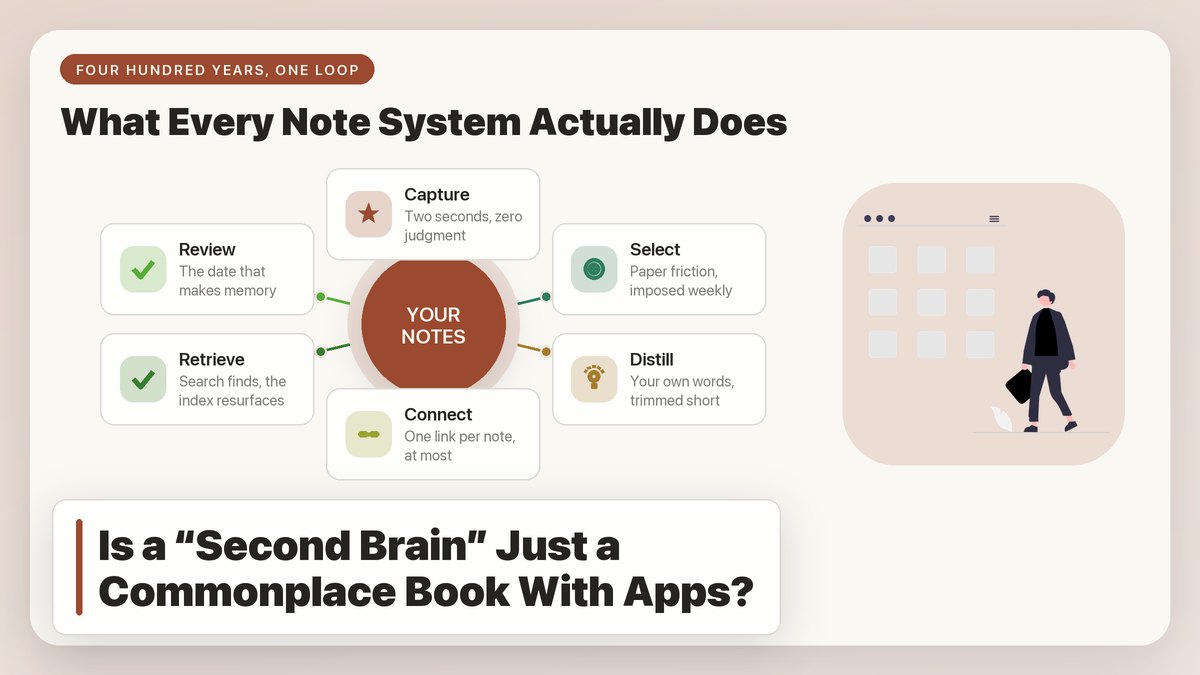
The trouble starts at “almost free.” When capture costs two seconds, the selection step disappears, and the system starts swallowing everything: whole articles saved unread, highlights dumped from a phone in bulk, screenshots of screenshots. Forte’s CODE method does include a distillation step, and he means it. In practice, and I’m going on what I’ve seen in my own archive and in a dozen other people’s, the capture and organize stages get all the attention because they’re the ones the tools are good at. Distilling takes the kind of quiet, sentence-by-sentence work that no app can do for you. That’s the expensive illusion in one line: the software makes the easy 20% of the work effortless and leaves the hard 80% exactly as hard as it ever was.
Search, the third upgrade, changes what a note is for, and it deserves a quieter mention because it’s the one people actually feel in daily use. In a paper book, a note existed to be revisited on the index’s schedule. In a digital system, a note exists to be found, and those are not the same job. Being found rewards keywords and volume; being revisited rewards quality and spacing. A system optimized only for findability slowly fills with notes that are easy to search and useless to read, which describes, roughly, the last archive I abandoned.
Where Digital Systems Break
Four failure modes, in the order they usually arrive
Four failure modes, all of them named by the note-taking community itself, arrive in a fairly predictable order, and the naming is a bit of a tell, because a practice that needs this much troubleshooting documentation is leaking somewhere. The collector’s fallacy arrives first. Saving feels like progress, and it isn’t; a folder of 300 unread saved articles is a to-do list that accuses you every time you open it. Most people who hit this stage don’t quit the system. They just stop opening it, which is quitting with extra steps.
Archive amnesia arrives next, and it’s stranger. You have 2,000 notes, you know the answer to your question is in there somewhere, and you cannot find it, because you saved the material under the author’s framing rather than your own. Search only works when you remember the words the original writer used, which you usually don’t, since the whole reason you saved it was that the phrasing was better than yours. This is the failure the paper index prevented: Locke’s addresses forced every entry to be filed under your own word for the topic rather than the source’s.
A constellation of dots drifting across Obsidian’s network view is what the graph delusion feels like, and it’s the third failure mode. You open the graph, watch the connected notes drift across the screen, and feel the system working. I’ve felt it too. What the graph shows is that links exist, and links existing is the easiest thing in a digital tool, about as hard as pressing enter. A constellation of 2,000 linked notes tells you nothing about whether any one of them was worth reading twice, and the graph can’t show you that, because that information isn’t in the links. It’s in the notes, in the words, which is precisely the part nobody films.
Abandonment is the last failure mode, and the most common of all. The system asks for maintenance the user never scheduled, the inbox rots, the guilt builds, and eventually a fresh app launches with a shinier icon and a faster import wizard, and the whole archive gets exported into it, where the cycle starts again. If you’ve done this two or three times across different apps, the pattern is worth noticing. The tool was never the problem.
An Honest Ledger
Six rows are enough to sketch the trade-offs for a friend choosing between the two, with the hype from both sides set aside:
| Dimension | Paper commonplace | Digital second brain |
|---|---|---|
| Capture friction | High; forces selection at the moment of capture | Nearly zero; selection has to be self-imposed |
| Retrieval | Index or memory of the address | Instant full-text search and backlinks |
| Capacity | Bounded by shelf space | Effectively unbounded; the bound is the problem |
| Review habit | Built in; you re-read what you copied | Optional; easy to never reopen anything |
| Ownership | Yours, fire and flood permitting | Tied to a company, a format, a subscription |
| Linking ideas | Slow, which means rare and deliberate | Instant, which means often thoughtless |
The pattern shows up as soon as you set the middle and right columns side by side: paper wins wherever the cost of writing forces judgment, and the app wins in the places where the cost of writing used to slow you down for no good reason. Search and links are pure gains, the two rows in that table where the digital column wins outright. Frictionless capture is a gain only if you replace the judgment the friction was doing, and most guides never mention that part, because judgment doesn’t come in a settings menu.
None of this means you have to pick a side, and most people who stick with note-keeping long term usually don’t. The hybrid I see working most often is boringly simple, and it usually costs about ten minutes a week of paper-to-digital transfers. Capture on paper when you’re reading away from a screen, because the friction is doing you a favor there, then move the survivors into the digital shelf at the weekly review, because search and links are where the software earns its fee. Paper at the front door, software in the archive, each medium holding the job it’s actually good at.
The Note Itself Hasn’t Changed
Anatomy of a note that earns its keep, in either medium
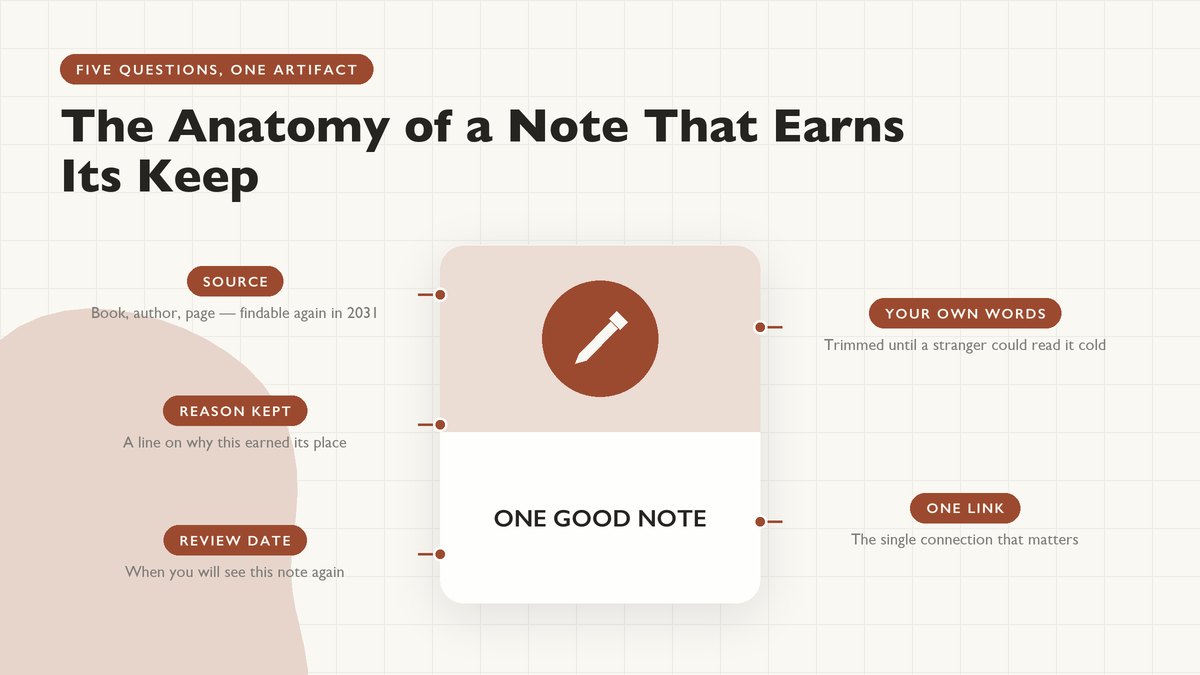
Five questions, answered the same way in ink or in a Markdown file, define the one object at the center of both systems: the individual note. After years of trying both, I’m convinced a good note is the same artifact in either medium. First, where did this come from, stated exactly enough that you could find the book or article again in 2031. What does it say, in your own words, trimmed until a stranger could read it. Why did you keep it, because a passage without a reason is dead weight. What does it connect to, one link at most, since a note that connects to everything connects to nothing. And when will you see it again, which is the question that separates a memory from a filing cabinet.
That fifth field, the review date, is the one nearly everyone skips, and it’s the one that carries the most weight. The research on how learning actually works keeps landing in the same place: pulling material from memory and revisiting it on a schedule are the techniques with the strongest evidence behind them, while re-reading and highlighting sit near the bottom. The landmark Dunlosky review, published in Psychological Science in the Public Interest in 2013, rated ten common study methods against the evidence, and the American Psychological Association’s plain-language summary, Learning Techniques: Promising and Not So Promising, puts retrieval practice and spaced review at the top by a wide margin. A note with a review date is a tiny machine for doing exactly those two things to your own archive.
A Layered Setup That Actually Gets Used
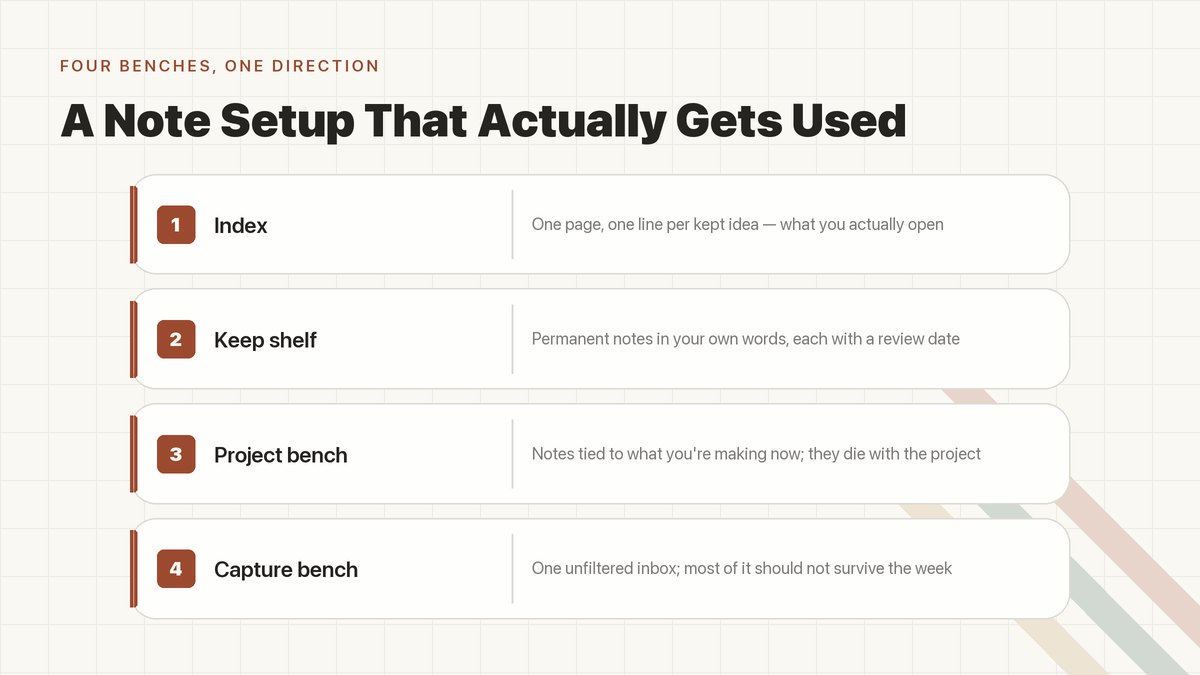
Four layers, kept loose, is the structure I keep coming back to, because how you arrange the notes matters less than people think. Picture it as a workshop with four benches instead of a single drawer, each bench with its own job and its own turnover rate.
- Capture bench. One inbox, paper or app, where everything lands unfiltered for a week at most. No folders, no tags, no sorting is allowed here, because the moment you start organizing at capture, you’ll stop capturing. A week is long enough for anything to wait; most of it shouldn’t survive the wait.
- The project bench. Notes tied to something you’re actively making or deciding, like the essay, the course, or the garden plan, and these get touched weekly and die with the project, which is fine, because their whole job was the project.
- The keep shelf. The permanent notes, the modern commonplace: only what survived the other benches, rewritten in your own words, each with its one link and its review date. This shelf should grow slowly, a note or two a week at most, and if it’s growing faster than that, the selection has broken somewhere upstream.
- Index. Locke’s contribution, still undefeated after 340 years. A single page, one line per kept idea, pointing into the keep shelf. Not a tag taxonomy and not a graph. One page. If an idea can’t earn a line on the index, it hasn’t finished becoming a note yet.
The four benches do the discipline for you, because stuff flows downhill through them on its own and almost nothing deserves to arrive at the bottom. The weekly pass is the only mechanism that decides what survives the trip, and that filter is the paper system’s whole lesson rebadged for a hard drive.
The Habit That Decides Everything
Twenty minutes, once a week, is the ritual every system stands or falls on, paper or digital. You open the inbox, promote what deserves it, re-read a handful of keep-shelf notes, and update their review dates, usually in less time than a single episode of a sitcom. Forte calls something similar the weekly review, while the commonplace keepers had no name for it because it was simply the reason you owned the book. Either way, this is the real engine, and no software feature substitutes for it.
Keep the ritual small on purpose. A review that takes two hours gets skipped by February; one that takes twenty minutes survives a bad month. I do mine Sunday evening with coffee, which is about the least productivity-coded sentence I’ve ever written, and it works precisely because there’s nothing to optimize. Five steps, all with real objects: open the inbox, promote two or three notes at most, read five old ones out loud if you want them to stick, close the app, go have dinner.
Every kept idea you re-read in the weekly review is a small argument you don’t have to re-derive, a metaphor you can hand a friend, a connection you often only notice the third time through. This is where your past reading starts paying rent. The capture side of note-taking gets all the attention because it looks like work. The review side is the part that compounds, and it asks almost nothing, which is exactly why it gets skipped.
As far as I’m concerned, the apps won, and they deserved to, because search and links and pocket-sized capture are real gains as far as I can tell, with no paper equivalent worth mourning. But the 1680s system is still the better teacher, because it understood something the app stores don’t sell. A note system’s value is set entirely by what you can find again and what you return to, and both of those are judgment problems, with storage barely entering into it. The advice I’d actually follow comes down to three verbs: keep the software, steal the discipline, and put a review date on every note you care about, starting with the ones you already have.
Update policy: we revisit this guide as the tools evolve and recheck every external link each pass. Related reads on this site: The Commonplace Book: A 400-Year-Old System for Keeping What You Learn and How to Learn an Entire Field From Books Alone.