Every reading-based language method comes down to one awkward skill, which is finding a book slightly too easy for your ego and slightly hard enough for your brain. This article covers how to find that book, what to do with it once it’s in your hands, and how to know when it’s time to trade up.
Two years on an app, a streak of several hundred days that most adults would envy, and then the same confession shows up on every language-learning forum. She froze solid the first time a native speaker asked a question that wasn’t multiple choice. What broke wasn’t her vocabulary. It was that she’d never once met the language as a living thing, only as a set of puzzles. I’ve watched this pattern repeat often enough, across maybe a dozen learners I know personally, that I now treat apps as appetizers and consider the meal to be reading. Real pages, real paragraphs, the boring stretches and the good parts of the language doing its actual job. And the most common way people fail at reading their way into a language has nothing to do with discipline. They choose the wrong book, feel stupid for three evenings, and quit.
The fix starts with a number, because the wrong book is a measurable thing. Reading researchers have spent decades on a question that sounds simple. How many words on a page do you need to know before the rest of them teach themselves? The answer most often cited in the literature lands between 95 and 98 percent coverage, and the older estimate associated with Coady and Nation puts pleasurable reading at 98 percent, which works out to roughly five thousand word families in English. Either way, the whole craft of reading into a language reduces to finding material inside that band, and it’s a skill you can pick up in an afternoon with one page and a pencil.
Twenty pages of a graded mystery novel is an hour of grammar and vocabulary arriving in context, with a plot bolted on so your attention can’t wander. That’s the second reason to take reading seriously, beyond the armchair. The people who learn languages best rarely have the best memory. They’re the ones who rack up the most hours in contact with the language, and reading is how you do that at scale when you don’t live where the language is spoken. A textbook chapter gives you maybe fifteen minutes of the same input, and then it’s over.
In this article
Why Reading Does What the App Can’t
Teachers have a name for this, and it comes with a founding text, Julian Bamford and Richard Day’s Extensive Reading in the Second Language Classroom, published by Cambridge University Press in 1988. Extensive reading means consuming lots of easy material at high volume, as opposed to intensive reading, which is taking one hard text and dissecting it with a dictionary until it confesses. The extensive kind looks lazy, and in classrooms it even runs under names like sustained silent reading, as if the silence were the scandal. The appearance is misleading. You’re not translating; you’re letting thousands of small exposures to words in context do the slow work that flashcards attempt to do fast. The input hypothesis, first published by the linguist Stephen Krashen in 1977 and later folded into his five-hypothesis monitor model, holds that we acquire language by understanding messages slightly above our current level, the “i+1” in his notation, rather than by memorizing rules. The evidence behind comfortable, comprehensible input is about as strong as language-learning evidence gets, though Krashen has had critics since the 1980s and the argument hasn’t fully died.
The Extensive Reading Foundation, a nonprofit whose chairman and co-founder is the same Richard Day, compresses the practice into three imperatives: read a lot, read easy, read what you enjoy. The middle one, read easy, is where the practice lives. When a text sits comfortably within reach, your brain stops treating the language as code to decrypt and starts treating it as information, and that switch is what makes words stick without effort. You already know the mechanism from English. You picked up “ominous” from a novel, not a vocabulary list, and some part of you can still feel the scene it came from. The mechanism works in every language researchers have looked at, and it doesn’t expire with age.
Apps deliver something different. They’re engineered around short sessions, quick wins, and constant testing, which serves you well for at least the first few hundred words and for keeping a daily habit alive. What they can’t supply is ten thousand words arriving in natural company, with the grammar woven in instead of itemized. I’ve got nothing against the apps; I used one daily for a year myself. But everything I actually kept from that year came from the reading I did alongside it, maybe twenty minutes a night.
Nobody ever got fluent off streaks. They got fluent off pages.
The Two-Minute Test That Finds Your Level
One full page from an ordinary book in your target language is the fastest placement instrument there is, and it’s been sitting in any library the whole time. A typical paperback page runs somewhere around 300 words. Open somewhere in the middle, where the plot has settled in, and read at a normal pace while you put a small tick over every one of the page’s 300 words you can’t claim to know. Words you’d need a second to recall don’t count as unknowns. Only the real ones do, the kind you’d fail if quizzed cold. Then add up the ticks before you turn the page.
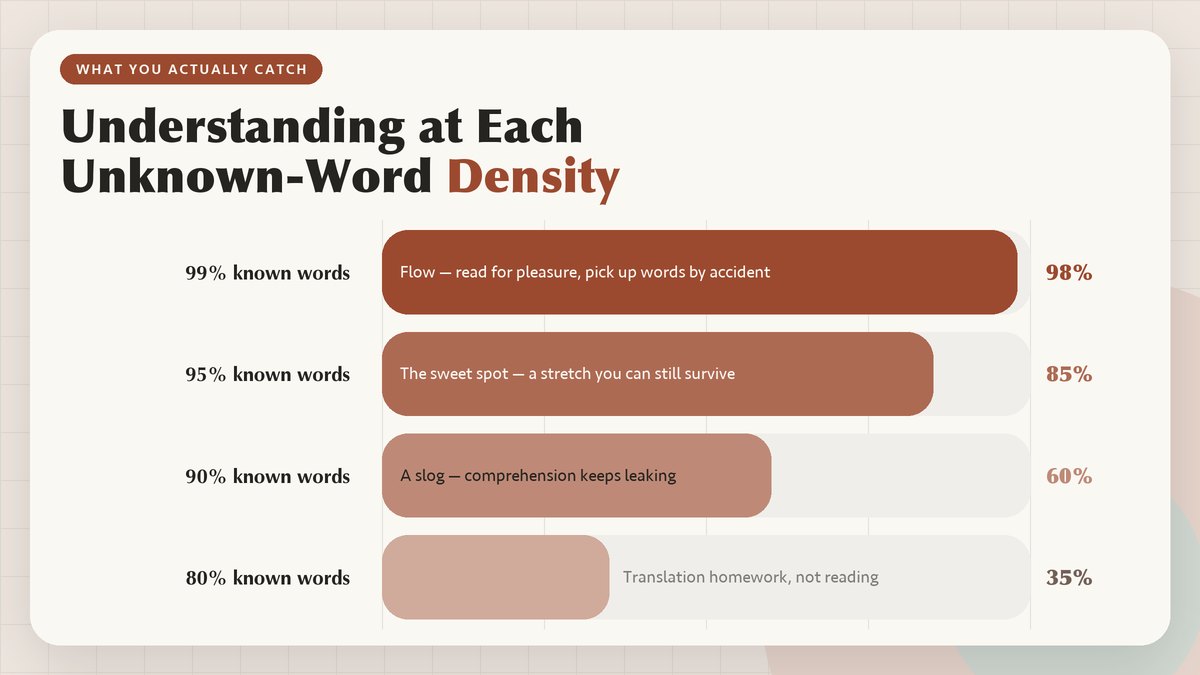
Five ticks or fewer on that 300-word page means you’re around 98 percent known vocabulary, the zone where you can read for pleasure and let the stragglers introduce themselves. Somewhere between ten and fifteen ticks puts you near 95 percent, the working zone where the reading is a stretch and occasionally a slog, but every page pays for its difficulty in new words absorbed in context. Past twenty-five unknowns on a single page you’ve dropped under 90 percent, and the research on this is blunt. Comprehension falls apart, and what you’re doing stops being reading and becomes decoding, which teaches almost nothing because there’s no context left for the words to stick to.
Forty-one unknowns on a single page isn’t unusual for a book that’s too hard, and the count gets humiliating fast when you run the test on a novel you were only pretending to read. At that density the book isn’t teaching you the language so much as teaching you to tolerate confusion, and the fix is never going to be willpower. It’s the children’s section of the library, where you can find a book with seven unknowns a page, and a month of those easier pages will typically halve your count on grown-up ones.
If you’d like a shared ruler for these stages, the CEFR scale, the Common European Framework of Reference published by the Council of Europe in 2001 and now used across European language teaching, defines six levels from A1 beginner to C2 mastery, and graded readers, exams, and courses are usually pegged to it. You don’t need to sit a test to use it. Just know that a reader labeled A2 is written for someone with roughly a thousand words, which turns the labels into a decent shopping shortcut when you can’t test a book in person.
What to Read at Each Stage
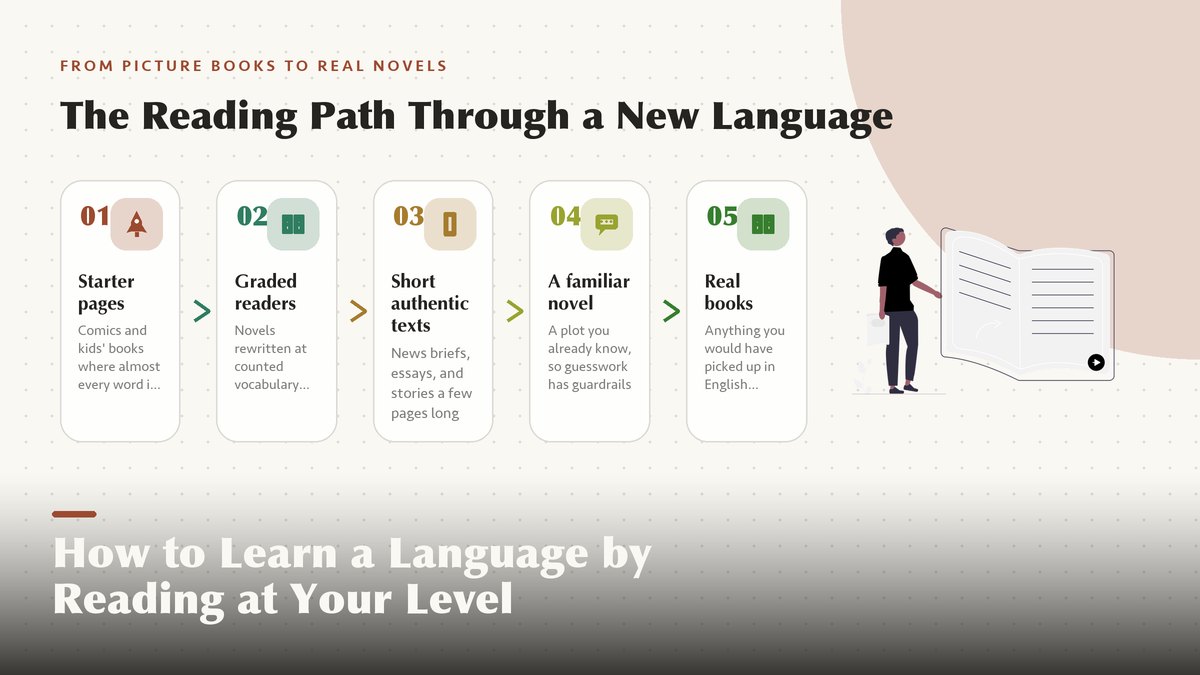
A Tintin album will hand you more usable French than a semester of tense tables, whatever your age, and that’s why your tick count points to comics first. At the earliest stage, comics and illustrated children’s books are unfairly good, because the pictures carry whatever you can’t read yet and the dialogue comes in short bursts. Hergé drew twenty-four of those albums in French, and each one is a few hundred pages of speech-bubble conversation written to be understood. People feel faintly silly reading them. Do it anyway, because nobody is watching.
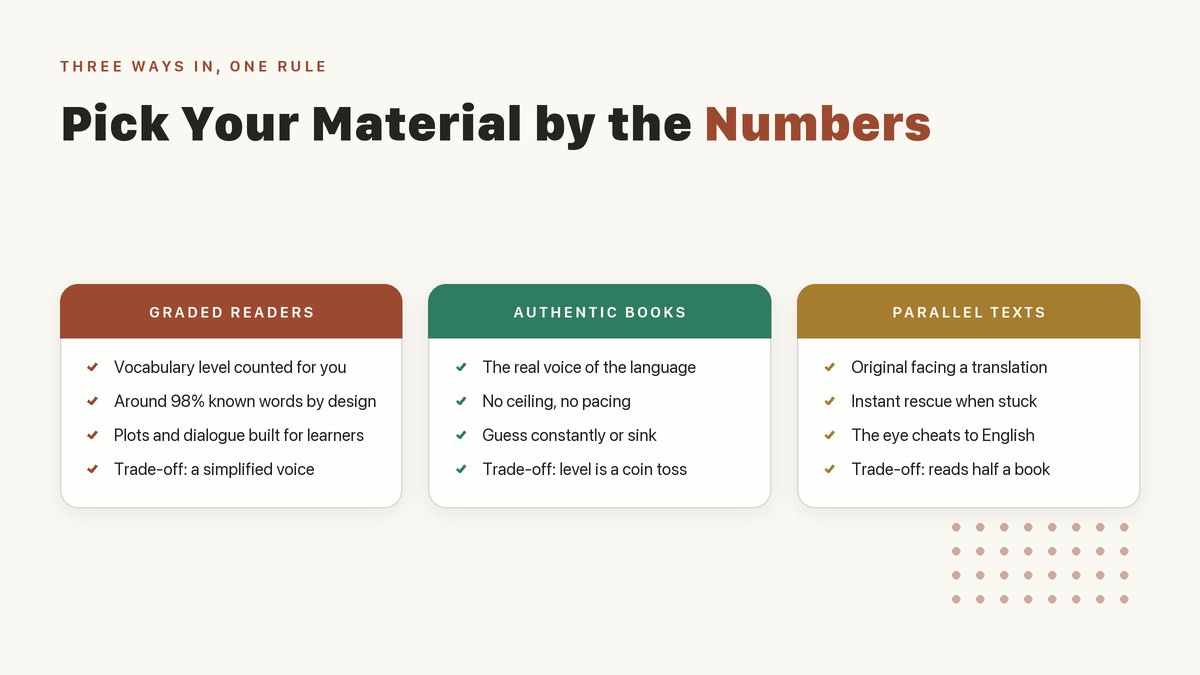
Graded readers start as low as 300 headwords and climb in measured steps toward unadapted novels, and they form the backbone of the whole method. A graded reader is a real book, often a real classic, rewritten against a counted vocabulary at a fixed level. Oxford’s Bookworms line was built around the 2,500 most frequent words, learner series exist for most widely taught languages, French, German, Italian, and Spanish all have multiple publishers, and the Penguin Readers collection alone runs seven levels from starter to advanced. The prose in a level-two reader is plain, certainly, but it’s plain in exactly the way a vocabulary of a few hundred words can process, and that plainness is the feature rather than the flaw.
| Stage | Material | Unknown words per page |
|---|---|---|
| First contact | Comics, picture books, learner apps | Under 5 (mostly familiar) |
| Building | Graded readers at the level below your test result | 5–10 |
| Stretching | Short authentic texts: news briefs, essays, familiar stories | 10–15 |
| Breaking through | A novel whose plot you already know, or one written plainly | 10–20, tolerated |
| Independent | Whatever you’d read in English anyway | Under 5 again, naturally |
Testing says you can survive a B1 book, so you buy the B1 book, and three chapters later it’s homework again. That’s the trap behind the most underappreciated piece of advice in this article. Pick the level below your test result. That usually means an A2 reader when the test said B1. The level below is the one you can sink into for long, relaxed sessions, and those long sessions are where the learning actually happens. Most learners climb faster from A2 comfort than from B1 struggle, which feels backwards and isn’t.
Project Gutenberg grew out of Michael S. Hart’s decision to type the Declaration of Independence into a computer in 1971, and once you’re ready for authentic books it deserves a bookmark. The site now holds tens of thousands of public-domain books, free, in dozens of languages, which means you can sample a chapter each from five novels in your target language without spending a cent, then commit to the one that reads like a six on the tick test instead of a twenty. Free also means you can abandon a dud halfway without guilt, which matters more than it sounds. Parallel texts, original on the left page and translation on the right, are another bridge, especially for languages related to English. Use them sparingly, though. Your eye will cheat to the English side constantly, and half the discipline of reading is resisting that cheat.
Crime and mystery novels are the classic first real book for a reason, and genre matters more than people expect. The sentences run plain, the dialogue sounds like actual speech, and the plot usually drags you past the hard parts whether you feel ready or not. Romance works much the same way with a warmer register. Literary fiction full of interior monologue is the worst possible first choice, critics be damned, because the difficulty hides inside the narrator’s head rather than sitting on the page where you can see it and tick it. Children’s chapter books by authors like Beverly Cleary merit a mention as well. They’re written by people who understand how vocabulary grows, sentence by sentence, and they never condescend about it.
One more option for the breakthrough stage, and I hold a small flag for this one. Choose a book you’ve already read and loved in English. The plot works as a safety net, so every unknown word lands inside a scene you half-own from the English version, and because you know what’s happening you can absorb the part you actually came for, which is how it’s said in the new language. It feels like cheating. It isn’t.
How to Read Without a Dictionary Glued to Your Hand
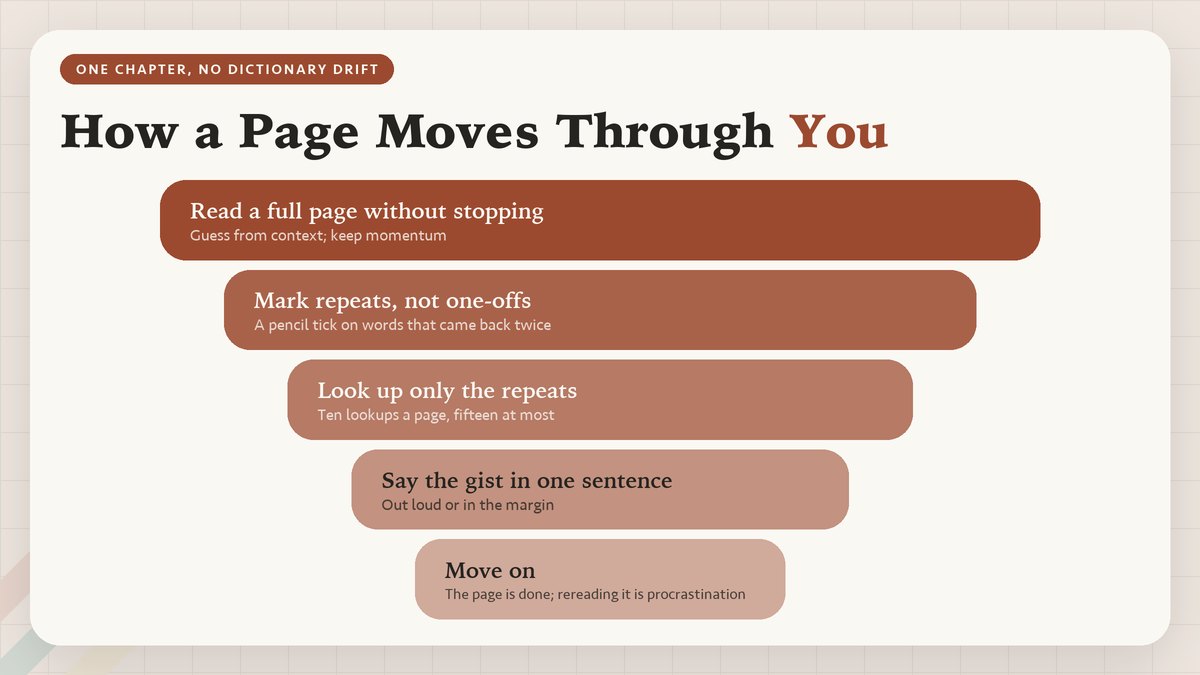
Open the book and read a full page without stopping, the same kind of 300-word page you used for the tick test. Unknown words will appear, maybe a dozen of them on a 300-word page. Guess them from context and keep moving, because guessing wrong is fine and guessing at all is the exercise. Context does most of the teaching in this entire method, and context only builds if you keep reading long enough for it to accumulate. Stop every fourth word and there’s no context, just a pile of lookups.
Ten lookups per 300-word page is a sound ceiling, fifteen at the outside, and the discipline that keeps you under it is marking rather than solving. When an unknown word comes back for a second time, tick it, and let the one-offs go entirely. A word that shows up once and vanishes probably isn’t one you need yet, and chasing it costs you the plot; a word that shows up three times is almost certainly one you need, and by the third appearance it’s half-guessed anyway. When you finish the page, or the chapter if you’re made of sterner stuff than I am, look up only the ticked words.
Say one sentence out loud, or write it in the margin, about what just happened in the chapter. That closes the loop in about thirty seconds. It’s the same retrieval move that usually works for textbooks, and it doubles as a check on yourself, since a chapter you can’t summarize is a chapter you were skating over rather than reading. The remedy for skating is almost always a level down rather than more effort. (A fuller version of this recall-first approach lives in our guide on reading textbooks and keeping the material, and it transfers to languages almost unchanged.)
One index card per book is my whole system for the words I look up. Add the keepers to a list, but only the keepers. A word earns its slot if it came back twice in real text, which on a 300-word page means maybe five keepers a chapter, never because a flashcard app decided you ought to know it. The card gets the words on the front and the page numbers on the back, which is deliberately low-tech. The friction usually filters out the duds, and I’d rather lose three useful words than warehouse forty useless ones.
Knowing When to Climb
Ten reading hours is my checking interval, which works out to roughly three weeks at my usual pace, though some months it’s two and some it’s five. Levels in a language behave less like stair steps and more like tide marks, at least in my experience, and the sign that you’ve outgrown your current books isn’t a test score, it’s a count you can actually take. You reach the bottom of a page and realize you ticked nothing. Or your count on the standard test page drops to half of what it was a month ago, which is an even better sign.
Losing five points of known vocabulary, dropping from 98 percent coverage to 93, can cost you a third of the meaning, which is the part worth holding in your head. Comprehension doesn’t slide gently as unknown-word density rises; it falls off a ledge, because unknown words cluster in the sentences carrying the new information and each gap drags down the whole sentence around it. This is why a book that feels only slightly too hard is usually far too hard, and why dropping one level feels insulting but reads like flying.
So the climbing rule runs like this: move up when easy books turn boring, and move up by the smallest step on offer, one CEFR level at a time. If the new level sends your tick count past twenty a page, drop back without ceremony. That isn’t failure, it’s calibration. And though I said ten hours between checks, you hardly need to sit through three bad sessions to know a book is wrong. The book is wrong, and you’re fine.
The Four Stalls That Stop Reading Learners
Four walls, in my experience, stop nearly everyone who tries this method, and they’re predictable enough to name in advance. First comes translating every sentence into English inside your head. It feels rigorous, and it caps your speed at translation speed, which is a fraction of reading speed. The way out is tolerance. Allow a sentence to stay fuzzy and trust the next paragraph to settle it, because comprehension in a second language is built from approximations over a few thousand words, while precise translation is a different, slower skill you don’t need for this.
Second is reading above your level to impress somebody, often yourself. The tell is that reading has turned into homework you keep saving for a day when you have more energy. Those days never arrive. A novel is the wrong venue for proving anything. The third wall is the mirror image, staying on learner material year after year because the real thing is scary. Graded readers are a bridge, and bridges get judged by whether you cross them. When the tick count says you’re ready, pick the real novel.
Ten pages a day will beat forty flashcards a day for getting you to actual books, and that’s the test for the fourth stall, which is quizzing instead of reading. Some learners turn nearly every chapter into flashcards and review sessions until they’re managing a language project instead of learning the language, and if that’s the hobby you actually enjoy, fine, enjoy it. But if the destination is reading, then reading is the practice. Flashcards aren’t worthless, mind. They have their place for the last stubborn few hundred words. They’re just not the engine.
A few hundred hours is the real tuition. The whole method fits on an index card: test a page, count the unknowns, take the book a level below your ego, read without stopping, look up only the repeats, say the gist, move on. Then repeat. The first month feels slow in a way that can bruise your pride a little. Then, one ordinary Tuesday, you finish a page in the new language and only notice afterward that you did it. That moment is the entire payoff, and it’s worth every easy book it took to get there.
A couple of related reads from this site. How to Read Textbooks and Actually Keep the Material covers the recall-first method that works in any subject, including grammar. And How to Finally Finish the Books You Start, because a half-finished reader teaches nothing at all. External sources were checked and live as of November 2026.