Textbooks are the one kind of book people feel guilty about. You highlight, you re-read, the pages turn, and three weeks later the chapter might as well be new. The problem isn’t your memory, and it isn’t a lack of discipline either. It’s a reading method built for novels, pulled page to page by suspense, running on a book that was never meant to be read that way.
A novel wants you to keep going; a textbook wants you to stop. That’s the whole difference, and almost nobody mentions it when they hand you a 600-page introduction to geology or economics or anatomy. Fiction is engineered to pull you forward with questions the author refuses to answer until page 400, and your brain rides that pull for free, no technique required. A textbook has no pull at all. Each page is complete in itself, dense with terms and definitions and diagrams, and nothing on page 90 cares whether you understood page 40. Reading it cover to cover at novel speed is like trying to fill a bathtub by waving a wet sponge over it. Something gets in, sure, but most of it runs off.
Picture the usual attempt, the one with the uncapped highlighter. It’s a Tuesday night, you’ve set aside two hours, and by the second hour your eyes have read every word of six pages while your mind has been elsewhere for at least three of them. You close the book feeling virtuous. A month later someone asks you about the chapter and you can’t produce a single idea from it, and the guilt starts. I’ve watched otherwise sharp adults run this loop for years and blame themselves, concluding they’re “bad at studying.” In my experience that’s almost never the real story, and the fix doesn’t start with putting in more hours. What they’re bad at is a skill nobody taught them, because school mostly tested whether they could read a textbook once and repeat it the next morning, which is a very different job from reading one to keep the material for good.
This article is the method I’d hand that person. It asks only for a pencil, a blank page, and fifty-minute sittings, none of which costs anything.
It works for self-educators working through a field’s standard text, for adults re-learning math before a career change, for anyone reading to keep rather than reading to finish. None of it is exotic, and very little of it is even new. Most of it is older than the highlighter, which is younger than people assume — Yukio Horie’s felt-tip marker dates to 1962, and the fluorescent Stabilo Boss didn’t reach desks until 1971 — and the highlighter, as we’ll see, is part of what went wrong.
In this article
The Trap You Already Know
Start with the habit you’re most likely using right now, which is highlighting, because dragging a marker across a sentence is the one study move that feels the most like learning. You read a section, some of it seems important, so you drag the highlighter across a sentence or two. Maybe you re-read the yellow parts before a test. The pages get colorful, and your confidence climbs with every stripe. Then the research lands. In the landmark 2013 review by Dunlosky and colleagues, which rated ten common study techniques against the actual evidence, highlighting came out all but useless and re-reading only slightly better; only practice testing and spaced practice earned the review’s top rating of high utility. The American Psychological Association’s summary, Learning Techniques: Promising and Not So Promising, lays out the ratings in plain language, and the pattern has held in the studies since.
Why does the weak method feel so strong? Psychologists call it the fluency illusion, a term out of the memory research of the 1960s. When you re-read a paragraph, it looks familiar, and the brain mistakes that familiarity for knowledge: the words flow, so you must know it. Except recognition and recall are different systems, and tests of memory almost always demand the second thing while studying almost always trains the first. You can recognize a definition on the page and be unable to produce it from an empty one. The gap between those two abilities is where most readers live without knowing it, and no stripe of yellow closes it.
There’s a second force working against you, and it’s older than the textbook itself. Hermann Ebbinghaus measured it in the 1880s, in the monograph usually cited as the founding experiment of memory science, by memorizing lists of nonsense syllables and charting how fast they drained away; in his own table, more than half the savings were gone within an hour and about two-thirds within a day, unless something interrupted the forgetting. Most of a learned list is gone within days either way. The forgetting curve has been replicated in broad strokes ever since, and its steepest section comes right after learning, which is precisely when most readers, having finished the chapter, close the book and move on. From the brain’s point of view, that chapter was never flagged as worth keeping.
Familiarity is not knowledge. The page recognizes you; you don’t recognize the page.
Read to Answer, Not to Cover
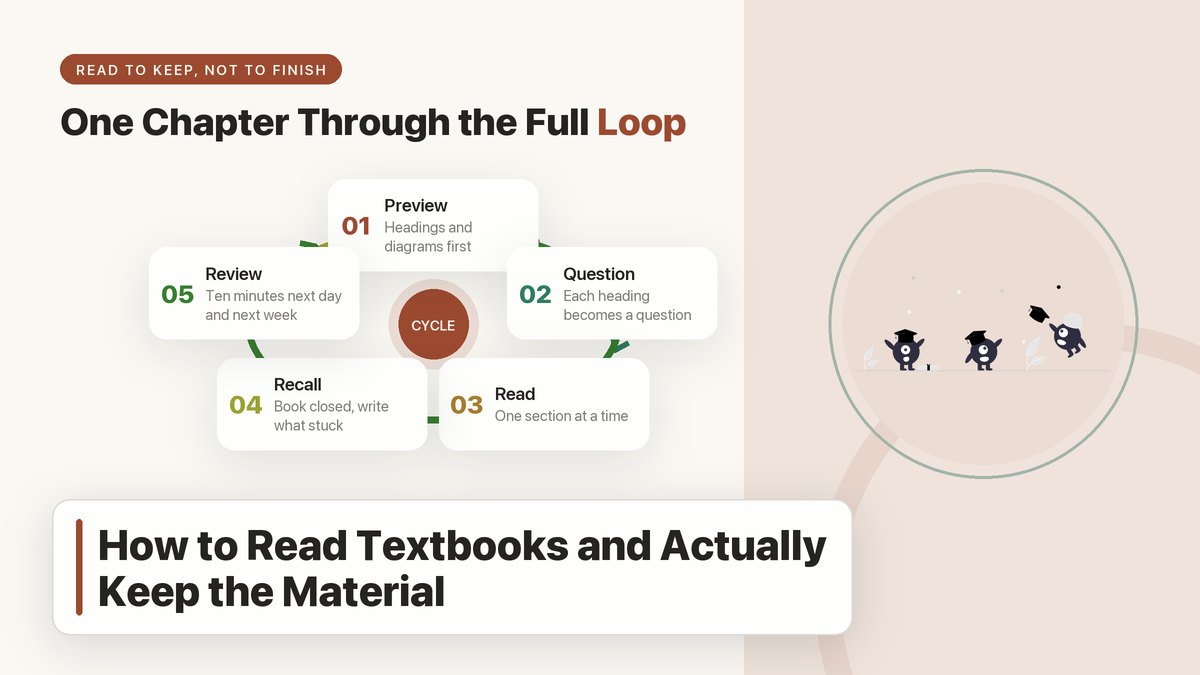
The fix begins before the first real sentence, in the ten minutes you spend on the chapter’s skeleton: its section headings, its summary, and sometimes a list of learning objectives printed up front. Read every heading in order, flip to the diagrams and charts, and read the chapter summary twice before touching the body text. It feels like skimming, and it isn’t. You’re building a coat rack so the detail has somewhere to hang when it shows up, and readers who skip this step spend the whole chapter wondering where things are going while readers who don’t already know.
Then turn each heading into a question before you read past it. “The Structure of the Neuron” becomes “what is the structure of a neuron?” and “Supply and Demand” becomes “what shifts a supply curve?” Write them in the margin beside the heading, or in the narrow left cue column of a Cornell notes page. This step feels like extra work because it is extra work, and that’s the point: struggling to answer a question is what makes the answer stick, which is why a passive reader can cover three chapters in the time an active reader spends on one, and the active reader is the one who keeps the material. The framework behind this goes back to Francis Robinson’s 1941 SQ3R method, surveyed, questioned, read, recited, reviewed, and it survives eighty years later for one reason. The questions are what make the answers stick.
While you read, chase those questions rather than the words. When a section answers one, say the answer in your own words in the margin before you move on. When it doesn’t, mark it for the recall pass later. Keep the highlighter out of your hand if you can; a pencil question mark in the margin has done more for me than any fluorescent stripe, because a question mark is a task and a stripe is decoration.
The Fifty-Minute Session
Textbooks reward short, planned sittings and punish marathons. After roughly 25 minutes of dense reading, most people’s comprehension flattens out while their eyes keep moving, and an hour in, you can “finish” six pages and be unable to say what was on them. So run the chapter in sessions with a shape, and let the page numbers fall where they may. Mine looks like this:
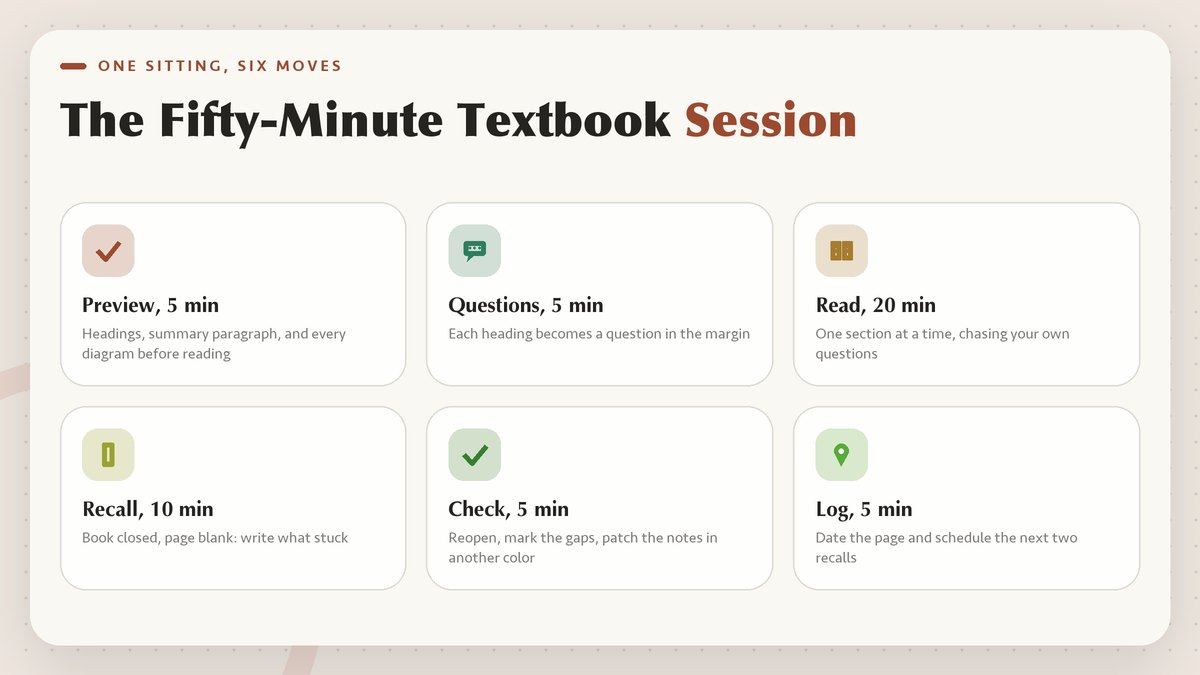
Preview takes five minutes, questions five, and then the reading itself gets twenty, one section at a time, pen down except for margin marks. At the twenty-minute mark you close the book no matter where you are mid-sentence. That closing is the move that changes everything, and it gets its own section below. After recall and checking, spend the last five minutes logging: date the page, and write down when you’ll revisit it, which should be tomorrow and again in about a week.
One chapter of a typical textbook takes three or four of these fifty-minute sessions, so four or five hours of sitting per chapter. That sounds slower than powering through, and per chapter it is. But powering through a twelve-chapter book and keeping two chapters’ worth is slower than keeping eleven, and the math isn’t close.
Close the Book, Then Prove It
Now the heart of the method, the part I’d keep if I had to throw everything else away. After the reading block, close the textbook, take a blank page, and write what you remember for ten minutes, in your own words and without the book’s vocabulary. Forget what you highlighted; none of it is allowed on the page. Forget the tidy definitions. What survives in your head, unaided, from an empty page: the main claims, the ideas in your own words, the diagram you can still see, the answer to each margin question you wrote earlier.
It’s an uncomfortable ten minutes. The distance between “I understood that” and “I can produce that” announces itself immediately, usually somewhere around the second or third thing you try to write. Good. That discomfort is the sensation of the brain deciding the material matters, because struggling to retrieve something strengthens the memory far more than reading it again. This is the testing effect, one of the most dependable results in cognitive psychology: retrieval practice, quizzing yourself instead of re-studying, beats re-reading in study after study, often by wide margins. In one widely cited experiment by Henry Roediger and Jeffrey Karpicke, students who tested themselves after a single reading recalled about sixty-one percent of the passage a week later, against roughly forty percent for students who had re-read it four times.
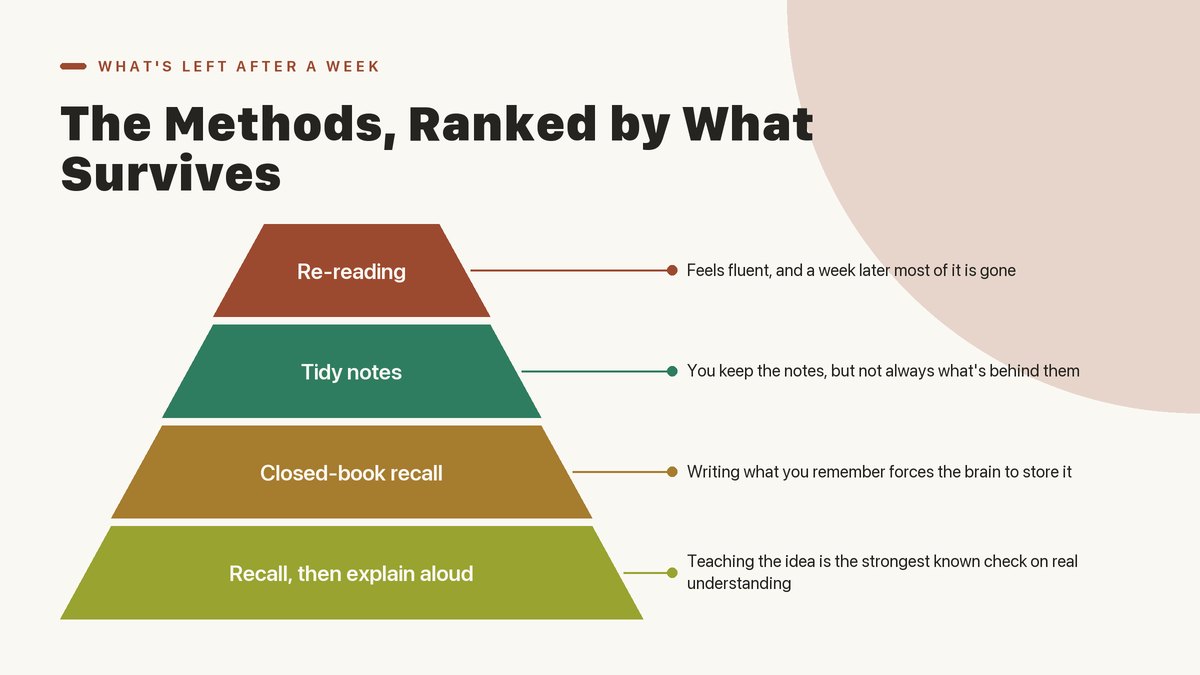
Only after you’ve written everything you can do you reopen the book. Check your page against the chapter and mark the gaps in a different color, a red pen if you have one, so the misses are the first thing your eye lands on at the next session. Those gaps are now your real notes: a short personal list of the three or four things that didn’t stick, which is worth more than a transcription of everything that did. The team behind retrievalpractice.org has spent years turning this research into practical guidance for exactly this kind of self-testing; the site is run by cognitive scientist Pooja Agarwal, who wrote Powerful Teaching (2019) with middle-school teacher Patrice Bain, and it’s the best free starting point if you want the science without the paywalls.
If you want the deepest check available, explain the section out loud to an imaginary student, or a real one. Saying it plainly, without the textbook’s vocabulary doing the work, exposes mush instantly. You either can run the explanation start to finish or you can’t, and the highlighted page has no vote.
Notes Are for Questions, Not Archives
Nearly everyone takes notes the wrong way around, copying the book’s sentences into a notebook and calling it learning. Transcription is stenography, not study, and it’s the main reason notebooks end up full and heads end up empty. Notes earn their keep when they record your questions, your answers in your own words, and the gaps the recall pass exposed. Everything beyond those three is furniture, nice to look at and useless to sit on.
If you want a paper structure built for this, the Cornell note-taking system from Cornell’s Learning Strategies Center is the classic for a reason. Walter Pauk devised it at Cornell in the 1950s and published it in his 1962 book How to Study in College: the page is split, cues and questions in the narrow left column of about two and a half inches, notes on the right, and a summary strip at the bottom you fill in later from memory. That later summary is a built-in recall pass wearing a notes costume. Pair it with the question-first habit and the page does half the method’s work for you.
Digital tools are fine here too, and I’ll admit I was a paper snob about this for longer than the evidence justified. What matters is what goes in, with the medium a distant second. A notes file that says “Q: what shifts a supply curve? A: input prices, tech, number of sellers — check why expectations count” is a study instrument. A notes file that defines supply curve in the textbook’s own sentence is a photocopy with extra steps.
When the Book Fights Back
Some chapters don’t yield to any of this on the first pass, and it’s worth saying so plainly, because everything above can read like a promise that fifty focused minutes always wins. It doesn’t. Math, statistics, anything problem-set-driven resists reading of every kind; nobody has ever recalled their way to understanding a Lagrange multiplier. For these chapters the loop changes shape. Read the worked example first, cover the solution steps with a sheet of paper, attempt the problem yourself, check, then read the explanation of the step where you stalled. The textbook becomes a reference during the attempt instead of the event itself, and the recall pass, when you finally reach it, is about the method behind the problem rather than the page.
And some sentences are simply above the reader for now, and no method in this article overrides that. When a paragraph resists three honest passes, mark it, write down in one line what you don’t understand (“why does the example need two constraints?”), and move on. Confusion that’s been named is a task you can return to. Confusion that’s been re-read five times is fog, and fog doesn’t lift because you stare at it. Often the next chapter resolves it on its own, because textbook authors, like novelists, sometimes plant an idea before they explain it, and the re-read you were about to force would have taken longer than the wait.
A small warning about the recall pass in math-heavy books, from my own misreading of the method: writing definitions from memory is the right move, but it can’t be the only move. For a subject built on solving, the recall page should be problems, ones you construct yourself from the section’s examples, attempted cold before any notes open. Definitions you can produce and problems you can’t solve are a common combination, and only the second half tells you the truth.
| Situation | What to do |
|---|---|
| Finished a section, feels understood | Close the book and write the summary anyway; the feeling is the fluency illusion talking |
| Recall page mostly blank | That’s the most valuable result of the session; read the section again tomorrow before anything new |
| Worked example in a math text | Attempt it covered first, then read only the step where you stalled |
| One sentence resists three passes | Name the confusion in a single line, mark it, move on and let later chapters work on it |
| A week since the last session | Ten minutes on the recall pages only, before opening the book at all |
The Week That Makes It Stay
Everything above happens inside one sitting. The staying happens across the week, and it’s the cheapest part of the method, which is exactly why it gets skipped. Before you shelve the chapter, schedule two short reviews: ten minutes tomorrow on your recall page and gaps list, and ten more in about a week. Write both dates in the log next to the page range while the session is still fresh, because a review that lives only in your intention does not happen. Each review is retrieval practice again, book closed, gaps page in hand, and each one flattens the forgetting curve a little more until the material plateaus at something you actually own.
Say you’ve spent four sittings on one chapter, about three and a half hours all told. The reviews add maybe twenty minutes on top. Those twenty minutes are what separate “I read that book once” from “I know that material,” and they work because the curve is steepest early; a 2006 review led by Nicholas Cepeda pooled 317 experiments on spaced practice and found the advantage at every retention interval it examined. Catching a memory while it’s sliding costs almost nothing; rebuilding it after it’s gone costs a full re-read. This is also why cramming keeps failing people who’ve sworn by it for years. Cramming can get material into short-term storage in time for Friday’s test, and the forgetting curve does not care about your test. It starts draining the moment you close the book either way. That is the whole argument for the log, small as it is; ten minutes of retrieval tomorrow, while the memory is still warm enough to reach, does more than an hour of re-reading will do a month from now, when the chapter has gone cold. The difference between the two readers shows up a month later, not on Friday, which is why it took decades of research to convince anyone.
None of this makes the textbook easy; it makes the effort land where it’s kept.
Pick the hardest textbook on your shelf, the one you’ve been avoiding for months, and run one chapter through the full loop. Notice which part of the process your brain argues with, because that argument, the resistance you can finally name, is the learning itself.
Methods referenced: SQ3R (Francis P. Robinson, 1941), the Cornell note-taking system (Walter Pauk, Cornell), and the learning-techniques evidence reviewed by Dunlosky et al. (2013). All external links checked November 2026.