Agents report reading the first paragraph of a submission and knowing, most of the time, whether they’ll keep going. Readers do the same thing at the bookstore, only faster and less politely. This is a piece about what the first paragraph is actually for, and how to write one that buys you the second.
A few years back I watched a friend of mine, a bookseller with twenty years behind the register, pick up a new hardcover from a stack on her counter. She read the first paragraph and put the book back down. Nine seconds, maybe ten. She wasn’t being cruel. She was being a reader, the same way every customer who walks in with ninety minutes and a stack of forty unread novels is being a reader. That stack held forty more novels, her evening had about ninety minutes left in it, and the book had one short paragraph to argue for getting both. It didn’t. I still think about those nine seconds every time I sit down to open something of my own.
The uncomfortable math catches up with every working writer eventually: your opening doesn’t have to be beautiful, and it doesn’t have to hook anyone, whatever that word is supposed to mean in a workshop, because it has exactly one job. That job is to get a stranger to decide, almost without noticing they’ve decided, that the next paragraph is a better use of their time than the forty other things they could be doing with the hour. The bar sits lower than most opening advice would have you believe, though it’s aimed at a different target than “start with a bang” or “start in the middle of the action.”
Most opening advice gets written as if boredom were the enemy, and it usually isn’t, because a reader holding your first page is asking quiet questions in a strict order (what is this, who is speaking, why should I stay), and the openings that fail tend to answer question three while leaving question one completely alone. The enemy is uncertainty, and uncertainty is harder to spot than boredom because it never complains; it just closes the book.
In this article
What the reader is actually deciding
I don’t think I’ve ever abandoned a book because nothing happened on page one, though I’ve abandoned plenty because I could tell, within a few sentences, that I didn’t want to spend six hours inside the head that produced them. Strip away the mythology and an opening is a sorting mechanism, because the reader’s first-paragraph question is much simpler than “is this book good,” and really they’re asking whether this is the kind of paragraph they want more of. Voice carries most of that decision, because what the reader is sampling is the felt texture of the sentences themselves — plot doesn’t carry it, and neither does a clever premise, at least not on page one.
This is why “start with action” goes wrong so reliably. Action without orientation is noise, not momentum, and a car chase told in a voice you don’t trust is exactly as easy to put down as a quiet kitchen scene. Even the old Latin name for the technique, in medias res (“into the middle of things”), is roughly a thousand years old, and it never licensed withholding the basics. Begin inside an event that’s already moving, the way the Iliad opens nine years into the Trojan War and trusts the listener to catch up, and don’t begin inside a confusion you haven’t earned, where the reader still can’t tell two characters apart by the bottom of the page.
Professionals who read openings for a living keep arriving at the same point in different words. QueryShark, the literary agent Janet Reid’s long-running blog of first-page autopsies, returns to it more than any other: in the opening you demonstrate that you can write, and the explaining can wait. Reid built the blog on submitted query letters, taking several hundred of them apart line by line over the years, and the flaw she kept flagging was explanation standing in for evidence. An agent reading a submission has already read the synopsis, so they know what happens, roughly; what they can’t know yet is whether the sentences on page one are sentences they’ll enjoy reading three hundred pages of. By the time most writers get around to showing off their prose, the reader has already quit.
Nobody owes you a second paragraph. The first one is a small audition, and the reader is the only judge.
The four jobs of an opening
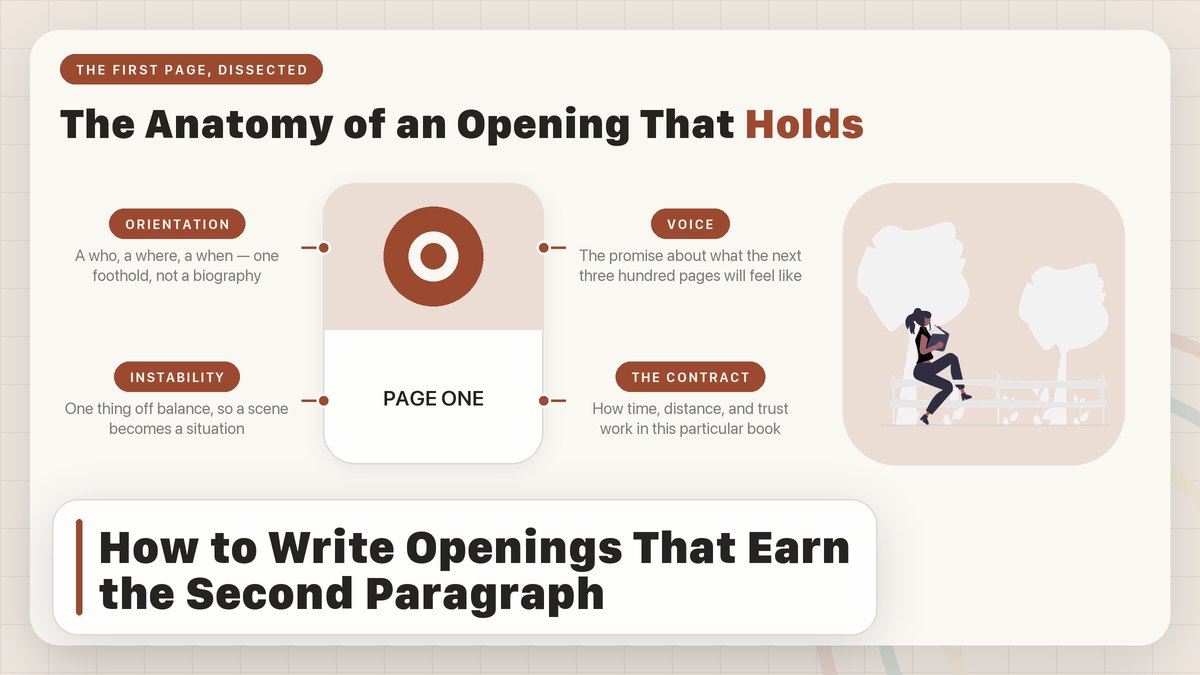
So what does the first page owe the reader? Four things, by my count, and three of them barely touch the plot.
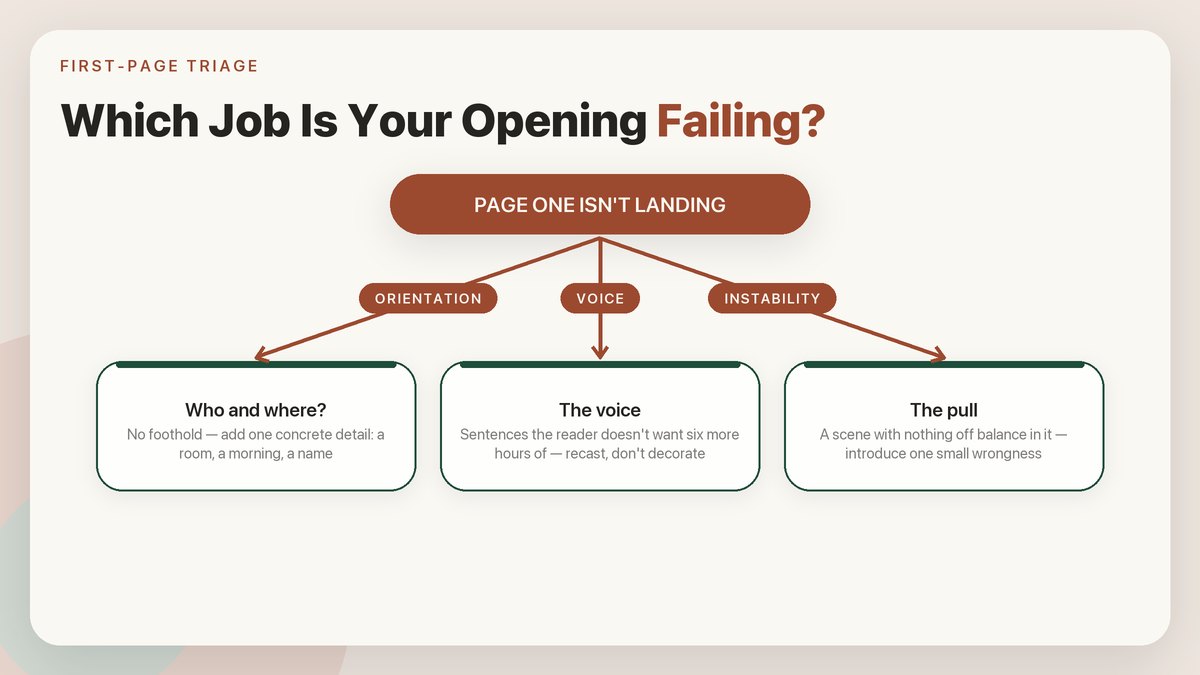
First, orientation. Somewhere in the opening paragraphs the reader needs a foothold, which means someone, somewhere, at some identifiable moment, and all of that doesn’t have to arrive in sentence one — that’s the rookie move that produces “The rain fell on Tuesday as Sarah, a nurse of eleven years, hurried along Baker Street.” But it has to arrive soon, and lightly. One concrete detail does the work of five abstract ones, and a line like “the light through the curtains was the color of weak tea” puts you in a room, a morning, a mood, without ever saying so outright.
Second comes a voice worth following, and nobody can hand you a formula for this one, which is precisely why it matters most. Voice in the opening is a promise about the next three hundred pages, telling the reader what it will sound like and whose company they’ll be keeping, and Mark Twain made the same bet when he opened The Adventures of Huckleberry Finn in 1885 with “You don’t know about me without you have read a book by the name of The Adventures of Tom Sawyer.” If the promise comes out flat or strained or working too hard, the reader believes it, because readers are strangely literal this way, assuming the first page is the book being honest with them.
Third, instability, by which I mean the sense that something, even something tiny, sits off balance. It doesn’t have to be a body or a breakup. In the best openings it’s often trivial, down to “a letter that shouldn’t have arrived” or a kitchen far too clean for the family living in it. Instability is what turns a scene into a situation, because a scene ends when it’s over, and a situation pulls.
A situation pulls.
The fourth job is the one almost everyone skips, which is teaching the reader the reader how to read the book. Every novel runs on conventions — how time moves, how close the narration sits to its characters, how much the narrator can be trusted — and the first chapter is where those conventions get set. Readers will forgive almost any convention except one they discover, fifty pages in, they’d never actually signed up for.
The first page, minute by minute
It helps to think of the opening as happening in real time, because for the reader it does. The first page isn’t a document the reader studies; it’s an experience they have, in about two minutes, moving through beats that stay stubbornly consistent across individual readers — or so writing centers report, and so agents describing their own reading keep confirming.
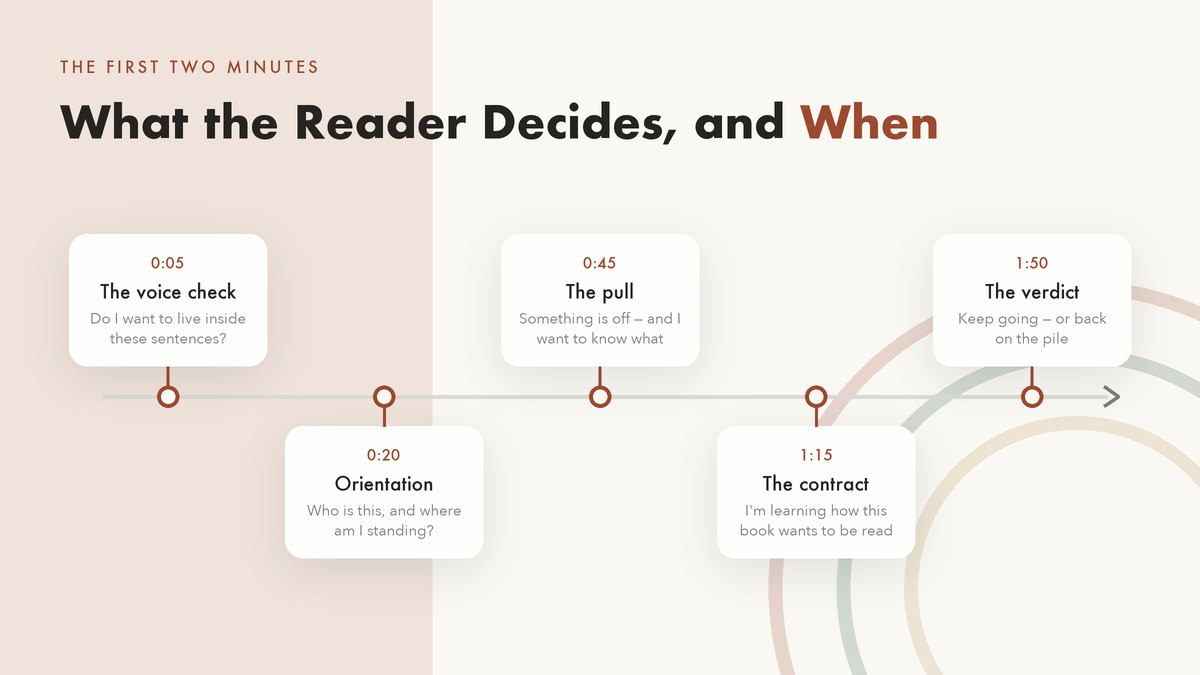
Missing from that timeline is the plot itself. Nobody commits to a book because of what happens next in the abstract; they commit because the what has started to matter, and it starts to matter because the who showed up first. The classic mistake, and the one QueryShark keeps autopsying, is a first chapter that spends its whole capital on question three while the reader still stands at the door holding question one. Give them a person, then a place, then a problem; Orwell does it in one sentence, with a cough, a stairwell, and a clock striking thirteen. The plot can look after itself for longer than you’d expect.
These beats don’t reward being gamed, which is worth saying plainly because the timeline makes the process look more mechanical than it is. Readers can smell a first paragraph engineered to hit checkpoints, and it reads the way a sales pitch sounds. The writer’s real job is to hold all four commitments at once and then forget about them, the way a dinner party host with a dozen guests stops thinking about whether everyone has water. The preparation shows up as ease, or it doesn’t show up at all.
Six opening moves that have worked for a century
None of this means inventing from zero. Openings, like endings, are a solved problem in most of their common forms, and your job is picking the right form for this particular book and executing it honestly. Studying how the masters did it costs nothing: Project Gutenberg, running since 1971, when Michael Hart typed the Declaration of Independence into an Illinois mainframe and started giving texts away, now carries some 79,000 free ebooks, with the complete opening chapters of every novel worth stealing from — everything published before 1930 and quite a bit after.
| The move | How it works | The way it goes wrong |
|---|---|---|
| In medias res | Begin inside an event already in motion, oriented within a line or two | Confusion passed off as energy; the reader can’t tell characters apart |
| The frame | A narrator looks back and tells you the story mattered | “Little did I know” throat-clearing that delays the actual scene |
| The voice grab | A distinctive narrator is simply worth listening to, plot aside | Quirk without content; style doing the work that a situation should |
| The wrongness | One small detail is off, and the reader wants to know why | The wrong thing is so small the reader assumes it’s a mistake by the author |
| The arrival | A stranger or a change enters a settled world | The settled world gets three chapters of description before the stranger shows up |
| The question | The narrator raises something unresolved and conspicuously declines to resolve it | A question the book then forgets to answer for two hundred pages |
Stephen King’s On Writing, published in 2000, is the part-memoir, part-craft book I’d put on any short shelf about openings, and it contains his account of writing with the door closed and revising with the door open, because the first draft belongs to the writer, the rewrite belongs to the reader. The publisher’s page for On Writing is easy to find, and the book earns its reputation. His core claim about openings is that the writer’s job is to make the reader complicit, quickly, in a lie both parties are happy to call a story.
What separates a move that works from the same move done badly is almost never the move itself; it’s whether the writer trusts it. The arrival opening fails when the writer doesn’t believe the arrival is interesting and pads backward to “set things up.” The frame fails when the narrating voice proves flatter than the story it frames. So if you’re using a classic opening, commit to it and get through it fast, because readers forgive convention and hesitation they don’t forgive.
How first pages lose their readers
Failure modes are as instructive as successes, maybe more so, because they cluster. Hand a writing-center volunteer a stack of unpublished first pages (they see them constantly, and Purdue’s OWL writing resources address several of these directly), and the same handful of problems will account for most early exits.
- Weather and scenery for scenery’s sake. “It was a bright cold day in April” is one of the most famous openings in English — George Orwell’s Nineteen Eighty-Four, published in 1949 — and it’s a trap, because Orwell spends the rest of the paragraph on a man with a cough and a poster with eyes that follow you. The weather was never the point; the clocks striking thirteen were. If your first paragraph could be transplanted into a book set anywhere else on earth, it isn’t an opening yet.
- Character inventories. Name, age, hair color, job, plus a childhood anecdote, all delivered before the reader has a reason to care. Description works as a reward for attention, not a down payment on it, though every workshop stack has manuscripts that front-load all four inventory categories inside the first half page.
- False starts. Chapter one opens in a dream, a prophecy, or an action set piece, and then chapter two backs up and begins the real book, slower and forty pages earlier. The reader experiences this as a broken promise, because it is one: they signed a contract on page one, and you don’t get to tear it up in the next room.
- Throat-clearing. The writer circles through the history of the town, the lineage of the family, how things used to be. Some of this material may well be needed, but later, usually around page 50, once the reader has a face to attach it to; the first page can’t carry it. I think of exposition as a debt you pay the reader back in scenes, and the opening is when the loan gets approved, so lead with your assets.
Strip it down and the common thread is easy to name, though hard to accept, because every one of these mistakes serves the writer rather than the reader. The inventory calms the writer who’s anxious we won’t picture the character. The throat-clear reassures the writer that the world is fully built. The false start shows off the writer’s range instead of spending it on the reader. None of them hands the stranger at the bookstore a single thing in the first two minutes they spend deciding, and that asymmetry is the deepest thing wrong with most bad openings, since they’re written toward the person who wrote them.
The prologue problem
A word about prologues, since they cause more first-page anxiety than any other structural choice. Common workshop wisdom says don’t write one, and the wisdom has a real basis, because readers have been burned by prologues that proved to be dreams, or excerpts from chapter thirty placed up front like a movie trailer, or six hundred words spent on a minor character who exists only to die and generate stakes. Strip the prohibition down, though, and it’s really aimed at prologues doing an end-run around the actual opening problem: if chapter one can’t hook a reader on its own, a prologue is a bandage on the wrong wound.
The prologues that work share a shape. They’re short, they sound tonally identical to the book that follows, and they carry information the reader will need, in exactly the form it’s given. A thriller that opens on a fifty-year-old incident the detective will spend the book uncovering is fine, provided the reader understands what they’re watching and why it costs them nothing to watch it. My test is rude but effective: cut the prologue, hand a reader chapter one cold, and ask what they missed. If the answer comes back “nothing yet,” the prologue was a delay wearing a costume.
First lines are a different problem
One more distinction deserves its own space, because workshops conflate the two constantly. The first line and the first page fail in different ways and get fixed with different tools. A first line is a headline, free to be strange, compressed, even a little misleading, since the second sentence stands right there ready to correct the impression. “It was a wrong number that started it” does its whole job in nine words, then gets out of the way.
A first page, by contrast, is a floor, and it has to hold weight (voice, orientation, instability) without creaking under the load. I’ve watched writers spend three weeks on a first line while the rest of page one sat there like a swamp, and the swamp is the problem. Readers barely remember first lines a chapter later; they remember, precisely and for the entire book, how the first page made them feel about the next three hundred.
So if you catch yourself polishing sentence one while paragraph three is still doing warmup exercises, stop and swap the effort around. The line will still be waiting once the page works, and it tends to get easier to write after it has a page beneath it that earns it.
Revise the opening last
All of this brings me to the most practical habit in the piece, the one Stephen King and most working novelists happen to share: don’t finalize your opening until the rest of the draft exists, down to the last chapter you intend to keep. The version you write before you know your book is a guess about what the book is. The version you write after the draft is a statement about what the book turned out to be, and those are different documents. I’ve cut entire first chapters that existed only to help me find chapter one; they were scaffolding, and scaffolding comes down when the building stands.
A clean procedure, and I mean this as literally as it sounds:
- Draft one gets a placeholder opening. Rough, functional, maybe boring; its only job is to get you into the draft.
- When the draft is done, find the real beginning. Somewhere in chapters one through three there’s a moment where the book actually starts, where a person and a place and an instability all show up inside the same scene. That moment is chapter one now; everything earlier was the writer warming up, and warmup gets selected and cut.
- Write the final opening in one sitting, then leave it alone for a week. Distance is the only reliable detector left at this point, and you’ll know in a single read whether the page is asking for the second paragraph or begging for it.
None of this is glamorous, but then neither is what it buys you. The best compliment an opening can earn isn’t “great first line.” It’s the quiet, nearly invisible thing that happened to my bookseller friend in reverse, dozens of times an evening at every bookstore counter in the country: the paragraph ends, the reader’s eye drops to the next one without a flicker of decision, and the book gets its next ninety seconds. It’s all any of us are ever really asking for, one paragraph at a time.
Related reading on this site: Show, Don’t Tell: What the Advice Actually Means and How to Outline a Novel Without Killing the Surprise. External references cited above: Wikipedia on in medias res, Project Gutenberg, Penguin Random House’s page for Stephen King’s On Writing, QueryShark, and Purdue University’s Online Writing Lab. All links checked November 2026.