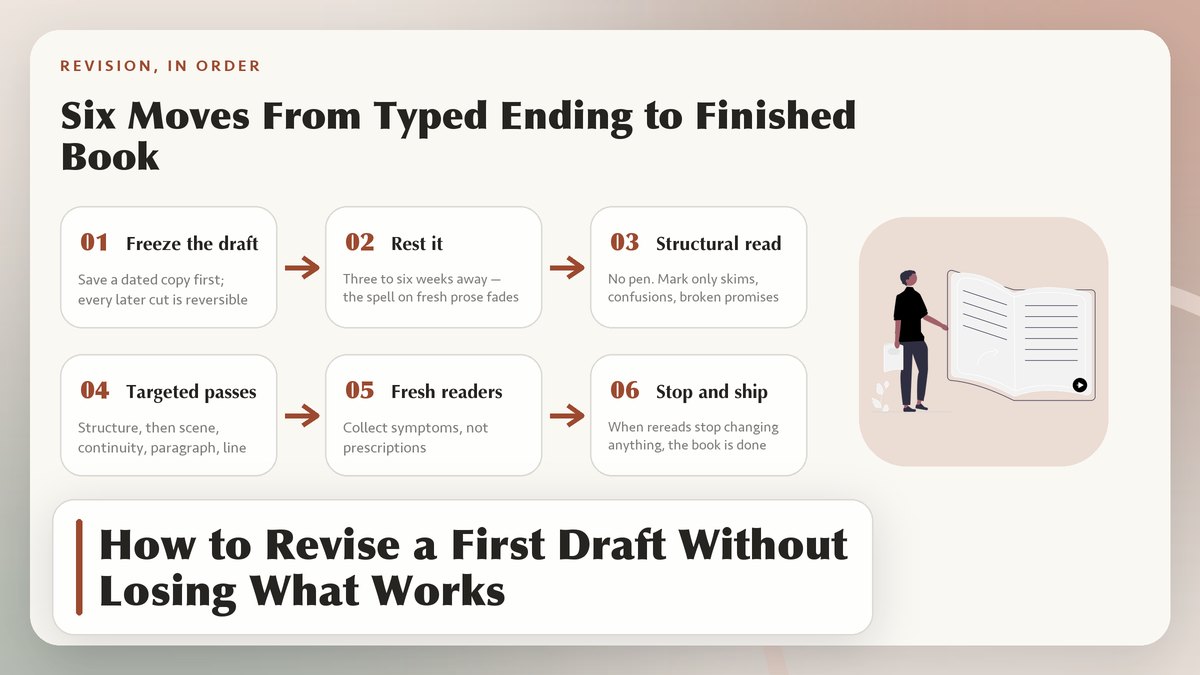
The first draft of your novel is done (at a NaNoWriMo pace that’s 50,000 words typed in thirty days), and now the dangerous part begins. Not the fixing, the choosing. Every cut risks amputating something alive, and every polish can sand off the voice that made the draft worth finishing in the first place. The writers who revise well don’t have steadier hands. They have a sequence, and it starts with putting the manuscript in a drawer for six weeks.
Somewhere around page 200 of the draft I finished last spring, a character says one line that is better than anything else in the book. I know because I remember writing it, and the little jolt is why I can still find the line in under a minute. That line is the reason people talk about revision the way they talk about surgery, and it’s why On Writing devotes its second half to the cutting rather than the drafting. You have to open the manuscript up, every cut uses the same blade, and somewhere in there lies the sentence you’d trade a chapter to keep. The fear has a basis, because on a 90,000-word draft the same judgment call that removes a dead subplot can take the paragraph the whole book leans on. The fix, though, has nothing to do with steadier hands. It has to do with knowing, before you touch a single word, which problems you’re allowed to fix in pass 1 and which ones you’ll be arrested for touching until pass 6.
Most bad revision is a category error, the kind Reedsy’s guide warns about when it separates the structural read from the copy edit. Line edits get done on a chapter that has no reason to exist, or the structure of a scene gets rebuilt when the scene only needed a 10-minute comma pass, and the draft gets worse because each pass pulls in a different direction. I’ve done both, sometimes twice in the same afternoon. There is a particular stupor that comes from polishing a paragraph for a full hour and then, in the next reread, deleting the whole scene that paragraph lived in, 60 minutes gone for good, and I’d like to spare you that afternoon.
Tinkering at the edges, a swapped word here and there (‘quite’ for ‘very’, that scale of edit), gets called revision because the file changed, and the timid writer underneath it is usually right to sense that the draft holds sentences worth keeping. They’ve also guessed correctly that reckless editing destroys more good writing than timid editing does. What they’re missing is the sorting step, because reckless revision kills darlings for one simple reason. It never bothered to identify them first, and identification comes before any blade comes out.
What follows is the order of operations I’ve settled on after 4 manuscripts, watching some of my own drafts survive revision and others flatline in it. It isn’t the only method that works, but it’s the one that loses the fewest darlings per problem solved as far as I can tell, and after that much trial and error I trust it more than any burst of midnight inspiration I’ve ever had.
In this article
Why Revision Feels Like Ruining the Book
Fresh prose holds a spell over the writer who made it, and the spell runs for roughly 2 to 6 weeks after you type the last page. You remember the afternoon, the coffee, the sentence that arrived fully formed, and the memory glues itself to the words so that cutting them feels like cutting the afternoon itself. This freshness problem warps every judgment you make about your own draft, so you’ll think a wooden paragraph is fine because you remember what you meant, and you’ll want to kill a scene that works for no better reason than that you’re tired of reading it for the 14th time.
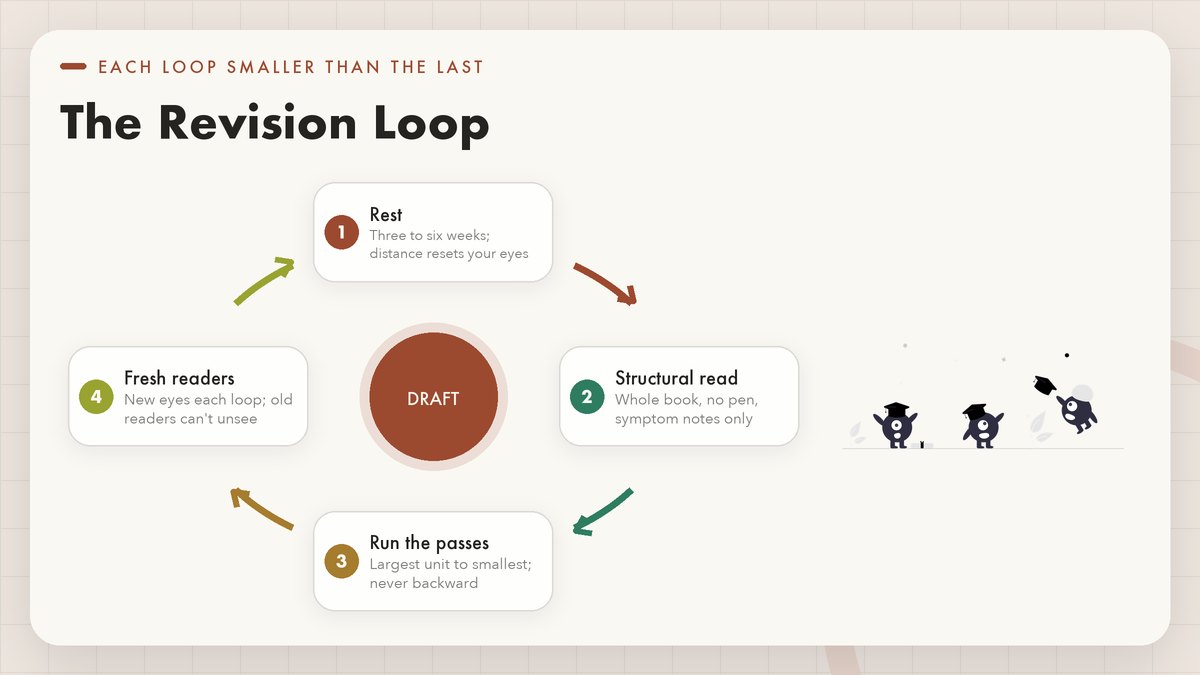
Six weeks in a drawer is the professional answer, and it’s boring, and it works. Stephen King advises putting the finished draft away for at least six weeks before rereading it, and the account of his own revision habits in On Writing (2000) is where most of us first met the idea. Six weeks is a long time to wait when the draft is calling to you. I’ve never managed the full six. Three weeks is my compromise, and even that much changes what I see on the page.
That frozen copy also settles the emotional question King raises about killing darlings, because the draft isn’t being destroyed. It’s being branched, the way a programmer forks a codebase in Git before touching it. You can always go back (a Ctrl+Z for the whole book), which paradoxically makes you far more willing to cut, since a cut stops being an execution and becomes a draft move; knowing every cut is reversible restores a surprising amount of courage.
Read-Through Zero: The Structural Read
3 kinds of notes, and 1 absolute ban, make up what I call read-through zero. After the rest, you reread the whole book in as few sittings as you can manage (Reedsy suggests one read-through right after finishing and a real one after the rest), forbidden from changing so much as a comma, and you keep a note open for exactly 3 kinds of entries, namely places you skimmed, places you were confused, and places where the book made a promise it hasn’t kept. That third category deserves the most ink, because if chapter 3 plants a locked door the protagonist never thinks about again, no amount of lovely sentences downstream will scratch the itch it leaves.
This pass answers the largest question revision can ask, which is whether this is the right book at all. Sometimes the answer is no, and then the move is a restructure rather than a polish; I’d rather learn that in one uncomfortable week than after eight months of comma work. Reedsy’s long guide to revising a novel opens with the same instinct, read first and plan second, and even suggests printing the manuscript and marking it up with two highlighters, one color per issue type, so you can see at a glance whether plot problems or prose problems dominate.
The structural read finds the holes; the 6 passes after it exist to decide which of those holes the book actually leans on.
Note the saggy paragraph the moment you see it, rank it against the other problems on the list, and keep moving; don’t stop to fix it at the sentence level on sight, because pass 5 isn’t licensed yet. Saggy paragraphs travel in packs, and once you see the full inventory they usually trace back to one structural decision made 3 chapters earlier, which is a problem the sentence pass is not allowed to touch.
Learning to Recognize What’s Load-Bearing
3 kinds of good material hide in every draft, and revision treats each differently. First there is the spine, the scenes and decisions a 1-page summary of the plot cannot function without. You may move spine material, combine it, compress it, but cutting it means the book falls over, and the summary tells you so. Then there’s the voice, meaning the particular way your narrator notices things, the rhythm of the dialogue, and the running joke in chapter 12 that never pays off plot-wise but pays off constantly in tone. Voice material survives everything except pass 5, the line pass, and even there it should get the benefit of the doubt.
The third kind is the sparkle, the gorgeous sentence you wrote at 1 a.m. sitting in a scene that’s otherwise doing nothing on the page. Sparkle is the hardest category to cut, because these really are the best sentences in the file, and they’re usually the material the writer is proudest of. My test takes 10 seconds. Ask what the sentence is holding up, the same check you’d run on a wall before pulling a stud; if I delete it and the scene stands unchanged, it was jewelry, and jewelry belongs in the notebook rather than cemented into the wall. Cut sparkle freely in pass 2 or 3, because nothing is gone; it has simply returned to the quarry for a book that needs it more, and the frozen copy you labeled with the date is the proof.
The Order of Passes, From Load-Bearing to Cosmetic
Structure before scenes, scenes before paragraphs, paragraphs before sentences, sentences before commas. That single ordering rule, 6 passes deep, protects the good stuff, and it never runs backward. Each of the 6 passes in the table below holds a license that explicitly excludes the smaller problems, and that exclusion is what keeps the darlings safe, since a sentence can only be killed by a pass that was actually allowed to look at sentences.
| Pass | What you hunt | What you’re forbidden to touch |
|---|---|---|
| 1. Structure | Missing or redundant chapters, broken promises, wrong order of events | Scenes, prose, dialogue, punctuation |
| 2. Scene | Scenes that enter late or leave early, no conflict, no turn | Sentences and word choice |
| 3. Character & continuity | Motivation drift, timeline errors, names and props changing | Pacing decisions made in pass 1 |
| 4. Paragraph | Buried leads, order of information, transitions that lie | Anything structural above |
| 5. Sentence & line | Rhythm, repetition, filter words, clichés | Scene content |
| 6. Proof | Typos, spelling, punctuation, formatting | Everything above (hand it to someone else if you can) |
Killing your darlings, the most quoted piece of revision advice, starts to mean something different once the 6 passes have an order. The phrase is often attributed to William Faulkner, though the older version belongs to Arthur Quiller-Couch, whose 1916 Cambridge lectures, collected as On the Art of Writing, told students to “murder your darlings.” The Wiktionary entry for revise makes a useful companion here, since the word comes from the Latin revidere and means, literally, to see again, which is the job description in one line. A darling that survives pass 1 and pass 2 is probably holding the book up, so you keep it. A darling that only ever worked as a sentence was furniture all along, and pass 5 is licensed to auction it.
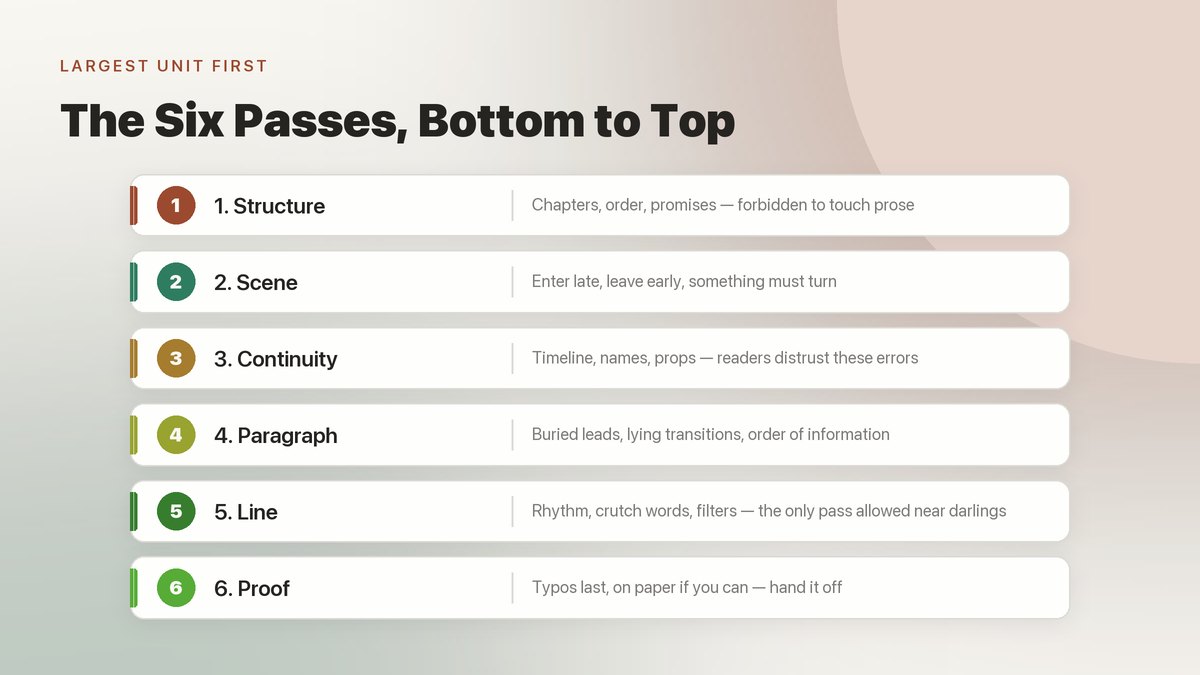
The timeline pass, pass 3 in the table, comes before any polish, because writers love to skip it and readers love to catch it. Build a bare chronology of the book, day by day or week by week, and check each scene against it before any pacing work, the way Reedsy’s guide advises. That means eye color, the name of the diner, whether the gun appeared before it was fired. These errors take minutes to fix and cost you a reader’s trust when a stranger finds them, because a continuity slip is the 1 mistake that makes readers distrust the author instead of the character.
Rebuilding Scenes Without Breaking Them
Diagnose each scene on 1 axis before you rewrite anything; does something change in it? A scene in which nobody wants anything, or wants it and gets it without friction, is choreography, and choreography is what pass 2 exists to catch. You don’t have to delete such a scene, because sometimes the fix is cutting the first 2 paragraphs, where the characters are still arranging themselves, and opening on the moment the want becomes visible; sometimes the scene needs an extra beat of quiet, 2 sentences at most, before the turn so the turn actually lands.
A dinner scene, three pages, two old friends arguing about a loan, shows the fix in concrete form. The argument is fine, but the scene opens with arrivals, coats, seating, drinks ordered, and a full page or 2 of warm-up before the loan ever surfaces. The scene doesn’t need to be shorter; it needs to start 2 beats later, on the sentence where one of them says the loan was never going to be repaid. Everything before that was staging, the most cuttable substance in any draft, because the reader reconstructs it for free the instant the conflict starts.
Now for the trick that keeps your best material intact during this surgery on pass 2. Never revise a scene in place; always rebuild it in a fresh document. I’ve rebuilt maybe 40 scenes across 4 manuscripts this way. Open a blank document next to the original, copy over only the parts of the scene you already know survive, and rewrite the connective tissue fresh. Whatever you can’t bring yourself to copy over in those 40 rebuilds was already dead; you just hadn’t admitted it yet. Whatever you do copy over gets to stay until pass 5, at least. The “lost” material I later mourned rounds to about zero. I mourned exactly 1 paragraph, and that paragraph was pride, not prose.
Feedback You Can Actually Use
“Where did you put the book down?” is the kind of question that keeps a critique useful, because a critique is not a verdict. Treat a critique like a verdict and you get 2 failure modes, defending the draft against every note so that nothing changes, or obeying every note so that the draft becomes a committee. The way out is to ask for symptoms rather than prescriptions, because a symptom reports where the reader stumbled, while a prescription merely explains how your reader would have written your book. “You should cut chapter two” is a prescription, and prescriptions arrive pre-loaded with someone else’s taste.
If you want a starter set of symptom questions, take these 4. “Where did you put the book down?” “Which character did you picture wrong?” “What did you think was going to happen at the midpoint?” “Where did you stop trusting the narrator?” 4 questions across 3 readers produces roughly 12 data points, and when 3 of those readers put the book down at the same chapter, the pattern is visible at a glance.
Collect the symptoms from all 3 readers, look for overlap, and treat overlapping symptoms as the diagnosis. 1 reader bored by chapter 2 is a data point. 3 readers bored by chapter 2 is a chapter-2 problem, and the design of the fix is yours. Communities built around exactly this rhythm exist for a reason, the biggest being National Novel Writing Month itself. The “Now What?” months run by NaNoWriMo exist entirely to shepherd finished drafts into revised ones; the program follows November’s 50,000-word sprint and runs in January and February, because the organization noticed long ago that finishing a draft and knowing what to do with it are different skills.
2 full feedback loops is normal for most books; 3 starts to polish the voice off. The loop closes whether you plan for it or not, since feedback goes in, you run 1 pass, the draft changes, and the changed draft needs fresh readers, because the ones who’ve seen the old version can’t unsee it. After loop 3 you’re usually re-deciding decisions that were already sound, which is the point where more input stops helping.
Line Editing Last, When It’s Finally Safe
Only after passes 1 through 3 are settled do you get to play with sentences, and by then the play is fast, because the pressure is off. Whole chapters may still be recut at this level, 30 pages of them if the structure demands it. A paragraph can migrate 2 chapters forward, a metaphor can be replaced with a plainer verb. What changes at pass 5 is that you’re now allowed to judge the prose on its own terms, which means this is the pass for rhythm, for crutch words (my own are “just,” “slightly,” and “little,” a tic I share with, apparently, every writer I know), and for the filter phrases that keep the camera at arm’s length. “She saw.” “He realized.” “They noticed.” Delete the filter and the perception usually stands on its own two feet.
Ten searches for ten crutch words takes twenty minutes and turns up two hundred problems, which is why the Find box comes before the ear. Run it over your own tic words while you’re in the file, because the Find box doesn’t fall in love with anything the way your ear does after months of reading the same screen.
Read the whole book aloud the way a professional copy desk works a proof, with one voice sounding the text and a second attention marking what the eye skips. Your ear will catch what your eye has gone numb to, the repeated sentence shape, the dialogue that sounds like two people delivering speeches at each other, the paragraph that runs a beat too long. Reedsy editor Maria D’Marco warns against letting sentences bloat to 40 or 50 words for exactly this reason, since prose that over-explains tires a reader and can even cause them to abandon the story. The standard proofreading methods collected on Wikipedia were mostly codified for academic and professional text, and its article on copy holding describes the spoken codes that evolved between paired readers, “bang” for an exclamation point among them; “double reading,” where a second proofreader repeats the first’s check and both initial the proof, is the same idea with two people. The physical tricks, reading backward, changing the font, reading on paper, transfer directly to fiction, and they work because they defeat the pattern-matching your brain does with familiar text. The same article notes that Mildred Tripp, who spent years as a specialty proofreader of Bible editions, considered her lack of religious interest an asset, since she never got wrapped up in the text she was checking. (Yes, I linked Wikipedia. A craft is a craft, its short section on reading aloud matches what every good line editor will tell you, and the Mildred Tripp anecdote is worth the click on its own.)
Catching yourself changing what happens in a scene, mid-line-pass, is the 1 alarm bell this stage has, because it means you’ve slipped backward to pass 2. Stop, park the idea in the notes file, finish the line pass, and only then decide whether the change warrants a new pass-1 cycle. Sometimes it does warrant that cycle. A line pass that keeps mutating into a scene pass never ends, though, and the draft you end up with after 6 months of that is usually flabbier than the one you started with.
Knowing When to Stop
Revision has a cost curve, and past pass 3 or so every additional pass removes more voice than it adds clarity. You can feel the moment arrive, because the changes you’re making start swapping one acceptable version for another and your reasons shrink from “this is better” to “this is different.” That second reason is the signal to stop, and I say this as someone who has ignored the signal more than once. The reader on the other side of the draft would rather have your book now than your perfect book never.
A full reread that produces fewer changes you’d defend out loud than changes you’d shrug about means the pass is done, and when a full structural reread produces no changes at all, the book is done. Reedsy editor Maria D’Marco puts the stopping point the same way. “Your goal here is not perfection (you’ll have to work with a pro editor to get there), it is balance.” Ship it, or send it, or put it in the query trenches. The next book will be better partly because of everything this revision taught you, and no amount of further tinkering will add to that tuition.
The two failure modes of revision, protecting the draft too hard and abandoning it too fast, end in the same place: a book nobody reads.
If you’re counting, a full revision of a ninety-thousand-word draft runs somewhere between 6 weeks and 4 months of actual working time, depending on how deep the structural problems go. More than 6 months on a single cycle and you’re probably re-deciding things you already decided, which is the freshness problem returning in a different hat.
Keep the frozen copy and the notes from read-through zero, because 5 years from now, when you can’t remember how the sausage got made, that file shows you a writer mid-swing, and some of the sentences in it, the ones the passes confirmed, are still the best you ever wrote.
Sources and further reading: the structural order here draws on Reedsy’s guide to revising a novel, the standard reference on proofreading methods, and the NaNoWriMo revision program, all linked above. Internal resources on this site: how to outline a novel without killing the surprise and fixing a saggy middle, which cover the neighboring problems on either side of revision.