Every story is told by someone, even when it pretends not to be. Middlemarch has a narrator who editorializes freely about the action, while a present-tense thriller seems to have nobody at all. Whoever holds the microphone shapes what your reader can know, how close they feel, and what kind of book you’ve actually written. This is how to make that choice on purpose instead of inheriting whatever voice you happened to read last month.
There’s a party trick some writing teachers pull in the first week of class, and it can level a room of confident beginners in about twenty minutes. They hand out the same twelve-line scene, a man waiting at a bus stop while it rains, and ask everyone to rewrite it from a different vantage point. What comes back never looks like the same scene. The version told by the waiting man is about impatience and the letter folded in his coat. The version told by the woman watching from the coffee shop across the street is about recognition, or near-recognition, because she can’t quite place him. A version told by nobody in particular can see both of them, plus the driver of the late bus finishing a sandwich two stops away. Same twelve lines of event, three different stories, to the last comma.
Point of view tends to get discussed as if it were a technical setting, a dropdown menu you configure once and forget, somewhere between font choice and margin size. It isn’t one, and treating it like one is how a draft ends up voiceless by page eighty. Point of view decides who the reader is allowed to love, what information can reach them, and how much of the truth they’re permitted to see, which is why Bleak House reads like two books stitched together: the Esther Summerson chapters, warm and first-person, and the omniscient sections that tour London without her. Change the narrator and you change the book, even when every plot point stays bolted in place.
And yet most of us pick one by accident. We start writing in whatever voice we’ve been reading that month (come off a crime binge and your draft comes out hard-boiled without a single decision being made), or we default to third person because it sounds the way a novel is supposed to, and only around page eighty do we notice something feels thin. By then there’s a real temptation to declare the problem plot-shaped and keep going.
Usually it isn’t the plot at all. Usually it’s the voice holding the pen, and the fix costs a weekend rather than a rewrite, once you know where to look.
It doesn’t help that the advice literature treats person as the big decision, first or third, when person is mostly a costume. The choices that actually move a reader live one level down: whose knowledge sets the limits, how close the camera sits, whether the narrator is honest. Two books can both be “third person” and share almost nothing else. One is a locked room where you wait out a blizzard with a frightened porter; the other is a grand ballroom where the author floats above the dancers reporting what everyone thinks of everyone, Middlemarch against a cozy mystery. Person tells you almost nothing. The machinery underneath tells you the rest.
In this article
The four real choices
Strip the theory down and you get four workable points of view for long fiction, plus a few gimmicks that survive mainly in flash pieces and experimental shorts. The roster hasn’t changed in a century, and any good survey of narrative mode lays it out plainly. Grammar guides like Grammarly’s point-of-view explainer will give you the same map with fewer Latin terms.
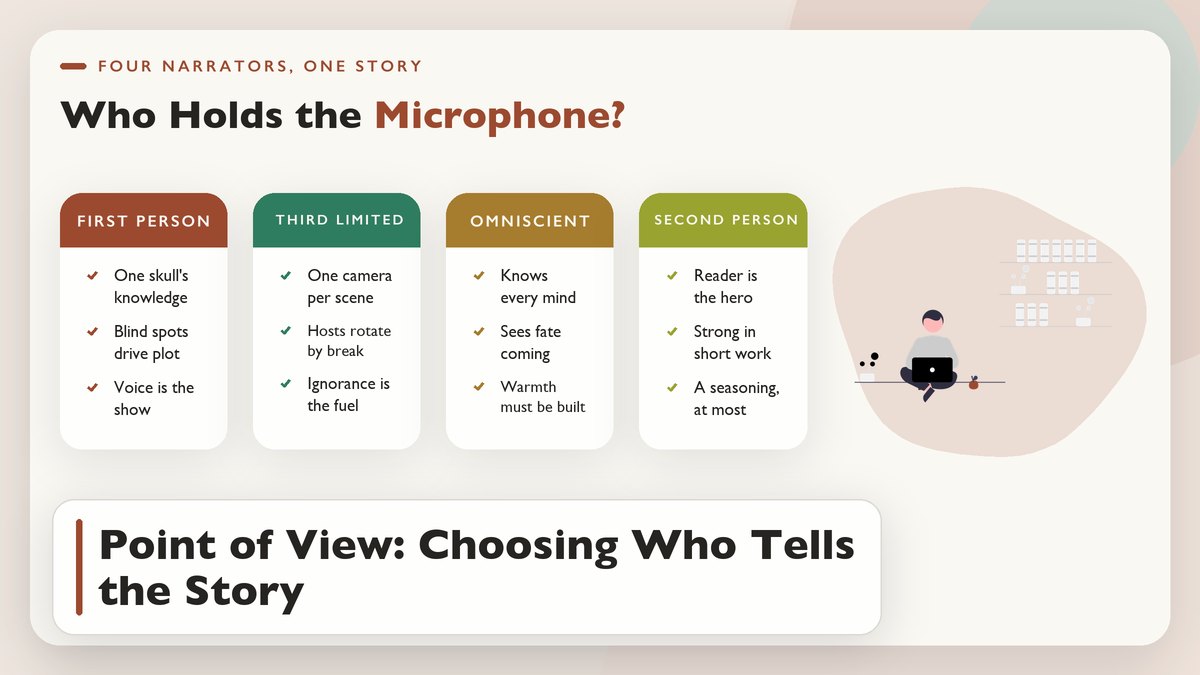
Start with the oldest option. First person puts a named character between the reader and the world, and everything arrives filtered through “I.” You get one skull’s worth of knowledge, one voice’s vocabulary, one set of blind spots, and those blind spots are often the whole show. Nick Carraway spends The Great Gatsby at Gatsby’s parties all summer without ever quite seeing the man, and the not-seeing is the novel. First person can run confessional, comic, or sweetly unhinged, and it lives or dies on whether the reader wants six more hours inside that particular head. If the answer is no on page two, no plot saves it, because a first-person novel has exactly one voice to spend and there’s no budget for a second.
Third person limited parks the camera behind one character at a time and dips freely into that one mind. You can run two or three such hosts, trading off by chapter or scene — A Song of Ice and Fire labels its chapters with the POV character’s name, so the reader always knows whose eyes they’ve borrowed — but the camera only ever knows what its current host knows, notices what that host would notice, and no more. Most literary and commercial fiction of the last fifty years lives here, partly because it splits the difference between intimacy and flexibility so evenly that writers forget it’s a choice at all.
Omniscient, the third-person version with no host at all, knows everything and says so. It can drift from the general’s tent to the drummer boy’s blister in the same paragraph, report what everyone is thinking, comment on the action, and generally behave like someone who has already read the ending and isn’t shy about it. Dickens, Tolstoy, and George Eliot all worked this ground in the nineteenth century, which is partly why the mode can read as antique now. It fell out of fashion for a stretch in the twentieth century, mostly because it’s the hardest of the four to run without sounding like a Victorian, but it never actually left.
Second person, “you,” is the specialist tool. It turns the reader into the protagonist, which is a fascinating trick and an exhausting one over three hundred pages; the shelf of novels that sustain it amounts to Jay McInerney’s Bright Lights, Big City (1984) and not much else. Short fiction, choose-your-path structures of the Choose Your Own Adventure kind (Bantam launched that series in 1979, and it went on to sell hundreds of millions of copies), and a seasoning chapter inside another POV; that’s where “you” does its best work.
| POV | Best for | What it costs you |
|---|---|---|
| First person | Voice-driven books, mysteries of character, comic narration | One skull only; the narrator must be worth listening to for the whole ride |
| Third limited | Most novels; multiple leads; suspense built on partial knowledge | You can never show anything your POV character misses |
| Third omniscient | Epics, family sagas, books where the community is the character | Distance is the default; warmth has to be engineered |
| Second person | Short work, fragments, framing devices inside other POVs | Reader fatigue; sustaining “you” for a full novel is a high-wire act |
A further wrinkle, because it confuses people: much of the intimacy readers associate with third person is actually free indirect style, where the narration borrows the character’s inner voice without quotation marks. It’s the engine behind most modern third-limited prose, and it’s why Pride and Prejudice — Austen’s 1813 novel, for all its eighteenth-century manners — still reads as close as a diary in places. Austen almost never pauses to quote Elizabeth Bennet’s thoughts, because she’s already narrating in them, sentence by sentence.
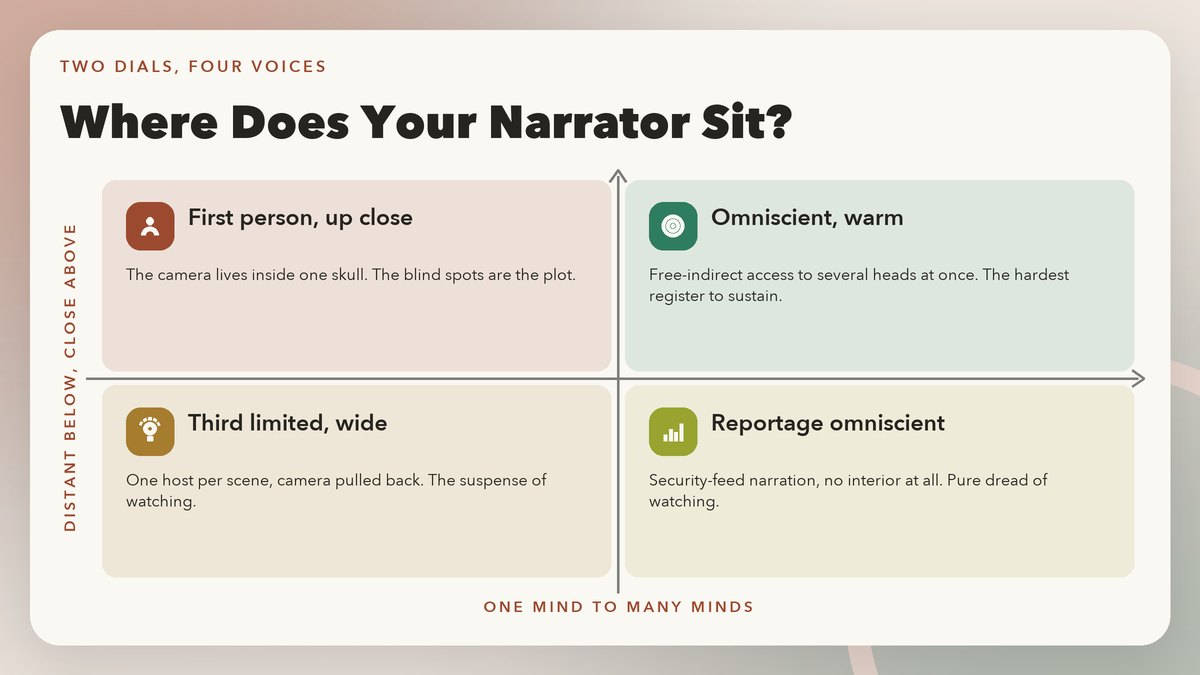
How distance actually works
John Gardner gave writers the most useful image for this in The Art of Fiction (1984). Point of view is a camera, and it has a zoom lens. At maximum distance you’re reporting events like a security feed, all exterior, no interior. Zoom in one stop and you start recording what the character notices. Zoom in further and you render thoughts as they’re being had, in the character’s own diction, their own bad grammar, their own private metaphors. Skilled writers slide this dial constantly, sometimes within a single paragraph, and readers rarely notice the motion even though it’s carrying part of the meaning.
The zoom is how you tune tension without touching the plot. Pull the camera back during an action sequence and everything turns colder, because the reader stops sharing the hero’s confidence and starts watching like a bystander who can’t intervene. Push in tight during a quiet conversation and a passing remark lands like a slap, for the opposite reason, since the reader is suddenly standing inside the skull that just absorbed it, with no distance left to interpret what the words are doing. In practice the choice runs scene by scene rather than book by book; distance is a dial you keep adjusting, not a setting you lock.
A practical version of the ladder, far to near, runs roughly in the order you’d use it inside a scene:
- Reportage. “Marta locked the door at nine.” Pure event, no interior. Good for transitions and establishing shots.
- Noticed detail. “Marta locked the door at nine and checked it twice.” One filtered observation tells us she’s anxious without naming the anxiety.
- Tagged feeling. “Marta felt a tightness in her chest as she checked the lock.” It names the emotion but holds it at arm’s length, a step closer than reportage yet still outside the skull.
- Free indirect thought. “The lock was bad. It had always been bad. She checked it twice anyway, the way her mother used to.” Now we’re thinking with Marta rather than about her.
- Direct interior monologue. “Bad lock. Bad building. Check it twice, like Mom did, like that ever saved anyone.” Closest setting, most expensive to sustain.
The transitions between rungs deserve as much care as the rungs. A zoom-in wants a hinge, some small physical anchor that carries the reader inward, and Gardner’s own famous sequence shows the hinge working. The roar, then the roar of engines, then a B-52’s engines, then one specific plane on one specific morning, each step narrowing by a single notch while giving the reader’s eye somewhere to stand. Jump straight from reportage to raw interior monologue without that hinge and the move feels like a teleport, and readers notice teleports even when they can’t name what happened.
None of this makes any rung “better” than another. Beginning writers get told to cut every instance of “felt” and “thought,” and there’s decent advice buried in that, since those tags usually mean you’re narrating from one step too far back — but reportage has its place, and a book narrated entirely at maximum zoom would be unreadable, like being hugged for six hours straight.
Head-hopping, and the one-brain rule
There’s a version of third-limited narration that slips between minds without a scene break, two paragraphs in Marta’s head, a line of dialogue, then suddenly the reader is inside Dan’s skull, reading Marta’s smile as contempt. Writers do it because it’s convenient, and because a handful of famous authors got away with it — William Faulkner rotated fifteen narrators in As I Lay Dying, but he did it with a labeled section break before each new voice, which is a different thing entirely. The technique has a name, head-hopping, and it has a reputation for a reason.
The problem isn’t that it breaks a rule. It deletes, mid-scene, the very mechanism your suspense was running on, because third limited works by making the reader share one person’s ignorance. They know what Marta knows, fear what she fears, and wait with her for the thing she can’t see coming. Hop into Dan’s skull for a paragraph and you spend that ignorance whether you meant to or not, since the reader now knows what Dan thinks of her smile, and you can’t un-tell them. Every later scene where Marta guesses at Dan’s mood has lost its charge.
The fix is procedural and cheap in most cases, which is why editors repeat it until it stops being interesting. One brain per scene. If you need Dan’s side of the smile, break the scene, drop a marker, and open a new one from his angle. Readers follow that signal without even noticing, because they’ve been trained on it since childhood. What they can’t follow is an unmarked slide between two minds, where they can no longer tell whose version of events they’re supposed to trust. And trust, once you start noticing it, is what point of view is actually made of.
One brain per scene isn’t a rule about manners. It’s how the reader knows whose version of events to believe.
A caveat, because this trips people up in practice: the one-brain rule binds within a scene, not across a chapter break, so trading POV at a marked break is not hopping even when the break lands mid-page. What carries the renegotiation is the signal itself, which can be as small as a space break, an asterisk, or a new chapter heading; any of these tells the reader the contract has been renegotiated, and they’ll happily re-aim their trust at the new host. Hop only when you haven’t signaled, and the reader experiences it as a small betrayal of something they didn’t know they’d agreed to.
Omniscient narration hops constantly and nobody complains, because omniscient declares itself up front, as Middlemarch does on its first page when the narrator sizes up Dorothea Brooke for us, and the reader signed that contract in the shop. The sin of head-hopping is promising one deal and delivering another, mid-paragraph, without telling anyone.
When the narrator can’t be trusted
Everything so far assumes the narrator is trying to tell the truth, but one of fiction’s oldest pleasures is the narrator who can’t, or won’t. Wayne C. Booth coined the term “unreliable narrator” in The Rhetoric of Fiction (1961), and the device itself is far older: the servant protesting too much in Wuthering Heights (1847), the murderer calmly explaining how careful he’s been in Poe’s “The Tell-Tale Heart” (1843). The category covers more ground than most people expect, because a narrator can lie on purpose the way Humbert Humbert manages Lolita‘s entire account, lie by omission, or simply be flat wrong, filtered through prejudice, grief, or simple stupidity, and flat-wrong is often the most interesting kind, because the reader gets to hold the narrator’s version against the facts the story keeps providing in the background.
William Riggan’s 1981 study of the form sorted unreliable first-person narrators into four types (the pícaro, the clown, the madman, and the naïf), with Huckleberry Finn as the naïf and Poe’s guilt-stricken murderers filing under madman. The craft question, though, is always the same: what does the unreliability buy you? When it works, and Agatha Christie’s The Murder of Roger Ackroyd (1926) is the textbook case, since the whole solution depends on the narrator having told the truth selectively, the device turns the reader into a detective, assembling the true story from the gaps and contradictions in the told one. It also costs you something real, which is plain emotional access: a slippery narrator gets held at arm’s length by design, so the book has to supply warmth elsewhere, usually through the very act of seeing through them. Readers love a character they’re smarter than. They just don’t love being told so.
Most working novelists use a milder version of the device than the famous examples suggest. Not a narrator who lies in bold type, but one whose perceptions are slightly, systematically bent: the optimist who reads every rejection as a scheduling conflict, the veteran who describes the new recruit’s fear with the particular care of someone who remembers his own. Kazuo Ishiguro built The Remains of the Day (1989) almost entirely on that gentle bend. Stevens reports events reliably and interprets them unreliably, and the reader senses the distortion without being able to name it. In that gap between what the narrator says and what the reader infers, the character actually lives.
Choosing for your story
So how do you actually pick? Start from what the book needs the reader to know, and write the answer in one sentence if it helps, because that’s the one thing point of view hard-codes. Plot matters less than you’d think at this stage, since a twist ending rarely rescues a book whose camera was pointed at the wrong head. Who must the reader understand from the inside for the story to land, and who can stay an observed mystery?
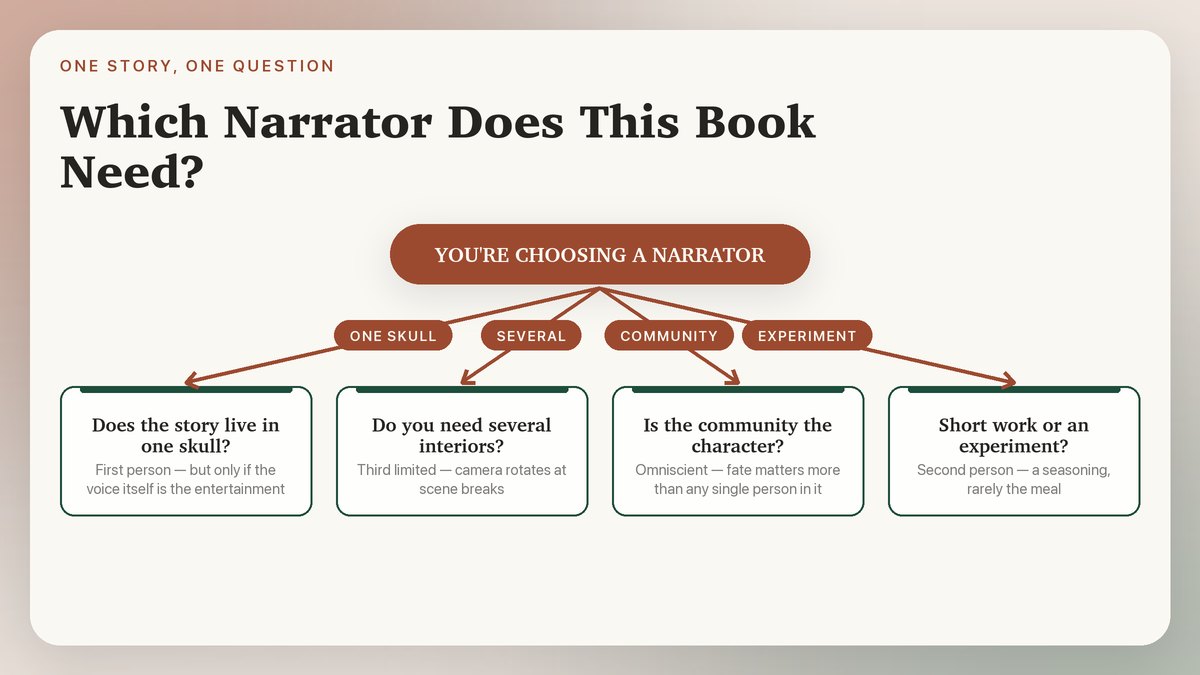
Run the questions in order:
- Does the story belong to one skull? If everything the reader needs is one person’s experience, wants, and blind spots, first person earns its keep. If you need several interiors, third limited does the job with less strain on the voice.
- Ignorance as fuel. If the suspense runs on what the reader doesn’t know, mysteries and thrillers usually want a limited camera, the way The Girl on the Train keeps us trapped inside Rachel Watson’s blackout-ridden account, because the reader has to discover the truth at the host’s pace. Omniscient can work, but you’d better be writing a different kind of suspense, the dread-of-watching kind.
- The community as lead. Sagas, multi-generation family books, anything where fate matters more than any single person, tend to want omniscient, or third limited rotating so widely it approaches it.
- Is your narrator the most interesting thing on the page? Be honest here. If the voice is the entertainment, go first person and lean in. If the voice is merely serviceable, third limited will flatter it more.
- Are you reaching for a second-person chapter? Ask what it does that a first-person chapter with the pronouns changed couldn’t. If the answer is “distance” or “discomfort,” fine, that’s a real effect. If the answer is “variety,” cut it.
A quick word on multiple POVs, since it follows every discussion of choosing: rotating third limited is a completely respectable structure and the backbone of half the bestseller list, but each POV character should be someone the book needs rather than a byproduct of the outline. Every added POV dilutes the others; two or three strong points of view beats five adequate ones, every time; and the reader will thank you for the restraint even if they never learn what you withheld.
If you’re mid-draft and something feels off
Most point-of-view trouble announces itself somewhere around page 100, as a vague sense that the book is thinner than it should be given how much is happening in it. Scenes work on paper and die on contact with an actual reader. The dialogue is fine; the plot is moving; the reader just doesn’t seem to care, and neither, if you’re honest, do you. Before you touch the plot, diagnose the camera.
First, check distance. If your prose is all reportage and tagged feelings, the reader is watching your characters through glass, and the fix is to slide the camera a stop or two closer in the emotional scenes and see if the book warms up. This is the cheapest revision there is, a couple of hours’ work across a full manuscript, and it fixes a surprising share of “flat manuscript” complaints, at least the ones that aren’t actually pacing problems in disguise.
Almost nobody does this, but it’s worth it: hand two or three scenes to a reader and ask afterward whose scene it felt like, not what happened, not whether they liked it, but who they were standing next to. If they name the wrong character, or no character at all, your camera placement is the problem, and no amount of line-level polish will rescue those pages.
Second, check for accidental hopping. Search the draft for the tell, which shows up as paragraphs where a character other than the current host suddenly has a thought, a feeling, or a physical sensation the camera shouldn’t be able to register. There will usually be more of these than you expect; I find a handful every time I run the check on my own pages, and I’ve been doing this a while.
Third, and hardest: consider whether the POV itself is wrong. If the story keeps straining against the narrator, if you keep inventing scenes that happen where your POV character isn’t, if whole chapters exist only to smuggle in information the narrator couldn’t plausibly learn, those are symptoms. Switching POV mid-draft sounds catastrophic and sometimes is, but a surprising number of first-person drafts turn out to be third-limited drafts wearing a costume, and the surgery is usually less invasive than feared. Change the pronouns in one chapter as an experiment. If the scene suddenly breathes, you’ll know what the book was trying to tell you.
Point of view is the promise your book makes about who the reader gets to be while they’re inside it, and every scene keeps that promise or breaks it, page by page, mostly in ways nobody will ever compliment you for getting right. There are no neutral scenes here. Choose the narrator on purpose, hold the camera deliberately, and a lot of the other craft problems stop being problems, because you’re no longer fighting the one decision that shapes everything downstream.
Further reading: the Purdue OWL’s section on writing in literature covers narrative voice and the conventions of literary analysis with academic care, and Gardner’s The Art of Fiction remains the classic on psychic distance.